
A garage workbench is the one fixture that decides whether every other garage project goes smoothly or turns into a scramble for a flat surface and an outlet. Most garages either have no dedicated bench at all, just a folding table dragged out when needed, or they have one that was never sized for the space. It is too deep to walk around, too flimsy to clamp anything to, or bolted in a spot that blocks the car. Good garage workbench ideas solve a narrower problem than garage organization in general: one surface, sized right, built to hold real weight, with power and light close enough to use it.
The right bench depends heavily on how much floor space is available and what the garage is used for: quick repairs, real woodworking, or a mix of both. The garage workbench ideas below cover wall-mounted and fold-down options for tight one-car garages, mobile and rolling benches for shared spaces, and fixed built-in benches for anyone who has a wall to spare and wants something that will not move.
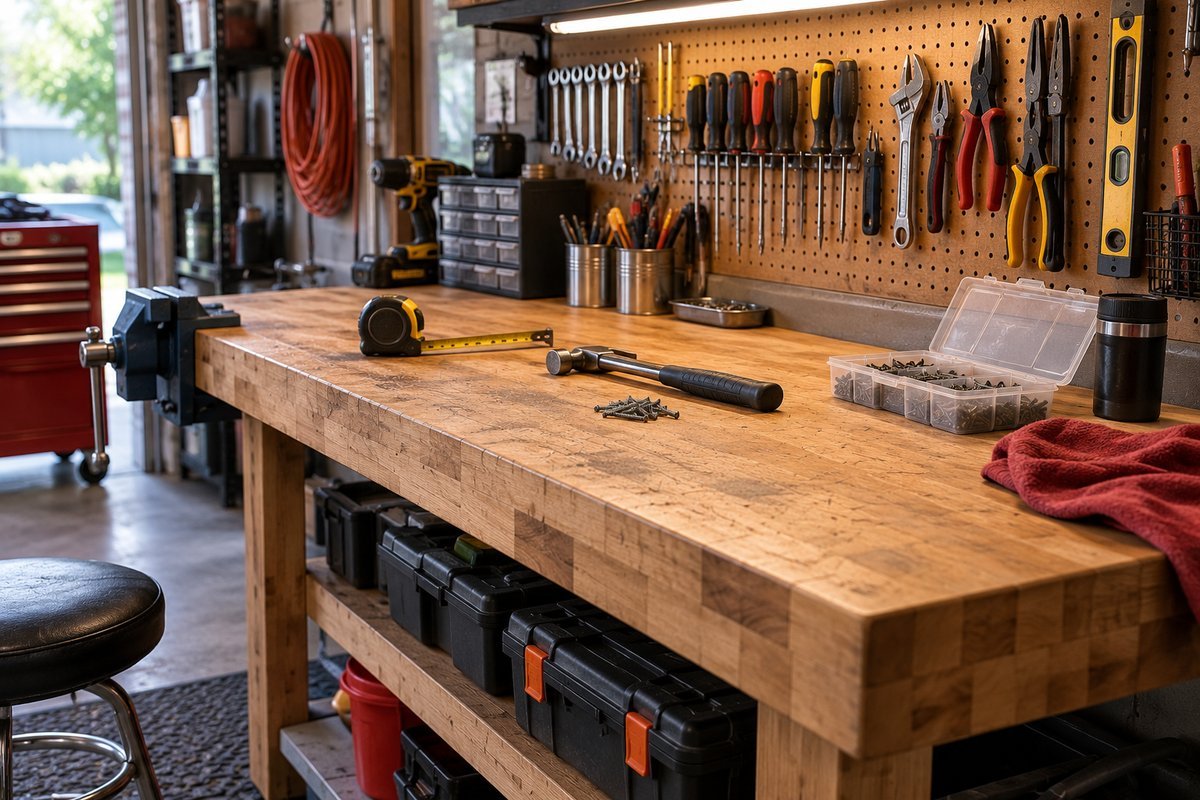
Quick take: Aim for 34 to 36 inches of height, 24 to 30 inches of depth, and at least 48 inches of width if the space allows it. Bolt any fixed bench into studs (the vertical wood framing behind the drywall), not just the slab. A butcher block (thick strips of wood glued together into a slab) or solid-core door top handles clamping and impact far better than particleboard. Budget $80 to $250 for a basic wall-mounted or rolling bench, $300 to $900 for a built-in bench with real storage underneath.
Budget option
Under $50 covers a salvaged solid-core door on sawhorses, or a basic plywood top on 2x4 legs. Not permanent, but functional for occasional use.
Free tool
Not sure how much weight your garage shelves can safely hold? Use the garage shelf weight capacity planner to check your shelving against your actual load before you stack it.
Free tool
Not sure what bin size fits your shelf? Use the storage bin size and fit calculator to check tote sizes against your garage, closet, pantry, or under-bed space before you buy.
Table of Contents
The decisions that matter
A garage workbench looks like a simple build, four legs and a top, but three decisions determine whether it holds up under real use or wobbles apart within a year.
- Match the height to how you work. A bench built for standing hand work sits around 34 to 36 inches high, roughly the same as a kitchen counter. A bench meant mostly for seated detail work or a bench shared with a younger builder should sit lower, closer to 30 to 32 inches.
- Anchor for the heaviest thing you will ever clamp to it. A vise mounted on an unanchored bench transfers every bit of force into rocking the whole structure instead of the workpiece. Any bench meant to hold a vise needs to be bolted to studs or weighted enough that it will not shift.
- Leave a walk-around margin if the bench sits in the middle of the floor. A bench pushed against a wall only needs clearance on three sides. A freestanding bench needs at least 30 inches on every side or it turns into the thing everyone squeezes past to get to the car.
How to choose a garage workbench, start to finish
Picking a bench online before measuring the space is how benches end up too deep to walk around or too short to be useful. This order avoids that.
- Measure the spot before shopping. Note the width, the depth to the nearest obstruction, and the ceiling height if the plan includes wall-mounted storage above it.
- Decide what the bench needs to survive. A bench for light hobby work and the occasional repair does not need the same top or leg strength as a bench meant to hold a bench vise and take hammer blows.
- Pick a type that fits the floor space, not just the budget. A rolling bench in a one-car garage that already fits a car with two inches to spare will get in the way daily.
- Choose the top material based on what will sit or clamp on it. Save the full comparison for the materials section below.
- Plan power and light before building, not after. Running a cord across the floor to reach an outlet is a tripping hazard that most people live with far longer than they mean to.
- Install storage underneath as part of the build, not as an afterthought. A bench with no storage plan usually ends up as a flat surface with tools scattered on top of it within a month.
Garage workbench ideas by type
The type of bench matters more than the brand or the finish. These four cover most garages, from a one-car space with no room to spare to a dedicated workshop bay.
Wall-mounted fold-down workbench
A fold-down bench hinges to the wall and folds flat when not in use, usually supported by a folding leg or a chain. It is the best choice for a one-car garage that cannot give up any floor space permanently. Expect $60 to $200 for a kit, or less to build one from a scrap door and a set of folding brackets. The tradeoff is rigidity. A folded-down bench flexes more under heavy clamping than a fixed one, so it suits light repairs and hobby work better than anything requiring real force.
Rolling or mobile workbench
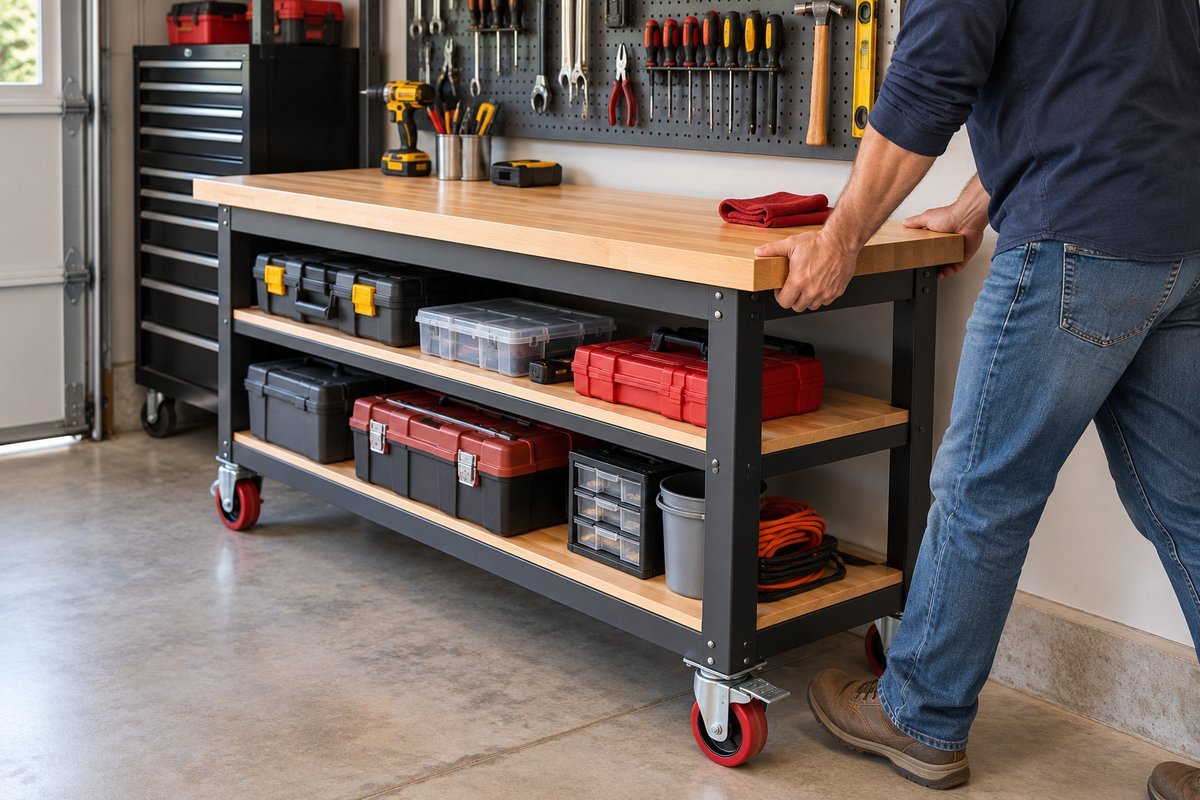
A rolling workbench sits on locking casters (small swivel wheels) and moves wherever the project is, then tucks against a wall when the car needs the space back. These run $100 to $400 for a mid-size unit with drawers built in, more for a heavy-duty steel frame rated for 500 pounds or more. Lock the casters before using it as a clamping surface. An unlocked rolling bench moves under pressure exactly like an unanchored fixed one does.
Fixed built-in workbench
A fixed bench, built into a wall or standing on its own permanent legs, is the strongest and most stable option and the one best suited to a vise or serious clamping work. Built-in benches run $150 to $900 depending on the top material and whether storage is built into the base. This is the right choice for anyone with a wall to dedicate and no plans to reclaim that floor space.
Modular workbench system
A modular system pairs a workbench top with matching rolling cabinets or drawer units that lock together, so the whole footprint can expand or shrink as the garage's needs change. Kits from brands like Gladiator or Husky run $300 to $1,200 depending on how many modules are included. The appeal is flexibility. A single cabinet module can start the setup, with more added later, rather than committing to one fixed size on day one.
Workbench height, depth, and sizing
Sizing is where most DIY benches go wrong, usually by copying a photo online without adjusting for the person using it or the room.
Height should match how the bench gets used, not a single universal number. Standing work like sanding, assembly, or repairs is most comfortable at 34 to 36 inches, close to counter height. Detail work done mostly seated, or a bench meant to be shared with a shorter household member, works better at 30 to 32 inches. A quick way to check: stand naturally with arms relaxed, and the benchtop should sit a few inches below the elbow.
Depth depends on what sits on top. A bench meant mainly for a vise and hand tools works fine at 20 to 24 inches deep. A bench that also needs to hold a benchtop drill press, a small table saw, or wide project pieces needs 28 to 30 inches to avoid tools hanging off the back edge.
Width is the easiest number to get wrong by underestimating. A 36-inch bench feels adequate in a showroom photo and cramped the first time two projects need the surface at once. Whenever the garage has the wall space, 48 to 72 inches gives enough room to leave one project set up while starting another.
Workbench top materials compared
The benchtop takes more abuse than any other part of the build, so this is not the place to grab whatever plywood scrap is on hand and hope it holds up.
Butcher block or solid hardwood holds up best under heavy clamping and impact, and it can be sanded and refinished when it gets worn. Plywood or a solid-core door costs less and is a solid middle ground for most garages. MDF (medium-density fiberboard) and particleboard are the cheapest, but screws strip out of them and they swell if they get wet, so keep them for light, occasional use. Glass and laminate (a thin plastic surface layer) tops look clean but chip and crack the first time something heavy or sharp lands on them.
Build your own or buy a kit
A basic workbench with four legs, an apron (the frame under the top), and a plywood top is a reasonable first build even for someone with limited tool experience. It usually costs $40 to $100 in lumber for a bench that would run $200 or more as a kit. A kit is worth the extra cost when the design needs to fold, roll, or lock together with matching storage modules, since building that kind of mechanism from scratch is a much bigger project than a stationary bench.
Building from scratch also means the bench can be sized exactly for the space instead of settling for whatever dimensions a manufacturer picked. That is worth factoring in for any garage where a few inches in either direction matters.
Storage built into the workbench
A bench with no storage plan becomes a flat surface covered in loose tools within weeks, which is why storage gets overlooked so often. Building storage in from the start solves that before it becomes a habit to break.
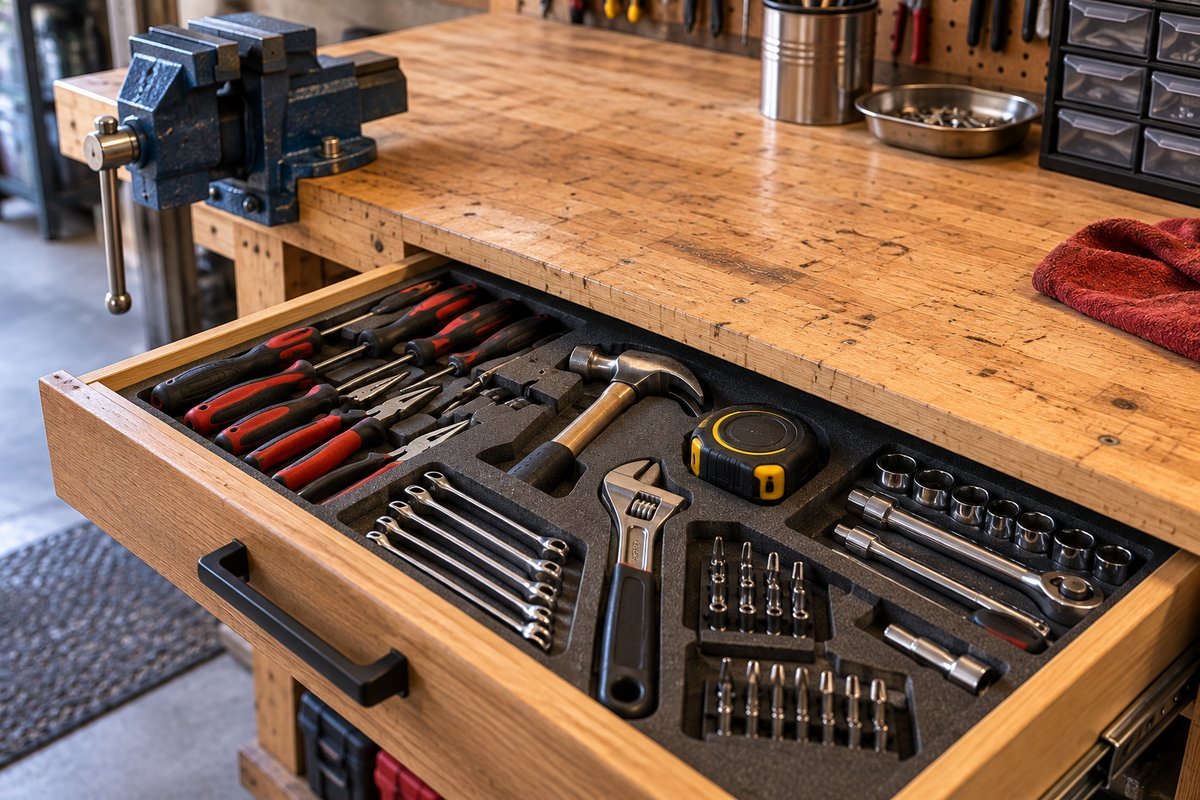
- Open shelf underneath. The simplest option, good for bins and larger items, but nothing stops it from turning into a shelf of loose clutter without bins to contain it.
- Drawers. Keep small parts and hand tools dust-free and out of sight, and work well paired with foam or rubber liners so nothing slides and rattles every time a drawer opens.
- Pegboard on the wall behind the bench. Keeps daily-use tools visible and within arm's reach without taking up any bench or floor space at all.
- A shallow lip or fence along the back edge. Stops small items like screws and fasteners from rolling off the back of the bench during a project.
Lighting, power, and safety at the workbench
A garage's overhead light is rarely enough on its own once a project needs real detail work, and lighting is one of the cheapest things to add after the fact. A task light or a strip of LED shop lights mounted directly above the bench, in the $20 to $60 range, makes a bigger difference to usability than almost any other single upgrade.
Power should reach the bench without a cord running across the floor. A surface-mounted power strip along the back edge or a wall outlet installed directly behind the bench solves this permanently. Running an extension cord across a walkway is a tripping hazard most garages live with far longer than they should.
Any bench holding a vise or power tools should also have a stable, level base. A bench that rocks on an uneven slab transfers that instability straight into whatever is clamped down, which is both a quality problem and, with anything spinning or cutting, a real safety issue.
Budget-friendly garage workbench ideas, by tier
Under $50: A salvaged solid-core door on sawhorses, or a basic plywood top on 2x4 legs. Not permanent, but functional for occasional use.
$50 to $150: A fold-down wall-mounted bench kit, or a built plywood bench with a shelf underneath for basic storage.
$150 to $400: A built-in bench with a hardwood or butcher block top, drawers or cabinets underneath, and a shop light mounted above.
$400 and up: A modular system with matching rolling cabinets, a steel or butcher block top, integrated power outlets, and pegboard or slatwall (wall panels with grooves that hold hooks and shelves) storage on the wall behind it.
Common mistakes
A few choices backfire in the same predictable ways.
- Building or buying a bench too low or too high for the person using it most often, which turns every project into an uncomfortable one.
- Skipping the anchor points. An unbolted bench that a vise is mounted to will rock and shift under real force.
- Choosing a top material based on looks instead of what will sit or get clamped on it.
- Leaving no storage plan, which guarantees the bench surface fills up with loose tools within a month.
- Placing the bench somewhere that blocks the car or a walkway, which usually means it stops getting used.
What we would skip
Not everything is worth the money.
- A glass or laminate benchtop. It looks clean in a showroom photo but chips, scratches, and cracks the first time something heavy or sharp lands on it.
- A bench with zero underneath storage in a garage that already has a clutter problem. It just moves the mess from the floor to the benchtop.
- An oversized bench that eats the only walkway to the car. A slightly smaller bench that gets walked around beats a bigger one that gets resented.
Renter-friendly garage workbench ideas
Anyone who cannot drill into a garage's walls or slab still has real options. A rolling workbench needs no permanent mounting at all and moves out with you when the lease ends. A fold-down bench can be mounted to a freestanding plywood panel braced against the wall instead of screwed into it directly, which avoids the wall damage while keeping the space-saving benefit.
Sawhorses paired with a solid-core door or a sheet of plywood are the simplest renter-friendly option of all: no mounting, no hardware, and the pieces break down flat for storage or a move. For more on organizing the rest of the garage around whatever bench setup you choose, see our Garage Storage & Organization hub.
If a packaged system makes more sense than building one, see how the major garage storage systems compare on price and capacity.
Once the bench is in, the tools around it need a home too. Our guide to garage tool organization ideas covers where to keep them.
Frequently asked questions
How high should a garage workbench be?
34 to 36 inches works for most standing work, about the same height as a kitchen counter. Seated detail work or a bench shared with a shorter person works better at 30 to 32 inches.
What is the best top material for a garage workbench?
Butcher block or solid hardwood holds up best under heavy clamping and impact. Plywood or a solid-core door is a solid, cheaper middle ground. MDF and particleboard strip out at screw holes and are best reserved for light, occasional use.
Do I need to bolt a workbench to the wall or floor?
Only if it will hold a vise or take real force. A bench used mainly for assembly or light repairs can stand freely, but any bench meant for clamping or hammering needs to be anchored into studs or otherwise weighted so it does not rock.
How much does a garage workbench cost?
A basic wall-mounted or rolling bench runs $80 to $250. A built-in bench with real storage underneath runs $300 to $900. Building a simple plywood bench from scratch usually costs $40 to $100 in materials.
What is the best garage workbench idea for a small garage?
A wall-mounted fold-down bench gives back the most floor space, folding flat against the wall when not in use. A rolling bench is the next best option if the bench needs to move out of the way rather than fold away entirely.
Can I build a garage workbench without power tools?
A basic bench can be assembled with just a drill, a saw (including a hand saw), and a tape measure. Pre-cut lumber from a hardware store cuts down on the tools needed even further.
Whatever type of bench fits the space, the height, anchoring, and top material decisions matter more than the brand name attached to it. Gladiator's modular system lineup is a reasonable reference point for what a mid-range build should include. For the rest of the garage around it, see our Garage Storage & Organization hub.