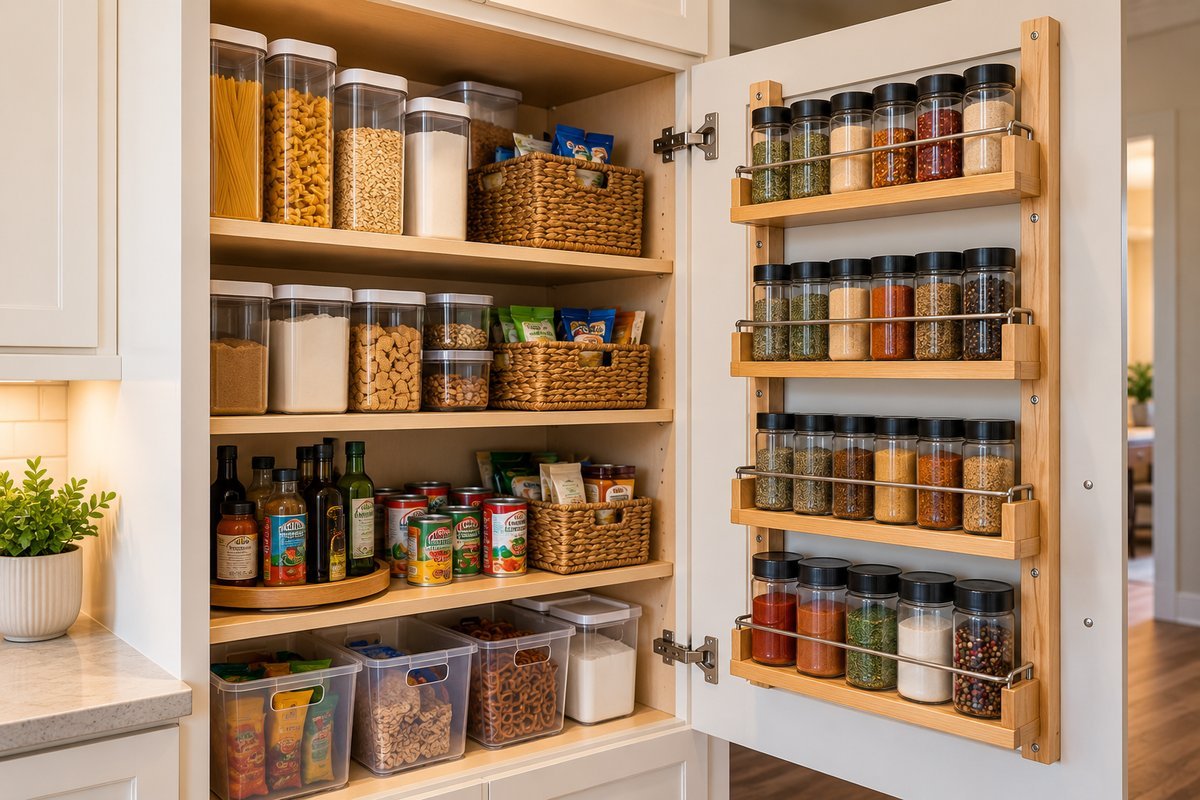
Most kitchens do not have a walk-in pantry, and that is where cabinet pantry ideas help most. If your food storage is one deep cabinet, or a single tall cabinet wedged between the fridge and the wall, you are not missing a room. You are missing a system. A cabinet pantry can hold nearly as much as a small walk-in once it is set up right, and the fixes cost a lot less than knocking out a wall to add one.
This guide covers what works inside a cabinet-style pantry: which pull-out systems are worth the price, how to use the vertical space most people waste on cabinet doors, what looks better in a photo than it works in real use, and how to budget the whole project by tier.
Quick take: A single deep cabinet works best with pull-out shelves instead of fixed ones, a door-mounted rack for anything flat, and shallow bins up front so you are not digging past soup cans to find the pasta. Skip the decorative lazy susan (a spinning tray) unless the cabinet is a corner unit. Budget $60 to $150 for a solid single-cabinet setup, more if you are converting a whole cabinet into a dedicated pantry.
Budget option
A door-mounted rack plus one set of stackable bins is the cheapest real upgrade a single cabinet can get, and it solves the two most common pantry complaints: nothing has a place, and flat items disappear.
Free tool
Not sure what bin size fits your shelf? Use the storage bin size and fit calculator to check tote sizes against your garage, closet, pantry, or under-bed space before you buy.
Table of Contents
What Counts as a Cabinet Pantry
A cabinet pantry covers more ground than people expect, and the right fix depends on which version you have.
A single deep cabinet doing double duty
This is the most common setup: one base or tall cabinet that holds canned goods, boxed food, and snacks alongside whatever else already lived there. The problem is almost never size. It is depth. A 24-inch-deep cabinet swallows small items at the back within a month, and fixed shelves make that worse because nothing moves without unloading everything in front of it.
A dedicated pantry cabinet, built or converted
Some kitchens have a tall, narrow cabinet built specifically for food storage, or an owner converts one. One well-documented example used a 90-inch IKEA Sektion cabinet with two doors and four drawers, set into a closet opening. The opening was 10 inches wider than the cabinet itself, which gave room to build out the base and let the drawers clear the existing baseboard. The build added pull-out shelves up top for canned goods and baking supplies, with the drawers handling grab-and-go items lower down. The lesson that carries over to any cabinet conversion: dry-fit every shelf and drawer before anything is permanently mounted, since a quarter-inch of misalignment is enough to keep a drawer from opening cleanly.
A cabinet with pull-out or roll-out shelving already built in
Newer cabinetry sometimes ships with roll-out trays already installed. If yours does, the fixes below still apply. You are just adding bins, dividers, and door storage on top of hardware that is already doing the hard part.
What Is Worth Buying
Four fixes cover almost every cabinet pantry, and they are worth buying in roughly this order.
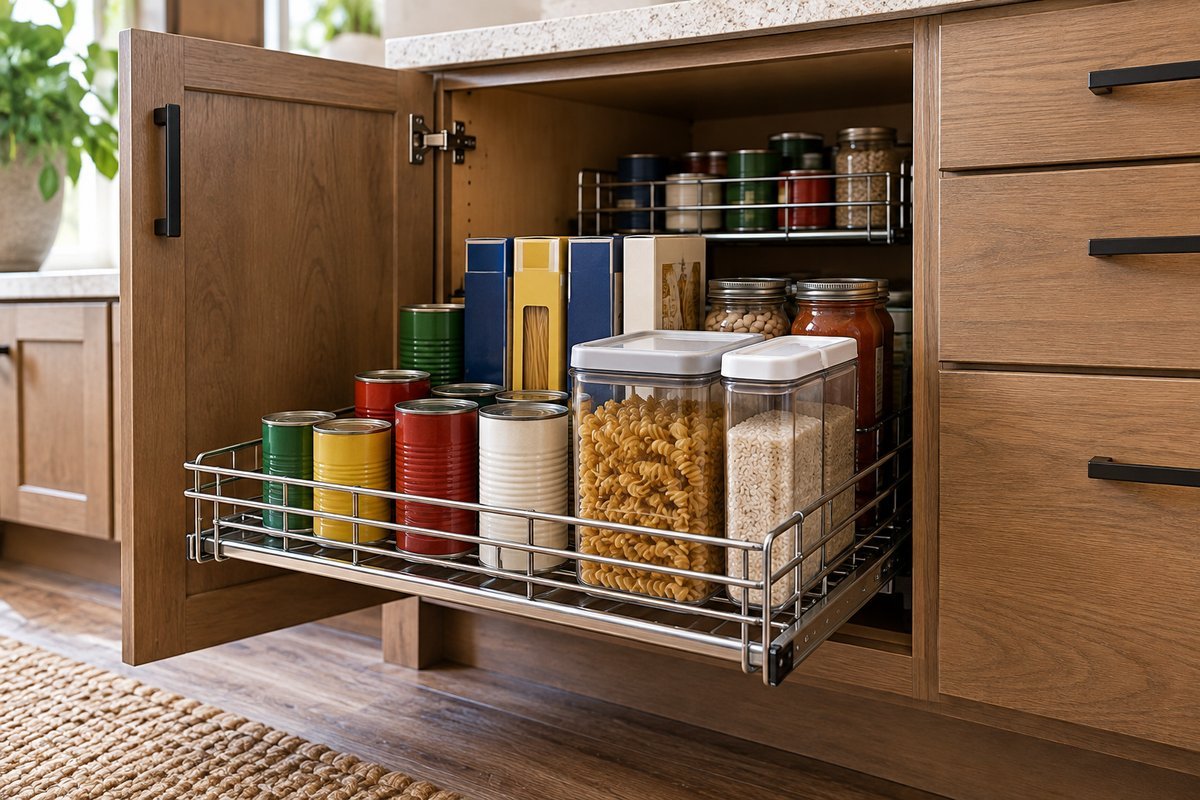
Pull-out or roll-out shelves
This is the single highest-value upgrade for a deep cabinet. A basic wire or laminate roll-out kit runs $40 to $90 per shelf for DIY hardware, and a soft-close, full-extension pull-out system installed by a cabinet shop lands closer to $150 to $350 for a full cabinet. Either way, the payoff is the same: nothing goes to the back of the cabinet to be forgotten, because the whole shelf comes to you instead of you reaching into it.
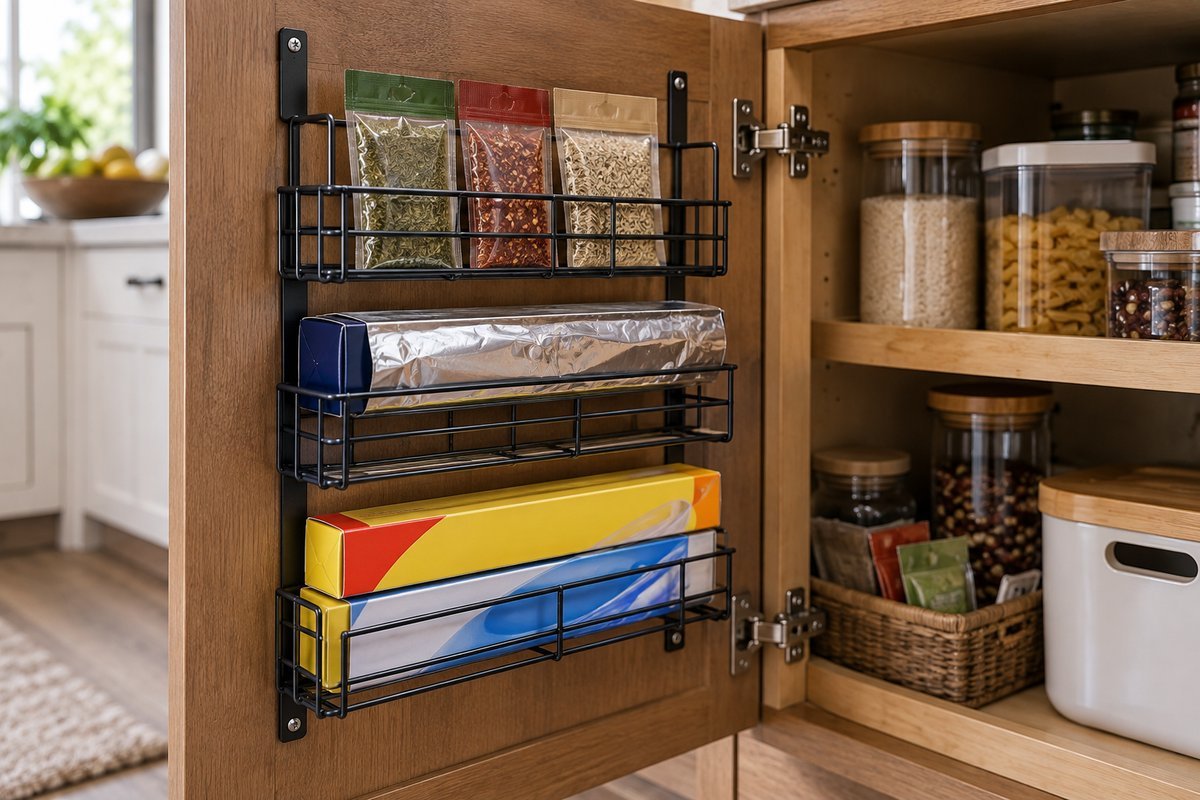
A door-mounted rack
The inside of a cabinet door is dead space on almost every pantry cabinet built before the last decade. A wire or clear-pocket door rack, $15 to $35, handles spice packets, foil, plastic wrap, and anything else flat enough to hang. It is the cheapest square footage you will add to the whole project.
Stackable, clear bins
Bins help by grouping items by category, not by looking uniform on camera. A set of clear stackable bins, $20 to $60 depending on size and count, keeps snack bars from sliding behind the rice and keeps opened bags of pasta from tipping over every time the shelf gets bumped. If spices are part of what is crowding the cabinet, our spice organization guide covers bin and rack sizing for that specific category.
Battery LED puck lights
Most cabinet pantries sit in a corner of the kitchen with no dedicated light source. A three-pack of battery-powered or motion-sensor LED pucks, $15 to $30, mounts with screws or a light adhesive strip in under ten minutes and solves the problem completely without an electrician.
A lazy susan, but only if the cabinet is a true corner unit
A rotating lazy susan only pays off in a true corner cabinet, where the alternative is reaching blind into an L-shaped space. In a straight, single-run cabinet, a lazy susan wastes the square corners of the shelf that a fixed or pull-out shelf would use. If you are working with a true corner cabinet, our corner pantry ideas guide breaks down lazy susan and blind-corner pull-out costs side by side.
Cabinet Pantry Storage Options Compared
A side-by-side view of where the money goes, and which of these cabinet pantry ideas fits which cabinet.
| Fix | Typical Cost | Best For | Install Difficulty |
|---|---|---|---|
| Pull-out roll-out shelf | $40 to $350 | Any deep cabinet | Easy to moderate (DIY kit) or professional install |
| Door-mounted rack | $15 to $35 | Flat items: spices, wraps, foil | Easy, 10 minutes |
| Stackable clear bins | $20 to $60 | Grouping loose items by category | Easy, no tools |
| Battery LED puck lights | $15 to $30 | Any cabinet with no light source | Easy, 10 minutes |
| Lazy susan turntable | $20 to $150 | True corner cabinets only | Easy to moderate |
Cabinet Pantry Ideas by Budget Tier
Under $50
A door-mounted rack plus one set of stackable bins. This is the cheapest real upgrade a single cabinet can get, and it solves the two most common complaints: nothing has a place, and flat items disappear.
$50 to $150
Add a DIY pull-out shelf kit for the cabinet's deepest section, plus battery LED lighting. This tier is where most single-cabinet pantries land, and it is usually enough to fix the depth problem completely.
$150 to $400
A professionally installed pull-out or roll-out system for a full cabinet, or a full lazy susan replacement for a true corner unit. This tier makes sense once you are treating the cabinet as a real pantry rather than patching an existing one.
$400 and up
Converting an entire tall cabinet into a dedicated pantry, complete with drawers, pull-out shelving throughout, and finished interior surfaces. This is closer to a small remodel than an organizing project, and it usually only makes sense if the cabinet in question was never designed to hold food in the first place.
Shelf Depth, Spacing, and Material
Depth matters more than shelf count in a cabinet pantry. A general rule that holds up well in practice: put deeper storage down low, drop to shallower shelves in the middle where you look most often, then go back to deeper storage up top for bulk items you grab less frequently. That way, the shelf height you scan at eye level never buries anything behind something else.
Our pantry shelving guide covers depth, spacing, and material choice in more depth if you are shelving a cabinet from scratch rather than retrofitting one. The short version: wire shelving is cheapest and best for ventilation, laminate (a thin plastic surface layer) resists spills and wipes clean easier, and solid wood costs the most but holds the most weight without sagging over a few years of canned goods.
Common Mistakes With Cabinet Pantry Ideas
- Mounting anything with adhesive strips alone instead of screws. Adhesive holds for a few weeks under light snack bags, then fails under the weight of canned goods.
- Buying a full pull-out system for a cabinet that is not that deep. If the cabinet is 12 to 14 inches deep, a door rack and bins solve the problem for a fraction of the cost.
- Skipping the dry-fit step. Test every shelf and drawer in place before permanently mounting anything, since small measurement errors only show up when you try to use the space.
- Buying matching containers before solving the visibility problem. A uniform set of bins looks better in a photo, but it does nothing if the shelf behind them is still too deep to see into.
What We Would Skip
Not every cabinet pantry idea is worth the money. Decorative lazy susans in a straight cabinet, for the reason covered above: they waste the square corners a fixed or pull-out shelf would use fully. Full-cabinet pull-out systems for a cabinet under 14 inches deep, where the same money buys a rack and bins with a better return. And single-use gadget bins sized for one product category, which stop being useful the moment your shopping habits change.
Renter-Friendly Ideas
Most of these cabinet pantry ideas work without modifying the cabinet itself, with two exceptions. Skip any pull-out shelf kit that requires drilling into the cabinet sides, and look for tension-mounted or freestanding versions instead. Command-brand hooks and strips hold a door rack or a light puck fine for the lifetime of a lease, as long as the surface is clean and the weight stays light. Freestanding wire shelf risers and stackable bins need no mounting, and both move with you at the end of the lease.
Frequently Asked Questions
How deep should a cabinet pantry shelf be?
12 to 16 inches works well for most canned and boxed goods. Anything deeper than 16 inches starts hiding items at the back unless it is on a pull-out or roll-out shelf.
Can I add pull-out shelves to an existing cabinet myself?
Yes, in most cases. DIY roll-out shelf kits are designed to mount to the existing cabinet sides with side-mounted slides, and most kits list the exact cabinet width and depth they fit. Measure the interior opening before ordering, not the door front.
What is the cheapest way to fix a disorganized cabinet pantry?
A door-mounted rack and one set of stackable bins, both under $50 combined. That single change fixes the two most common complaints: items with no assigned spot, and flat packaged goods disappearing behind everything else.
Is a lazy susan worth it in a cabinet pantry?
Only in a true corner cabinet. In a straight, single-run cabinet, a lazy susan wastes the square corners of the shelf that a fixed or pull-out shelf would use fully, so the cost rarely pays off there.
How do I organize a cabinet pantry without drilling into the cabinet?
Use freestanding wire shelf risers and stackable bins that need no mounting at all, plus adhesive hook strips rated for the weight of what you are hanging. Skip any pull-out kit that requires drilling into the cabinet sides if you are renting.
These cabinet pantry ideas work for one deep cabinet or a whole cabinet turned into a pantry. They cover the real gap in almost every setup: depth, visibility, and a place for flat items that otherwise end up loose on a shelf. For manufacturer specs on soft-close pull-out systems, Rev-A-Shelf's pantry pull-out lineup is a useful reference for sizing before you buy. And for more fixes across every part of the kitchen and pantry, our Pantry Organization hub covers shelving, spice storage, and corner cabinets too.
The same principles carry over to an oddly-shaped pantry: see these under-stairs pantry ideas for making an angled ceiling and tapered footprint work.