
Most spice organization advice online is a photo of matching glass jars on a tiered shelf, with nothing about what that setup costs, how long the labels last, or whether decanting was ever a good idea in the first place. This is the fuller version: real spice organization ideas broken down by how your kitchen is laid out, what each fix costs, and which popular fixes professional organizers say to skip.
The right method depends less on how many spices you own and more on where you cook and how you reach for them. A drawer near the stove, a narrow cabinet, and an open pantry shelf all call for different setups, even though the underlying goal, knowing what you have and finding it in five seconds, is the same in every kitchen.
Quick take
- Storage conditions: dark, cool, and dry beats any container choice. A spice stored above the stove degrades no matter what jar it's in.
- Skip decanting into matching jars unless you pour the same handful of staples daily. Professional organizers rank it as one of the most wasted-effort pantry projects.
- Organize by how you cook, not alphabetically. Grouping by cuisine or task (baking vs. grilling) matches how people reach for spices. The alphabet doesn't.
- Most kitchens need $15 to $60 in organizers, not a full drawer-insert custom build.
Budget option
Under $25 covers a freestanding tiered rack or lazy Susan and a basic set of front-facing labels, enough for most small to medium spice collections with no installation.
Table of Contents
What matters before you organize your spices
Spice organization content online focuses almost entirely on containers and layout. The container matters far less than where the spice sits, and most spice racks that look great in photos are mounted in exactly the wrong spot.
Keep spices dark, cool, and dry. Light and heat both break down the essential oils that give a spice its flavor, and moisture clumps ground spices and invites mold in anything with residual oil content. Texas A&M AgriLife Extension's storage guidance for dried herbs and spices is direct about this: store in tightly covered containers, in a dark location like a cabinet or drawer, away from direct sunlight. It specifically says to keep them away from the areas above the dishwasher, microwave, stove, or refrigerator, and away from sinks or heating vents.
The classic "spice rack over the stove" is the single most common mistake. It looks efficient because the spices are close to where you cook, but it's also the hottest, most humid spot in the kitchen every time a pot is on. Keeping spices in a drawer, cabinet, or on a wall away from the stove keeps them fresher for years longer.
Airtight matters more than matching. A loose-fitting lid lets aroma and flavor escape between uses, regardless of how attractive the container is. Original spice jars and tins are almost always airtight by design. That's one practical reason to keep spices in their original packaging rather than an open-top decorative jar.
How to organize your spices, start to finish
- Pull every spice out and check the date or the smell. If a ground spice doesn't smell like much when you open the lid, it won't add much to a dish either. This step alone usually clears 20 to 30 percent of a spice collection.
- Decide where you cook and pick a storage spot within arm's reach, not the prettiest wall in the kitchen. A drawer or cabinet near the stove beats a shelf across the room every time you're mid-recipe.
- Group spices by how you use them (cuisine, task, or frequency, covered in detail below) before choosing a container system, since the grouping determines whether you need a drawer insert, a tiered rack, or a door-mounted organizer.
- Pick a container system that matches the space, not the other way around. A drawer insert only works in a drawer deep enough to hold it upright. A cabinet door organizer only works if the door swings clear of it.
- Label at eye level, not on the lid. A lid label disappears once a jar stands upright in a drawer or deep cabinet. A front-facing label on the jar stays readable in any storage orientation.
- Keep the everyday six to eight spices most accessible and let the rest live one shelf back or one drawer deeper. Salt, pepper, garlic powder, and whatever spices define your usual cooking don't need the same prime real estate as ones used twice a year.
Spice storage methods, by kitchen setup
No single spice organizer is best. The right one depends entirely on what kind of space is available near where you cook.
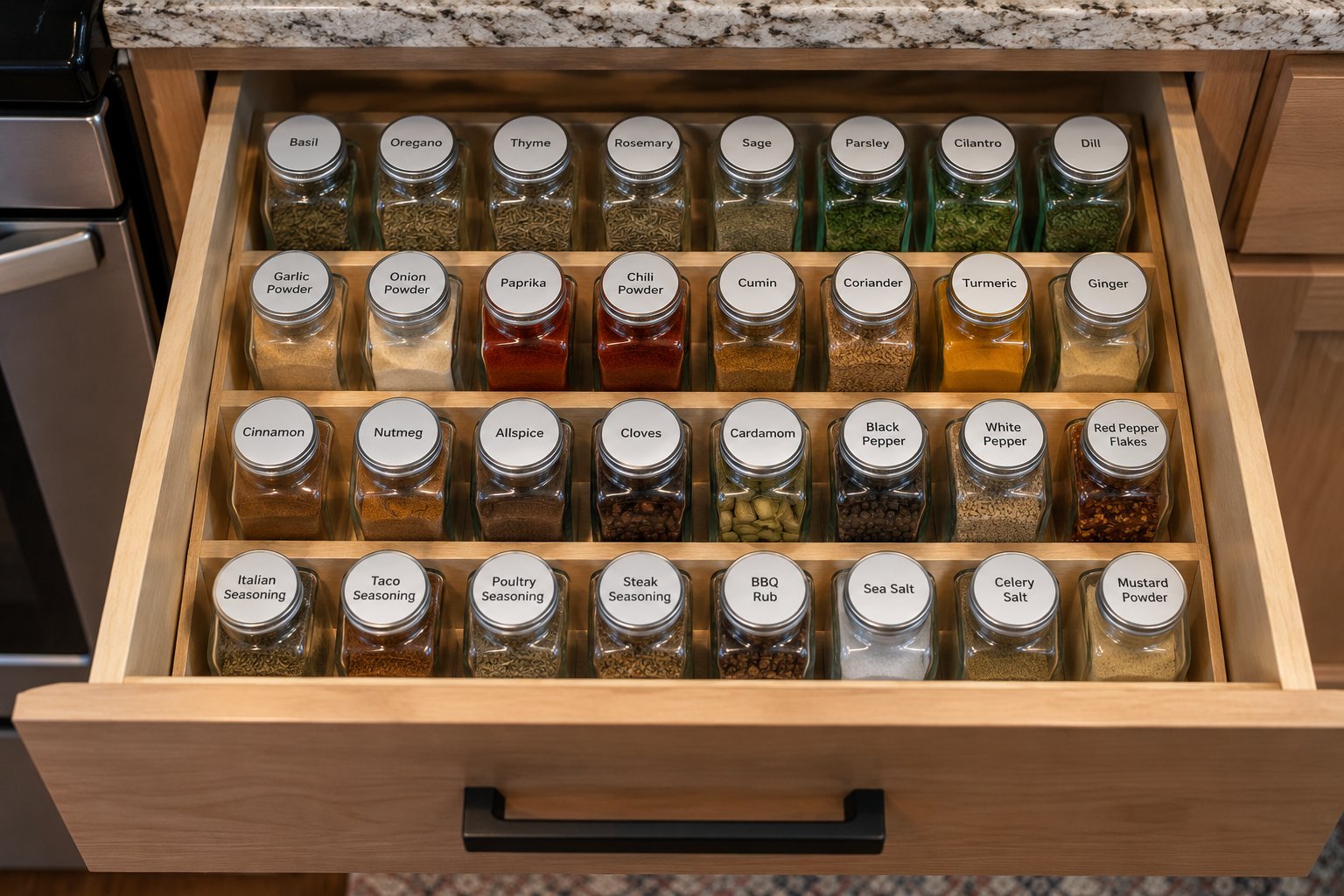
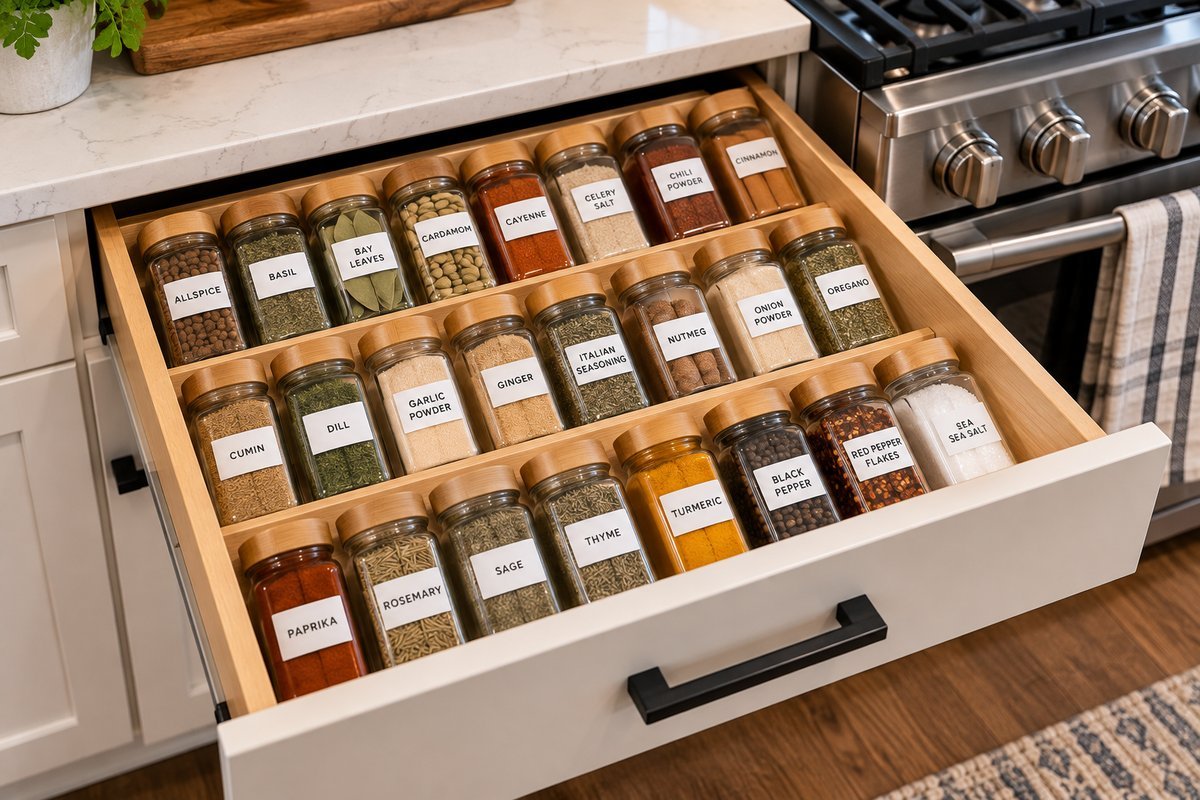
Drawer inserts: a tiered wood or metal tray that drops into a drawer, angling spice jars up so labels are visible from above. Works only in a drawer deep enough to hold jars upright, and is the best option for anyone with a free drawer within reach of the stove.
Pull-out cabinet racks: a narrow wire or wood rack that slides out from inside a cabinet, sized for one row of jars per shelf. Makes good use of a slim gap next to a cabinet's other shelving, and keeps spices out of sight without burying them in the back.
Freestanding tiered racks and lazy Susans: the lowest-commitment option, since nothing gets mounted or installed. A tiered step rack works well inside a cabinet or on a pantry shelf. A lazy Susan is specifically useful in a corner cabinet or for round bottles that get lost standing in a row.
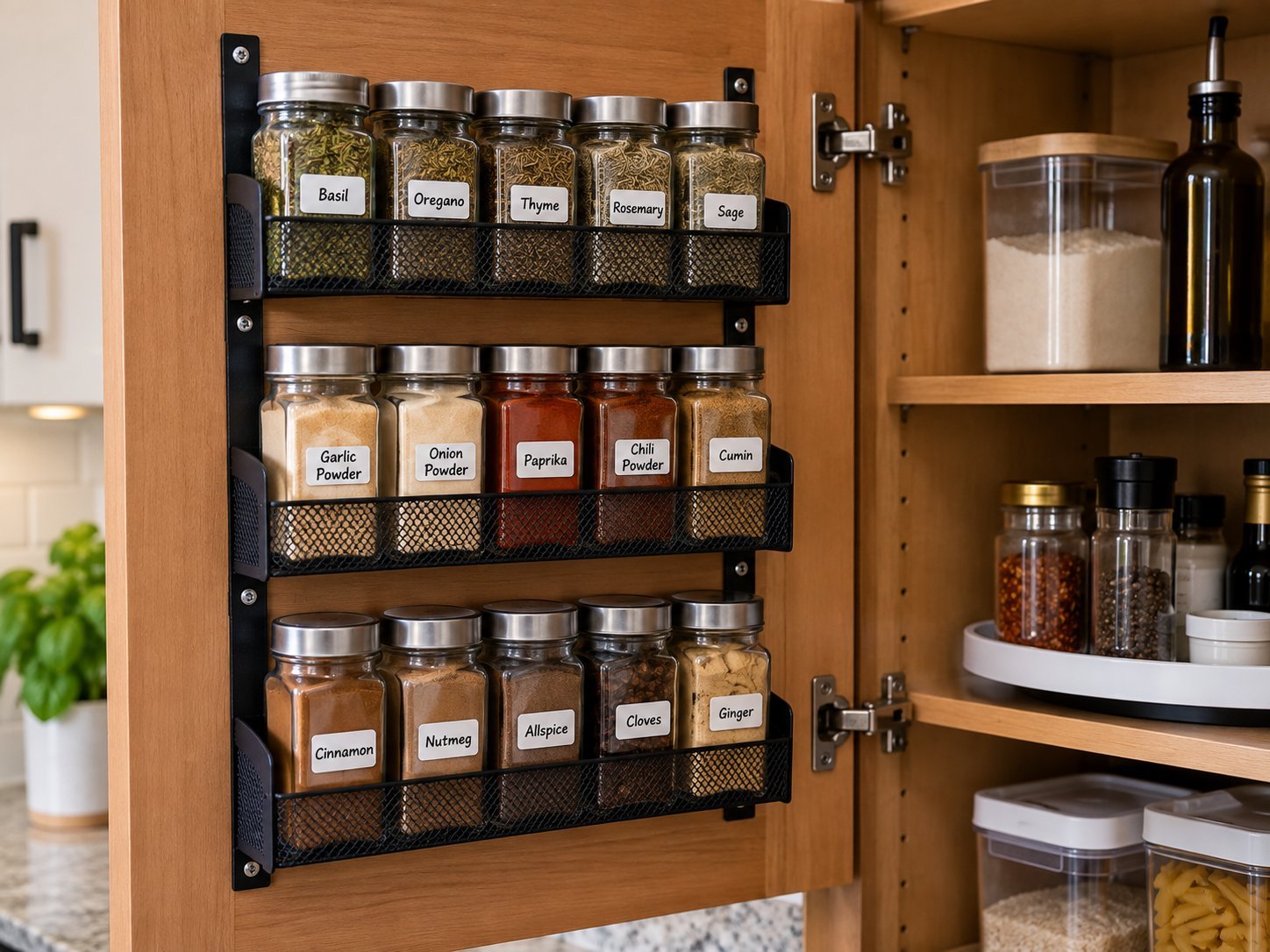
Cabinet door organizers: a wire or plastic rack that mounts to the inside of a cabinet door, reclaiming space that would otherwise sit empty. Some hold dozens of small containers at once, which makes them a strong fit for a large spice collection with no dedicated drawer or shelf to spare. The door still needs clearance to close over what's mounted on the shelf behind it.
Wall-mounted racks and magnetic strips: shelving or a metal strip mounted directly on a wall, holding jars or magnetic tins in view. Keeps spices close at hand while cooking, but only works away from the stove's heat and steam, and a magnetic strip specifically requires jars or tins with a magnetic bottom, not standard glass spice jars.
Pantry shelf or door storage: the simplest option for anyone with pantry space to spare, using a shelf, a lazy Susan, or a door-mounted rack the same way a cabinet would use one. The tradeoff is distance: a pantry across the kitchen from the stove adds real steps to a spice-heavy recipe.
| Method | Typical cost | Best for | Renter-friendly? |
|---|---|---|---|
| Drawer insert | $15 to $40 | A free drawer near the stove | Yes |
| Pull-out cabinet rack | $20 to $50 | A narrow gap inside a cabinet | Mostly (check for screws) |
| Freestanding tiered rack / lazy Susan | $10 to $25 | Any shelf or cabinet, zero install | Yes |
| Cabinet door organizer | $20 to $45 | Large collections with no spare shelf | Mostly (check mount type) |
| Wall rack / magnetic strip | $15 to $40 | Open wall space away from the stove | No (needs drilling) |
| Pantry shelf / door storage | $10 to $35 | Kitchens with pantry space to spare | Yes |
The best way to group spices isn't alphabetical
Alphabetizing a spice collection is one of the most common spice organization ideas, and it's also the one professional organizers push back on most consistently. Recipes aren't written alphabetically, and in a household with more than one cook, an alphabetical system rarely survives more than a few weeks before someone puts cumin back in the wrong spot.
Three groupings hold up better in practice:
- By cuisine: keep Mexican, Italian, and Indian spices in their own clusters if that's how meals get planned. Reaching for "taco night" spices as a group is faster than hunting for cumin, chili powder, and oregano individually.
- By task: separate baking spices (cinnamon, nutmeg, allspice) from savory cooking spices, since they're rarely needed in the same session and often live in different parts of the kitchen anyway.
- By frequency: whatever gets used multiple times a week (salt, pepper, garlic powder, a favorite chili blend) belongs at the most convenient spot regardless of category. Everything else can sit one shelf back.
The common thread across all three is that the system matches how the kitchen is used, not how a spice rack looks staged for a photo.
What is worth buying
A handful of products cover almost every real spice organization need:
- A tiered drawer insert, roughly $15 to $40. The single highest-impact buy for anyone with a spare drawer near the stove.
- A lazy Susan, roughly $10 to $25. Best for a corner cabinet or any collection of round bottles that get lost standing upright.
- A cabinet door rack, roughly $20 to $45. The direct fix for a large collection with no shelf or drawer to spare.
- Front-facing labels, roughly $10 to $20 for a basic set. Worth it for jars stored flat or angled, where a lid label goes unreadable.
- A magnetic strip and matching tins, if going that route, roughly $25 to $45 for a starter set. Only worth it for a wall spot away from the stove.
Budget tiers
Free (an afternoon, nothing to buy): pull everything out, toss anything that's lost its smell, and put spices back grouped by cuisine or task instead of scattered. This alone fixes the "I know I have that somewhere" problem in most kitchens.
Under $25: a freestanding tiered rack or lazy Susan and a basic set of front-facing labels. Covers most small to medium collections without any installation.
$25 to $60: a proper drawer insert or cabinet door organizer sized to the actual space, plus labels. This tier is where most kitchens land for a collection of 20 to 40 spices.
$60 and up: a wall-mounted system or a custom-built pull-out rack for a large collection or a kitchen being organized from scratch during a remodel.
What we would skip
Decanting an entire spice collection into matching glass jars is the single most photographed spice organization idea, and it's also the one professional organizers most consistently advise against. Professional organizer Darla Demorrow has put it plainly: decanting spices into matching jars is time-consuming, costly, and wasteful. The problems compound quickly across a real collection: transferring spices through a funnel wastes product, decorative jars are frequently smaller than the original packaging (leaving unusable spice behind), and the cost of 20 or more matching containers adds up fast for a purely visual upgrade.
Original spice packaging is also, in most cases, already airtight and already sized correctly for the amount inside. The better version of this idea: keep spices in their original containers and solve the visibility problem with labels and a rack or insert that lets you see what you have, rather than repackaging everything from scratch.
We'd also skip alphabetizing a shared kitchen's spice collection, for the reasons covered above, and skip storing spices in any rack mounted above or beside the stove, no matter how convenient it looks in a photo.
How long spices stay fresh
Properly stored spices don't spoil the way food does, but they do lose potency, which is the part most spice organization ideas skip entirely. Texas A&M AgriLife Extension's storage guidance gives concrete ranges: whole spices (peppercorns, whole allspice) hold their quality for 3 to 4 years, ground spices (cumin, ginger, paprika, chili powder) for 2 to 4 years, and leafy dried herbs (basil, oregano, rosemary) for 1 to 3 years. Vanilla extract is the one exception and keeps essentially indefinitely.
Whole spices consistently outlast their ground counterparts, since grinding exposes far more surface area to air and light. If a recipe allows for either, buying whole and grinding as needed is a real way to extend a spice's usable life, not just a cooking preference.
The simplest freshness check doesn't need a date: open the container and smell it. If a ground spice barely smells like anything, or a dried herb crumbles to dust with no aroma, it's not going to contribute much to a dish even though it isn't technically spoiled.
Common mistakes
- Storing spices above or beside the stove because it's convenient, without accounting for the heat and steam that shorten every spice's usable life.
- Buying a container system before measuring the space, then discovering a drawer insert is too tall to close the drawer, or a cabinet door rack blocks the shelf behind it.
- Decanting the entire collection into matching jars, taking on hours of transfer work and ongoing relabeling for a purely visual upgrade.
- Alphabetizing a shared kitchen's spices, a system that looks organized on day one and rarely survives more than a few weeks of real use by more than one cook.
- Never checking for freshness, so a spice from years ago keeps taking up prime real estate while contributing almost no flavor to anything it's added to.
Renter-friendly spice organization ideas
A rental kitchen usually rules out drilling for a wall-mounted rack, but nearly everything else on this list installs and removes without a mark. Freestanding tiered racks and lazy Susans need no tools. Most drawer inserts simply drop into an existing drawer. Cabinet door organizers that clip onto the door edge, rather than requiring screws, hold just as much as a permanently mounted version and come off cleanly at move-out. Command-brand strips can even hang a lightweight magnetic panel on a wall away from the stove, for anyone set on the magnetic-strip look without drilling into someone else's kitchen.
Spices are only one part of the pantry. For the shelves around them, see our pantry shelving ideas and cabinet pantry ideas, or start from the pantry organization hub.
Frequently asked questions
What is the best way to organize spices?
Group spices by how you cook (by cuisine, by task, or by how often you reach for them) rather than alphabetically. Store them somewhere dark, cool, and dry away from the stove, and pick a container system (drawer insert, tiered rack, or door organizer) that fits the space you have.
Should I decant my spices into matching jars?
Most professional organizers advise against it. Decanting wastes product through the funneling process, decorative jars are often smaller than the original packaging, and the cost adds up fast across a full collection. Keeping spices in their original, already-airtight packaging and organizing with labels and a rack solves the same visibility problem for far less time and money.
How long do spices stay fresh?
Whole spices generally hold their quality for 3 to 4 years, ground spices for 2 to 4 years, and dried leafy herbs for 1 to 3 years, according to Texas A&M AgriLife Extension's storage guidance. Whole spices consistently outlast ground versions of the same spice, since grinding exposes more surface area to air and light.
Where should spices not be stored?
Avoid storing spices above or beside the stove, near the dishwasher or microwave, or near a sink. Heat, steam, and direct sunlight all break down the flavor compounds in spices faster than normal use would.
Should spices be organized alphabetically?
Not for most households. Recipes aren't organized alphabetically, and an alphabetical system rarely survives more than a few weeks in a kitchen with more than one cook. Grouping by cuisine, cooking task, or frequency of use matches how spices get reached for.
What is the cheapest way to organize spices?
Emptying out expired spices and regrouping what's left by cuisine or task costs nothing and solves most visibility problems. Beyond that, a basic freestanding tiered rack or lazy Susan in the $10 to $25 range covers most small to medium collections without installation.