A corner pantry sounds like a bonus until you try to use the back. Builders love tucking a pantry into a dead corner because it recovers square footage the kitchen layout would otherwise waste. But that same angle is what makes half the shelf depth nearly unreachable without kneeling on the floor and reaching blind. Most corner pantry ideas online show the finished photo and skip the part where someone has to get a bag of flour out from behind three rows of canned tomatoes.
This guide covers the mechanics: what makes the corner hard to use, which fixes solve the reach problem and which just look good in a listing photo, what each one costs, and which popular corner pantry ideas are worth skipping entirely. It covers both shapes people call a corner pantry: a walk-in pantry built into an angled or L-shaped room corner, and a corner base or wall cabinet doing pantry duty in a kitchen with no dedicated pantry room.
The single biggest failure point in a corner pantry is the same in almost every kitchen: the last 12 to 18 inches of a blind corner, the part hidden behind the adjoining wall or cabinet run. A rotating or pull-out system fixes that dead zone for $150 to $800 depending on the mechanism. Full-depth open shelving works fine for a walk-in corner pantry with a real door and enough width to step inside. It fails inside a shallow cabinet-style corner where nothing rotates or slides.
Budget option
Under $50 covers a door-mounted wire rack plus a few uniform bins, enough to fix most corner pantries without a magic corner system.
Free tool
Not sure what bin size fits your shelf? Use the storage bin size and fit calculator to check tote sizes against your garage, closet, pantry, or under-bed space before you buy.
Table of Contents
The two things people call a corner pantry
Two different setups share the same name, and the fixes for each aren't interchangeable. A walk-in corner pantry is its own small room, built into a corner of the kitchen and usually entered through an angled or clipped-corner door, with shelving wrapping two or three walls inside. A corner cabinet pantry has no separate room. A base or tall cabinet simply occupies the spot where two counter runs meet, and it does pantry duty as part of the regular kitchen cabinetry.
Knowing which one applies matters because a walk-in corner is far more forgiving. Someone can step into the room and reach the shelves from the side. A corner cabinet can't be entered, only reached into, and that's where the real problem shows up: the innermost corner, in both setups, is the hardest 12 to 24 inches in the entire kitchen to use.
Why the corner itself is the problem
Two walls meeting at 90 degrees puts the back corner roughly twice as far from the opening as a straight wall shelf of the same depth would be. In cabinetry, this has a trade name: a blind corner. Cabinet installers use it because the back few inches can't be seen or reached without pulling out everything stored in front of them first.
A walk-in pantry corner is more forgiving since a person can physically step into the room. But a shelf that wraps a tight interior angle still loses several inches of usable depth to the wall thickness and the shelf bracket itself. Standard base cabinets run about 24 inches deep. A blind corner cabinet is often 33 to 42 inches wide, and roughly a third of that width sits directly behind the adjoining cabinet, completely unreachable without some kind of mechanism to bring it forward.
Corner pantry ideas by pantry type
The right fix depends on which of the two setups above you have, and on how much floor space the corner has to work with.
Walk-in corner pantry ideas
If there is room to step inside, treat the corner itself as a dead zone for large, infrequently used items rather than daily ones: the turkey roaster, the punch bowl, the bulk pack of paper towels. Keep open shelving on the two straight walls at a standard 12 to 16 inch depth for items you reach for every week, and reserve the corner for categories that come out only a few times a year.
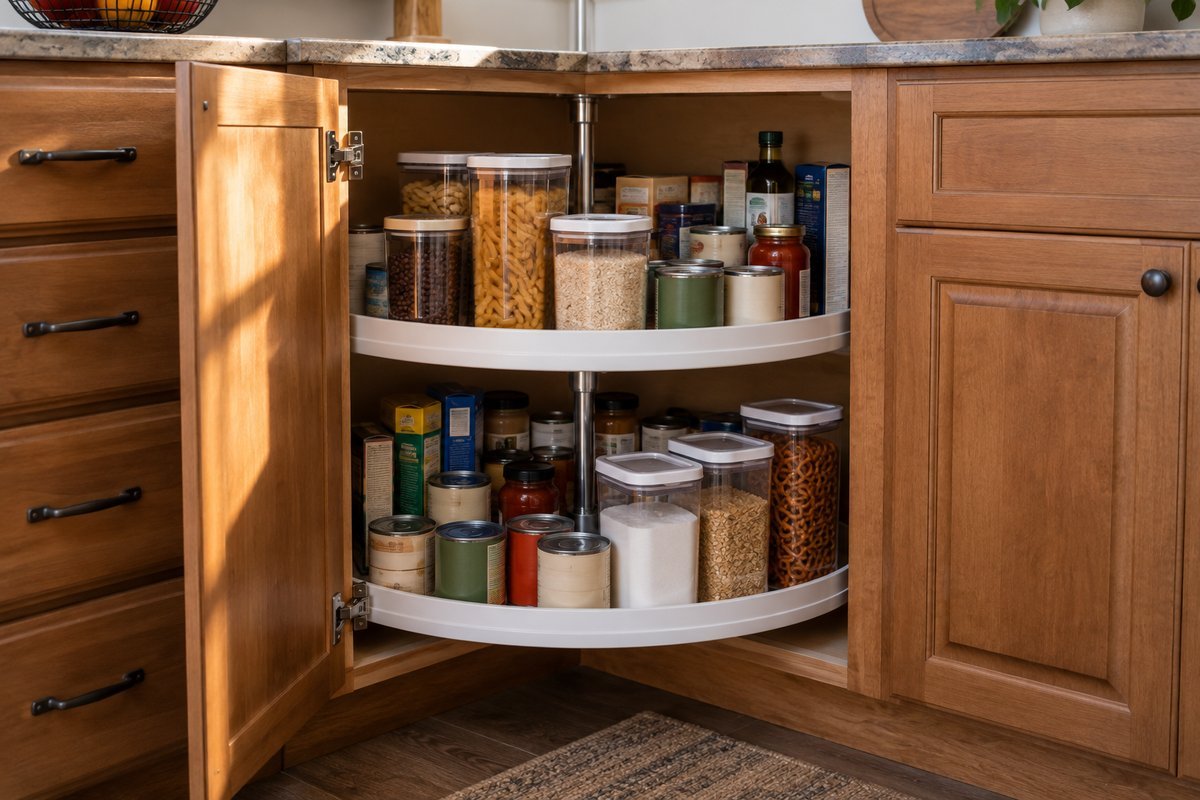
Where the corner has real floor space (a walk-in of 5 by 5 feet or larger), a lazy Susan-style rotating floor unit, or a set of corner-fit wire shelves can reclaim the angle instead of leaving it as dead space. Full-height storage on the inside of the entry door adds real capacity without touching the corner problem at all, and it's one of the cheapest wins available in any walk-in pantry.
Corner cabinet pantry ideas
This is the version with the real reach problem: a blind corner base or tall cabinet functioning as the household's pantry. A rotating shelf system or pull-out corner drawer is almost mandatory here. Without one, the back third of the cabinet is storage you can't access without unloading everything in front of it first.
Tall pantry-style corner cabinets, sometimes called a utility cabinet in kitchen design, sometimes use a bi-fold or pocket door specifically so nothing blocks the opening while shelves pull forward. That detail is worth checking before buying an insert, since a standard swing door can physically stop a rotating tray partway through its turn.
Reach-in pantry with an angled corner
Some reach-in pantries, closet-depth rather than walk-in, have one wall meeting an angled or clipped corner instead of a squared one, often where the pantry backs onto a stairwell or an exterior wall angle. The angled wall itself usually isn't the storage problem. The issue is a standard straight shelf run that stops short of the angle, leaving a wedge-shaped gap unused.
A custom-cut shelf following the actual angle, or a simple corner shelf unit sized to the wedge, recovers that gap instead of leaving it as a triangle of wasted space. This is a cheap fix compared to anything mechanical, since it's just an unusually shaped shelf rather than a moving part.
What is worth buying
A short list covers almost every real corner pantry, whether it's a cabinet retrofit or a walk-in room.
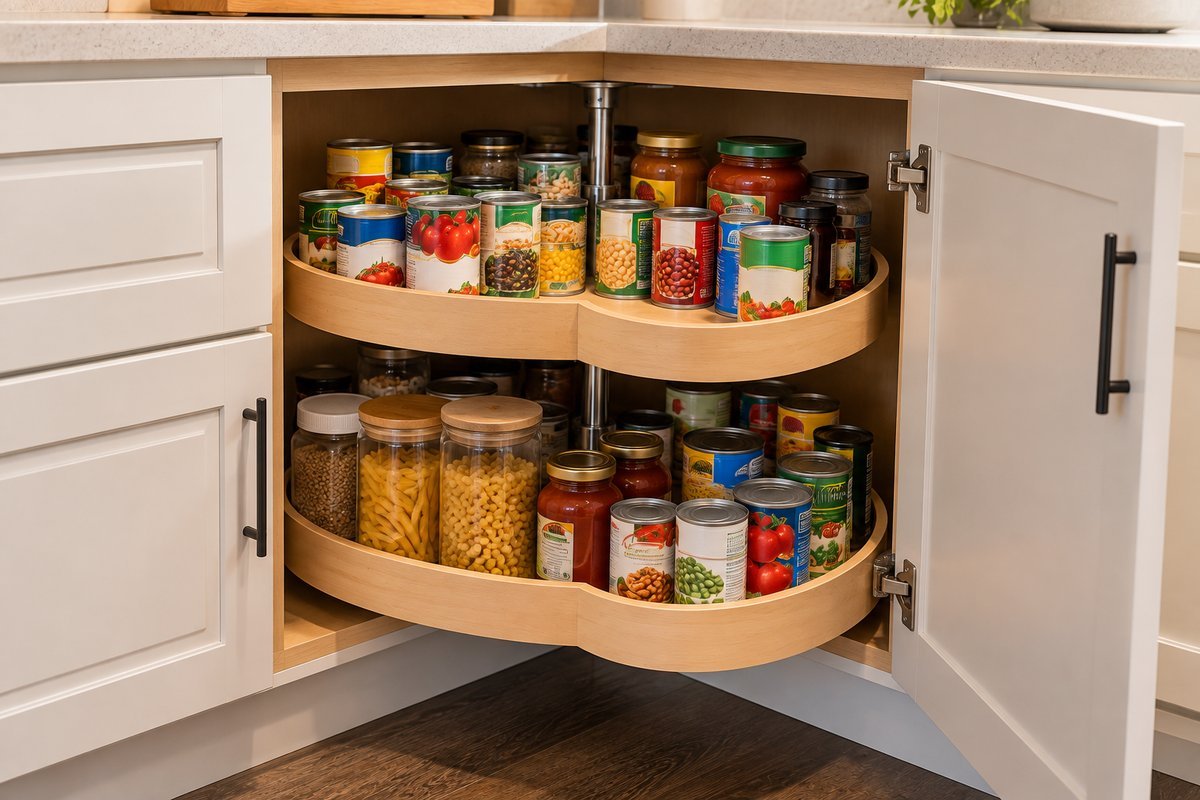
- Lazy Susan corner unit (2-shelf or 3-shelf rotating tray): roughly $150 to $400. Recovers around 70 percent of a blind corner storage space, and since the shelves rotate, most retrofits need no cabinet modification.
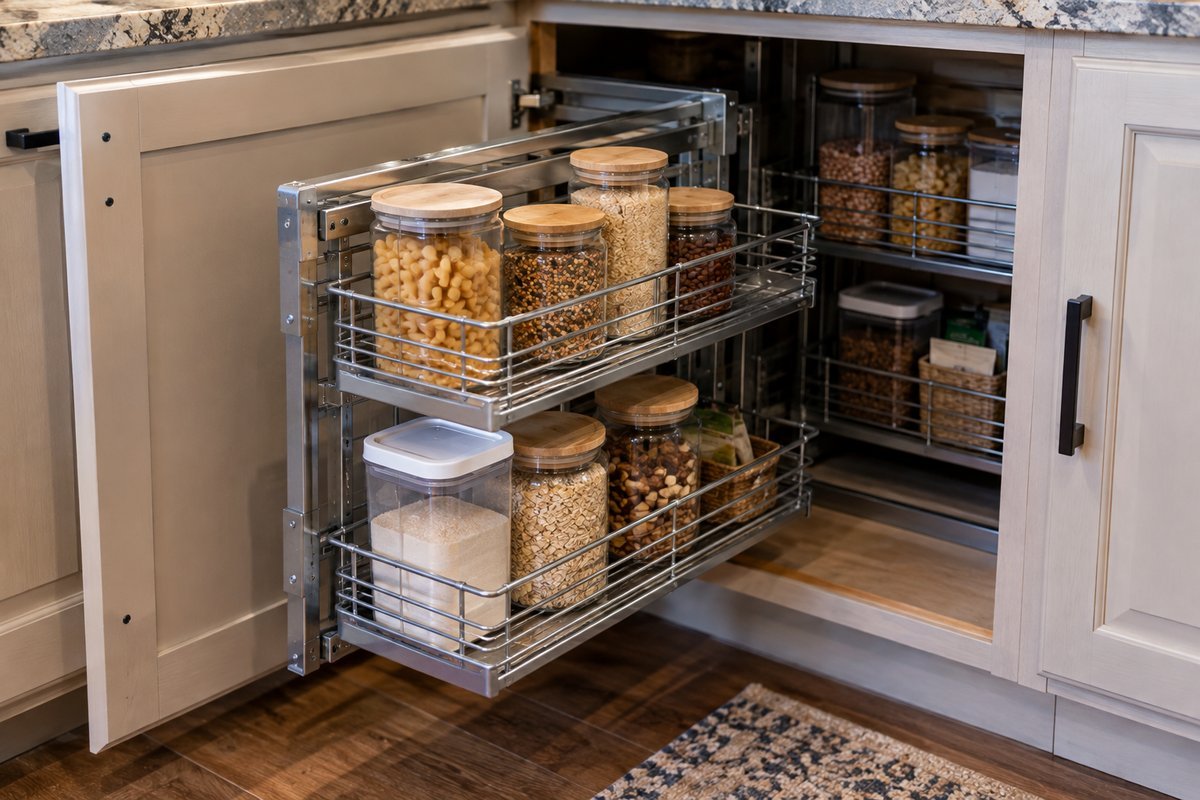
- Corner drawer system (pull-out drawers on full-extension slides, sometimes branded a magic corner): roughly $300 to $800 depending on the number of tiers. Recovers closer to 85 percent of the corner space and shows everything at a glance instead of requiring a spin to find it, at the cost of a higher price and sometimes a cabinet door swap.
- Blind corner pull-out organizer (a sliding wire basket system that rides on a track and pulls the whole unit into the room): basic wire versions start under $150, premium systems from manufacturers like Rev-A-Shelf run several hundred dollars. It sits between a lazy Susan price and a full drawer system.
- Door-mounted wire or over-the-door racks: $20 to $60. Adds real storage without touching the corner mechanism at all, and works best paired with one of the options above rather than as a standalone fix.
- Clear stackable bins: $8 to $20 each. These matter more in a corner pantry than a straight one because uniform shapes let a rotating shelf spin without items catching on each other. See our spice organization ideas for how to size bins for a rotating shelf specifically.
Lazy Susan vs corner drawer vs blind corner pull-out
Each mechanism trades cost against how much of the corner it recovers. Here is how the four real options compare side by side.
| Solution | Typical cost | Space recovered | Best for | Watch out for |
|---|---|---|---|---|
| Lazy Susan (rotating tray) | $150 to $400 | ~70% of corner | Budget retrofits, existing cabinets | Pivot mechanism wears over time. Items can slide if the shelf isn't contained |
| Corner drawer / magic corner | $300 to $800 | ~85% of corner | New builds or full remodels | Highest cost. Often needs cabinet modification to retrofit |
| Blind corner pull-out (wire basket) | $150 to $400+ | ~75% of corner | Existing blind corner cabinets, no door swap needed | Track length limits reach on very wide corners |
| Fixed corner shelf (no mechanism) | $30 to $100 | ~40% of corner | Walk-in pantries with room to step in | Back of the shelf still requires reaching in by hand |
Budget-friendly corner pantry ideas, by tier
A smaller budget doesn't mean skipping the fix. It means picking the right tier for what the corner needs.
- Free (a weekend, nothing to buy): empty the corner completely, sort into keep, donate, and toss, and reassign the true dead zone, the back 6 to 12 inches, to the least-used category in the house rather than whatever gets shoved in last.
- Under $50: a door-mounted wire rack plus a few uniform bins for whatever sits in front of the corner.
- $50 to $200: a basic two-shelf lazy Susan or an entry-level wire pull-out organizer.
- $200 to $500: a three-shelf lazy Susan or a mid-tier pull-out system with soft-close slides.
- $500 and up: a full corner drawer or magic corner system, usually only worth it during a broader kitchen or pantry remodel rather than as a standalone retrofit.
Corner pantry shelving: depth, spacing, and material
Standard shelf depth for straight runs is about 12 inches for canned goods and boxed items, and 16 to 20 inches for bulkier items. Go deeper than about 20 inches and items at the back become invisible even on a wall that has nothing to do with the corner.
Corner-specific spacing is its own consideration. On a rotating unit, shelf spacing needs about 10 to 12 inches of clearance to fit a typical cereal box or a tall bottle standing upright. Measure the tallest item that will realistically live there before buying a unit with fixed shelf spacing.
Material matters more here than on a straight shelf. Wire shelving is the cheapest option and lets you see through to what is stored behind an item, but it doesn't support uneven weight as well as a solid shelf does. Melamine (a hard plastic coating over pressed board) or solid wood shelving costs more but keeps small items from tipping through the gaps that wire leaves. Weight ratings matter more on a rotating unit than a fixed shelf too, since the load is cantilevered off a central pivot rather than resting across a full shelf span. For a deeper look at material and spacing choices on the straight runs, see our pantry shelving ideas.
How long a corner pantry fix holds up
A wire lazy Susan with a simple ball-bearing turntable typically lasts several years of daily use before the rotation gets sticky or uneven. A metal or reinforced plastic base tends to outlast the cheapest all-plastic units by a wide margin.
A pull-out drawer system on real full-extension (the drawer pulls all the way out) slides generally holds up longer under daily use than a rotating tray. It has no pivot point to wear out, only linear slides rated for repeated cycles. What breaks a corner fix down over time isn't usually the mechanism itself. It's overloading it. A lazy Susan loaded past its rated weight starts binding within months, and the fix is redistributing weight, not replacing the whole unit.
Fixed shelving in a walk-in corner holds up indefinitely, since nothing mechanical can wear out. The tradeoff is that it never gets any easier to reach than it was the day it was installed.
Common corner pantry mistakes
A few corner setups backfire in the same predictable ways, almost always because the corner itself never got measured or assigned before the buying started.
- Buying a rotating or pull-out system before measuring the actual cabinet opening. Blind corner units have minimum opening requirements, and a unit sized for a 36-inch cabinet won't fit a 33-inch one.
- Leaving the true dead zone unassigned. If you don't deliberately store anything there, whatever gets shoved in last ends up there instead, and it stops being retrievable within weeks.
- Choosing a lazy Susan for a corner that already has full drawer access underneath it. Spend the money on the part of the pantry that's hard to reach.
- Skipping the swing-radius check on a rotating tray. Some lazy Susan trays need the cabinet door to open past 90 degrees to clear the tray as it rotates, and a door with restricted swing, from an island or an adjacent appliance, can jam the mechanism entirely.
What we would skip
Not every corner pantry idea is worth the money. A full magic corner system in a cabinet that only ever holds infrequent bulk items is more than that cabinet needs. The reach problem those systems solve doesn't matter much if nothing in there gets pulled out more than a few times a year.
We would also skip the cheapest all-plastic lazy Susan trays in a household that stores anything heavy, cast iron, large glass jars, that kind of thing. The bearing wears out fast under real weight, and the tray becomes wobbly within a year. And a decorative corner shelf unit with no real depth is worth a second look before buying. Some corner shelving is sized more for display than pantry capacity and holds less than a straight shelf with the same footprint.
Renter-friendly corner pantry ideas
A freestanding lazy Susan turntable, one that simply sits on an existing shelf rather than mounting into the cabinet, rotates the same way a built-in one does with zero installation, and it moves out with you. Wire pull-out baskets that hook over an existing shelf edge rather than screwing into the cabinet frame work well in a rental where drilling isn't allowed.
Door-mounted racks with tension-mounted brackets, rather than screws, handle over-the-door storage without leaving holes behind. The zoning and dead-zone reassignment steps cost nothing and transfer identically to the next place, which is why they are worth doing even in a pantry you might only have for a year or two.
Frequently asked questions
What is the best way to organize a corner pantry?
Start by identifying the true dead zone, the back 12 to 18 inches that's hardest to reach, and assign it to your least-used category rather than leaving it unclaimed. Add a rotating or pull-out mechanism if the corner is a cabinet rather than a walk-in room, and keep daily items on the straight shelf runs where they are easiest to grab.
Is a lazy Susan or a corner drawer better for a pantry?
A lazy Susan is the cheaper option and recovers about 70 percent of a blind corner space for $150 to $400. A corner drawer system costs more, $300 to $800, but recovers closer to 85 percent and lets you see everything at once instead of spinning the tray to find it. Budget and how often you use the corner are the deciding factors.
How deep should corner pantry shelves be?
Standard straight-run shelves work best at 12 inches for canned and boxed goods, up to 16 to 20 inches for bulkier items. Anything deeper and items at the back become invisible even outside a corner, which defeats the purpose of the fix.
What is a blind corner cabinet?
A blind corner cabinet is a standard base or wall cabinet where roughly a third of the interior width sits directly behind the adjoining cabinet run, hidden and hard to reach without pulling out everything stored in front of it. It is the trade term for the specific reach problem a corner pantry or corner kitchen cabinet creates.
Can you add a lazy Susan to an existing cabinet without replacing it?
Yes, in most cases. Freestanding lazy Susan trays simply sit on an existing shelf with no installation. Many rotating or pull-out systems are designed as retrofits into a standard blind corner cabinet opening as long as the opening meets the unit's minimum width and depth requirements.
For the rest of the site's pantry coverage, including shelving broken down by depth and material and a full spice organization breakdown, see the Pantry Organization hub.