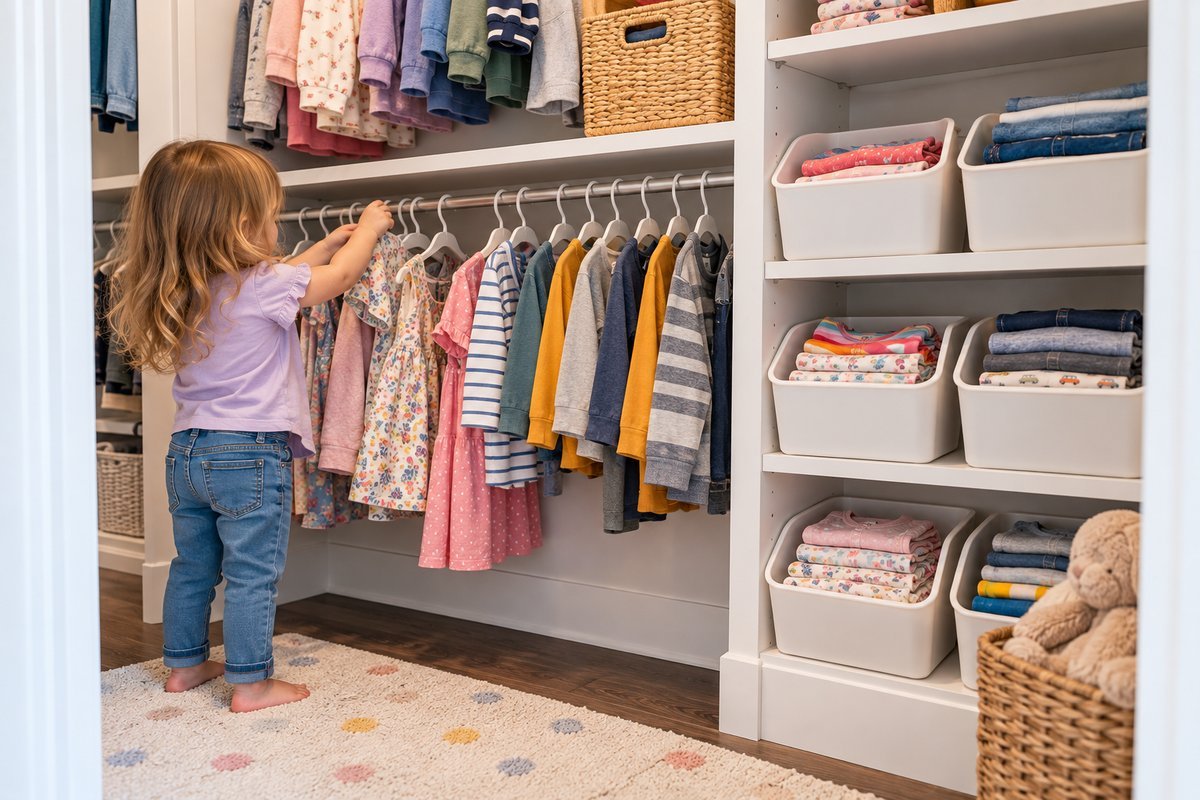
Good kids' closet organization ideas have a shorter shelf life than almost any other room in the house. What fits a three-year-old is wrong for a seven-year-old, and what worked for your first kid falls apart the moment a sibling starts pulling clothes off the rod to see what's underneath. Most organizing advice treats a kid's closet like a smaller version of an adult one. It isn't. The height changes, the mess tolerance changes, and the kid using it is supposed to eventually use it without your help.
Quick take
Adjustable double-hang (two rods, one above the other) rods beat fixed shelving for cost and longevity, since they move as your kid grows instead of getting replaced. Everything below elbow height should be something your kid can reach and put back, or the system only works when you're the one doing the putting away. Bins beat drawers for anyone under about seven, since a bin you can dump and refill is more forgiving than a drawer you have to slide and align. Budget for one system that lasts five-plus years rather than three systems you replace every eighteen months.
Budget option
A $30 to $50 pass with stackable bins, labels, and a low hook strip covers the basics for a toddler or elementary-age kid's closet.
Free tool
Not sure where to hang the rod or space the shelves in your own closet? Use the closet rod height and shelf spacing calculator to get exact numbers for your closet's width and height.
Free tool
Not sure what bin size fits your shelf? Use the storage bin size and fit calculator to check tote sizes against your garage, closet, pantry, or under-bed space before you buy.
Table of Contents
What makes a kids closet different from an adult one
An adult closet gets organized once and mostly stays that way, which is what makes a kids closet different. A kids closet gets reorganized every year or two, whether you plan for it or not, because the kid using it keeps growing. Rod height that's perfect for hanging up a toddler's shirts is unreachable two years later when they've grown into pants and jackets. A system built around folded onesies doesn't have anywhere to put a stack of school folders and a backpack.
The other real difference is who's doing the organizing. An adult closet only has to make sense to the adult who built it. A kid's closet has to make sense to a kid, which means low enough to reach, simple enough to use without instructions, and durable enough to survive being yanked, climbed on, and occasionally used as a fort.
Ideas by age, since one setup doesn't cover a kid's whole childhood
Toddler and preschool (roughly ages 1 to 5)
At this age, almost nothing needs to hang. Most toddler clothing is small enough to fold and stack in open bins, and a toddler can't reach a rod anyway. For this age, keep things simple: a low shelf or a stack of open bins at floor level for pajamas, onesies, and everyday outfits, sorted loosely by type rather than by precise category. A toddler won't sort five bins correctly, but they can usually manage two or three.
Keep the rod itself high, out of reach, for the handful of items that do need to hang, like a coat or a special-occasion outfit. That space is for you to manage, not them.
Elementary age (roughly 5 to 10)
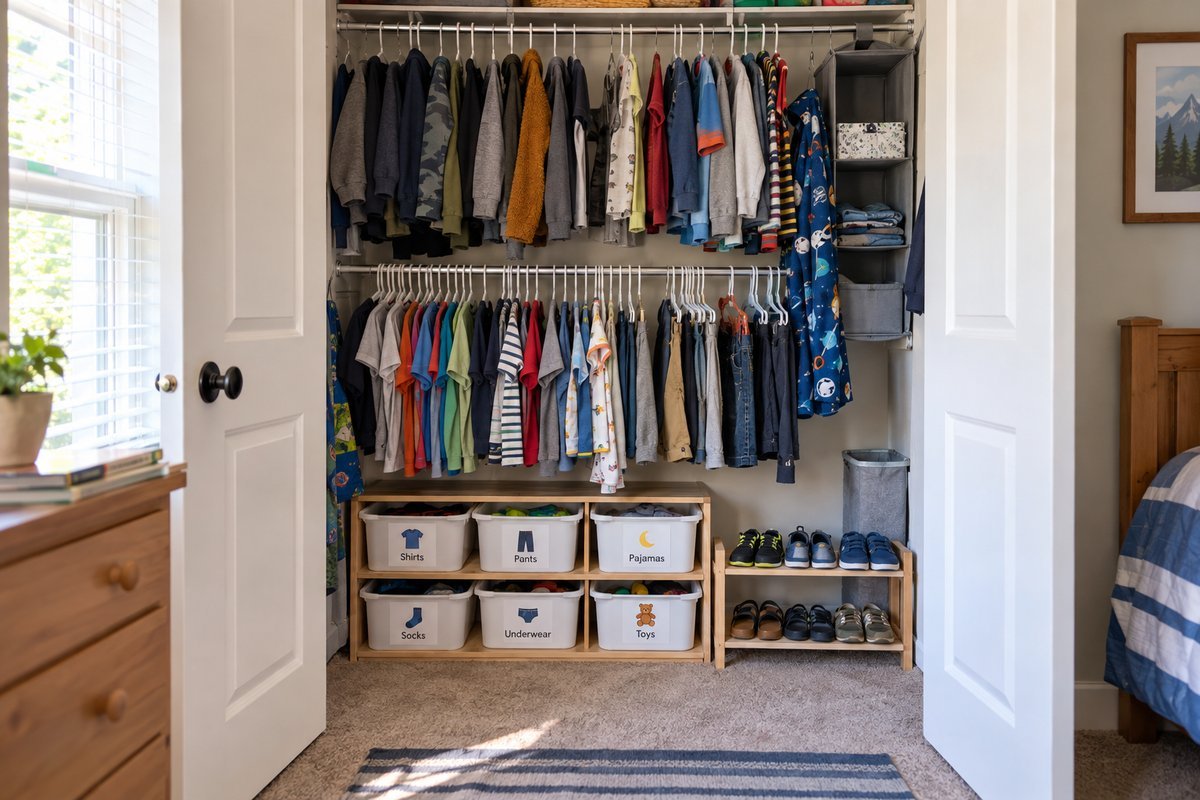
This is when a kid starts using their own closet, so an adjustable double-hang rod works well. A lower rod at a height they can reach holds everyday shirts and pants on hangers, and a second rod above it (or the same rod raised, if it's adjustable) holds longer items. Add a low shelf or a few cubbies for folded items, and a shoe bin they can use without your help.
This is also the age where labels start to matter. A kid who can read can match a label to a bin, which turns "clean up your closet" from a request that needs supervision into one they can do alone.
Tween and teen (roughly 10 and up)
By this point, the closet can look close to an adult setup, with a higher rod, folded storage on shelves or in drawers, and more items that need hanging space instead of bins. The main thing that still matters is giving them a system they'll keep using instead of abandoning, which usually means asking what's bothering them about the current setup before redoing it. A teenager who says their closet is a mess is often describing a specific problem, like "I can't find matching socks" or "there's nowhere for my backpack," not asking for a full redesign.
Adjustable systems that grow with your kid, compared
The core decision is whether to buy a system built to be reconfigured, or buy fixed shelving and just replace it as your kid outgrows it. Adjustable systems cost more upfront, but you get more value because they last through several growth stages instead of one.
| System | Typical cost | Grows with kid? | Best for |
|---|---|---|---|
| Fixed wire shelving (builder-grade) | $0 (usually already installed) | No, rod height is fixed | Renters not wanting to touch the existing closet |
| Adjustable track system (Elfa-style) | $150-$400 per closet | Yes, rods and shelves reposition on the track | Homeowners planning to keep the same closet through multiple age stages |
| Freestanding closet organizer | $40-$120 | Partially, shelves adjust but overall height doesn't | Renters wanting more structure without permanent changes |
| Stackable cube storage | $25-$80 per set | Yes, cubes can be added, removed, or relocated | Toddler and elementary-age open storage, especially in a shared room |
An adjustable track system is the closest thing to a one-time buy here. You reposition the rods and shelves as your kid grows instead of buying new furniture, and most track systems are designed to be moved to a different closet or a different house entirely if you relocate.
Storage that survives how kids use a closet
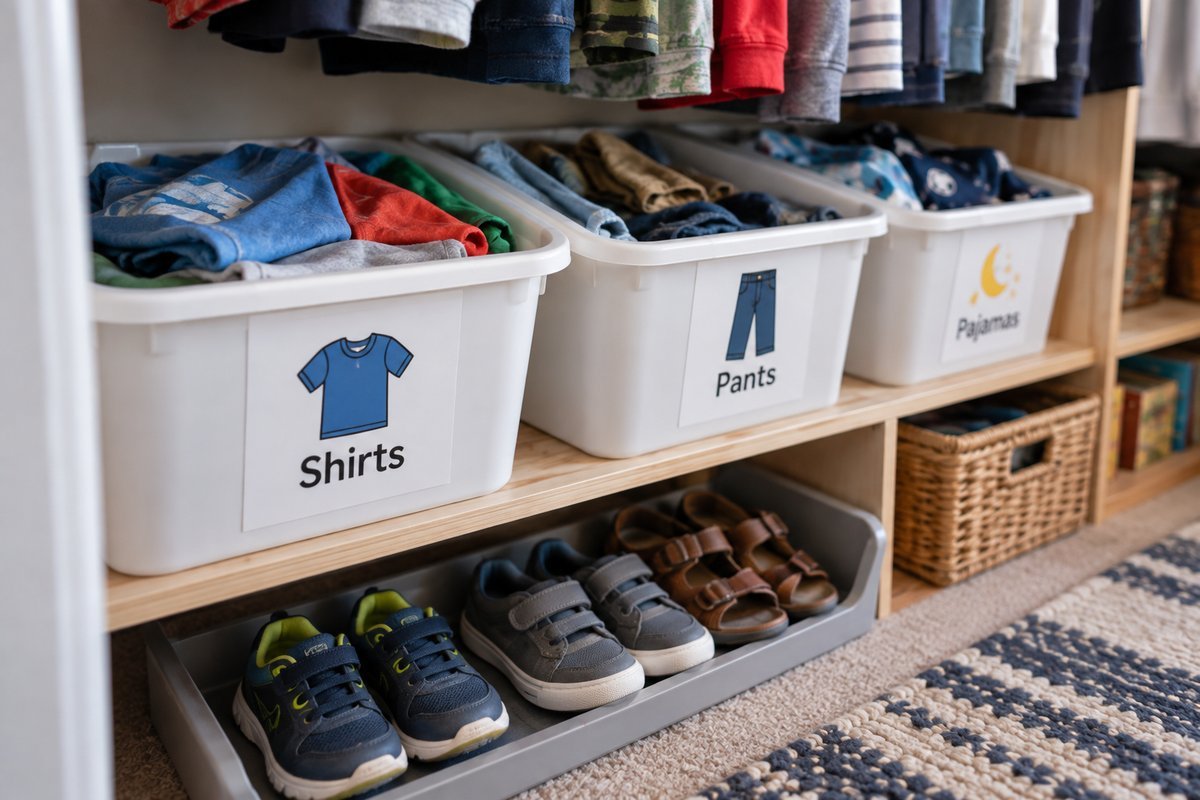
Bins beat drawers for younger kids because a bin only asks for one motion: dump it in, or pull the whole thing out. A drawer asks for two, opening it fully and then closing it again, and a rushed six-year-old skips the second one more often than not. Open bins without lids are more likely to get used correctly than bins with lids, since a lid is one more step between "I have clean laundry in my hands" and "it's put away."
Labels matter more here than in almost any other closet in the house. Picture labels work before a kid can read. Word labels work after. Either way, a labeled bin turns putting laundry away into matching, which is a task most kids can do well before they can organize from scratch.
Shoe storage that isn't a pile on the floor
Kids' shoes multiply fast between sneakers, boots, sandals, and whatever sport they're doing that season. A shoe pile on the closet floor is one of the most common problems to solve, because kids kick their shoes off wherever they land. A shallow bin or low shoe rack placed right at the closet entrance, rather than in the back, catches shoes before they end up on the room floor. Over-door shoe organizers work well for smaller kids' shoes but get outgrown once a kid moves into full-size sneakers, since the pockets are usually sized for younger feet.
Sharing a closet between siblings
A shared kids' closet works best when it's split visually, not just physically. Two kids sharing one rod and one shelf tend to end up with a mixed pile neither of them takes ownership of. Splitting the closet down the middle, even with something as simple as a strip of colored tape on the shelf edge, gives each kid a section that's theirs to manage. If the kids are different ages, expect to revisit the split every year or two, since the older kid's side will need more hanging space while the younger one still needs mostly bins.
What's worth buying, and what to skip
Worth paying for: an adjustable rod system if you're staying in the home for several years, sturdy bins with a shape that doesn't collapse when half-full, and a step stool kept inside or right next to the closet so kids can reach the upper section without climbing on shelving.
Skip: elaborate labeled compartment systems for a toddler who can't sort more than two or three categories yet, decorative hanging organizers that look good but hold less than a plain bin, and anything marketed as "kid-proof" that's just more expensive than the plain version of the same product.
Budget tiers
A kids closet doesn't need a full system replacement. At the low end, a $30 to $50 pass with stackable bins, a set of labels, and a low hook strip covers the basics for a toddler or elementary-age kid. A mid-range $100 to $200 pass adds a freestanding organizer or a small set of adjustable shelves. The $300-plus range is where a full adjustable track system lands, and it's the one tier worth planning around a multi-year timeline rather than buying reactively when the current setup stops working.
Common mistakes
Kids' closet setups that fail tend to fail the same ways. Building the closet around how you'd organize it, not how a kid your child's age will. Skipping the step stool, which turns the top shelf into dead storage. Using drawers for a kid too young to reliably close them. Buying a system sized for right now with no way to adjust it in a year, which means redoing the whole closet instead of just repositioning a rod.
Durability and safety
Kids' closets take more physical abuse than any other closet in the house, from clothes yanked off hangers to shelves used as a climbing aid to reach something on top. Anchor wall-mounted shelving and closet systems into studs (the vertical wood framing behind the drywall), not just drywall anchors. The combined weight of a kid pulling on a shelf and whatever's stored on it can pull a poorly anchored bracket straight out of the wall. The Consumer Product Safety Commission's anchoring guidance covers how to do this safely.
Avoid open wire shelving at a height where a young kid could stand on it to reach higher. Keep anything heavy, like bins of shoes or boots, on lower shelves rather than up top where a fall risk is worse.
Related reading
For the reach-in and walk-in layouts an adjustable kids system usually gets built into, see our closet organization ideas and small closet organization ideas guides.
FAQ
What age should a kid start organizing their own closet?
Most kids can start matching labeled bins around age four or five, and can manage a full low-shelf-and-rod system with occasional reminders by six or seven. Full independence, including putting away laundry without prompting, usually comes later and varies a lot by kid.
Should I buy an adjustable system for a toddler's closet?
If you're staying in the home long-term, yes, since the same track system that holds toddler bins now can hold an elementary-age rod setup later without buying new hardware. If you're renting or expect to move within a couple of years, a freestanding organizer is usually the better value.
How do I stop a kids closet from becoming a dumping ground?
Keep the system simpler than feels necessary. A closet with six labeled categories sounds thorough but usually collapses into one pile, while a closet with two or three broad categories is more likely to get used correctly.
What's the best kids closet system for a shared room?
In a shared room, start with a visual split: a clear boundary between each kid's section holds up better than one shared system both kids are supposed to maintain together. Stackable cube storage works especially well here since each kid can have their own cubes without needing a permanent wall-mounted split.
A closet built for an older kid or teen needs a different layout entirely. See these walk-in closet organization ideas for when there is finally room to hang things.