A mudroom locker bank does one thing a row of hooks can't: it gives every person in the house their own column of space, top to bottom. Backpacks stop landing on the floor and coats stop migrating to the coat closet three rooms away. Whether you build one from scratch or convert an existing nook, the same rule holds. The difference between a locker system that survives five years of daily use and one that's wobbly by winter comes down to a handful of decisions made before any wood gets cut.
This guide covers what matters when planning mudroom lockers, how the build process goes from measuring to finishing, layout options for different entryway shapes and budgets, and the mistakes that show up first when a locker bank is built too light or sized wrong for the people using it.
Quick take
- Locker width: 12 to 16 inches per person is the working range. Go narrower and coats crowd each other.
- Bench height: 17 to 19 inches, matched to a standard chair seat, not a bar-height perch.
- Anchoring: the whole bank ties into wall studs (the vertical wood framing behind the drywall), not just the base into the floor, or it racks forward under real use.
- Doors vs. open cubbies: open fronts get used correctly by kids. Doors look tidier but only if someone closes them.
Budget option
Under $400 covers a modular locker set or a bench plus hooks combo from a home center, assembled as is with no custom carpentry.
Table of Contents
What matters before you build
Most mudroom locker failures aren't design failures. They're structural ones. The bank looks right on day one and starts leaning, sagging, or pulling away from the wall within a season because it was never fastened to anything solid.
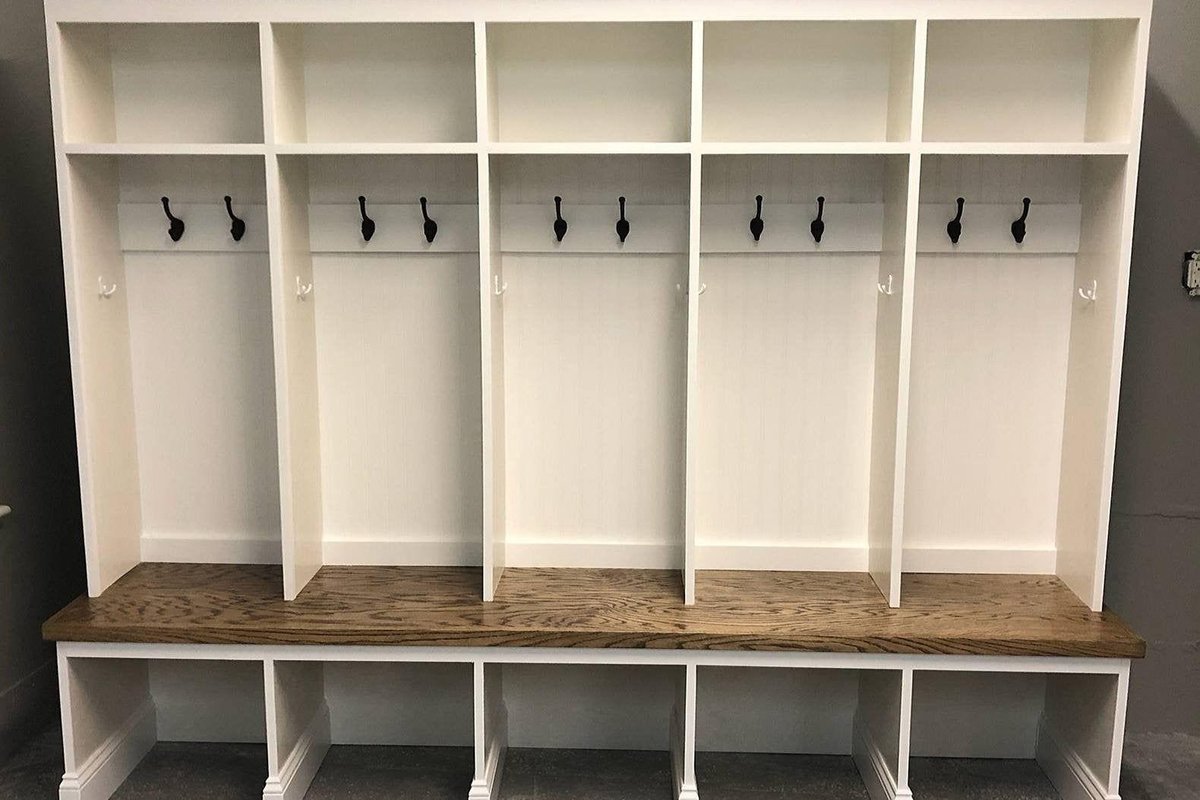
Anchor to studs, not just drywall. A locker bank loaded with wet boots, backpacks, and winter coats easily carries 150 to 300 pounds across its width. The base can sit on the floor, but the back of the unit needs to be screwed into wall studs at a minimum of two points, ideally three on anything wider than five feet. Drywall anchors alone aren't rated for this kind of sustained, repeated-impact load, and Kreg Tool's own mudroom locker build plans call out stud attachment as a non-negotiable step, not an optional upgrade.
Match the material to the abuse it'll take. Mudrooms see more moisture, grit, and scuffing than almost any other room in the house. Plywood with a hardwood veneer (a thin layer of real wood glued over a cheaper core) or MDF (medium-density fiberboard) with a durable paint finish both hold up better than particleboard. Particleboard (a cheap board made from pressed wood chips and glue) swells and its layers peel apart the first time a wet umbrella leans against it for a week.
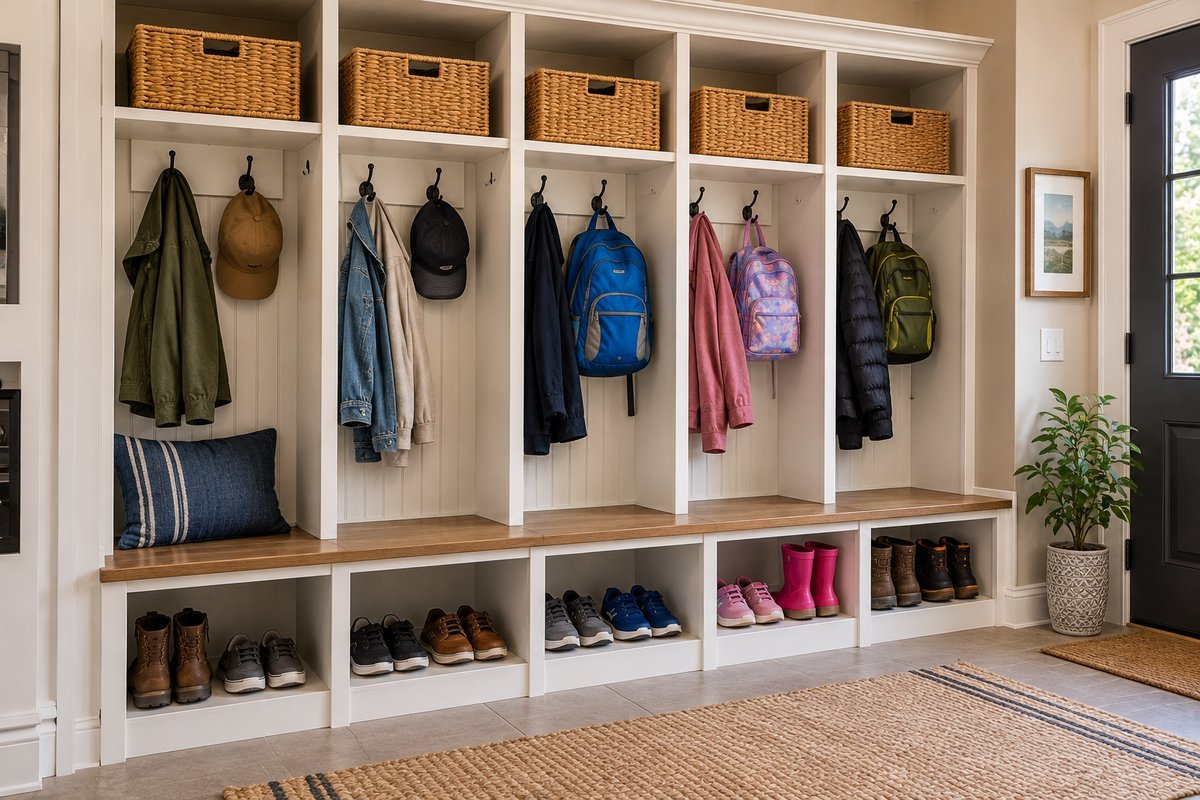
Plan for the people using it, not an idealized family. A locker sized for an adult's coat and boots is wrong for a six-year-old's backpack and rain boots. If the household has a mix of ages, either size the lower cubbies smaller and lower for kids, or accept that everyone gets a full-size column and the smaller kids just have extra room.
How the build goes, start to finish
- Measure the space and count the people. Multiply the number of household members by 12 to 16 inches to get a rough total width, then check that against the wall you have. Most entryways end up compromising somewhere in that range per person.
- Find and mark the studs across the full width of the planned bank, not just at the ends. This determines where the back cleats (strips of wood screwed to the wall to carry the cabinets) and ledger boards go before any cabinet carcasses are built or set in place.
- Build or order the carcasses. Whether it's site-built plywood boxes, assembled stock cabinets, or a modular kit, get all the individual sections in place and level before attaching them to each other or the wall.
- Fasten the bank to the wall studs first, then screw adjoining sections to each other through the sides. Attaching sections to each other before they're wall-anchored is how a whole bank can rack forward as one unit.
- Add the bench top last, once the base cabinets are square and secured, so the top can be scribed to fit against an uneven wall rather than leaving a gap.
- Install hooks, hardware, and any doors after finishing (paint, stain, or sealant) has fully cured, so hardware doesn't get gummed up or misaligned by a wet finish.
Mudroom locker layouts, by type
Locker banks generally fall into three approaches, and the right one depends on budget, how permanent the household wants the setup to be, and how much carpentry experience is on hand.
Built-in vs. stock vs. modular
Built-in (site-built): custom plywood or MDF carcasses built to the exact width of the space, painted or stained to match trim. This is the only option that uses 100% of an oddly-sized wall and looks like it was part of the original house, but it takes real carpentry time and isn't something that moves with you.
Stock cabinets: standard base and upper cabinets from a home center or cabinet maker, set side by side and topped with a bench. Faster than building from scratch and often cheaper than a full custom built-in, but the total width has to work out to a multiple of standard cabinet sizes, which sometimes leaves an awkward gap at one end.
Modular/freestanding: pre-built locker units (sold individually or as sets) that sit against the wall without being permanently attached to the house. These still need to be anchored for tip-over safety, but they can be added to, rearranged, or taken along when the household moves.
| Type | Typical cost | Fits odd widths? | Moves with you? |
|---|---|---|---|
| Built-in (site-built) | $800 to $3,500+ | Yes, custom-fit | No |
| Stock cabinets | $600 to $2,200 | Only in standard increments | Possible, with effort |
| Modular/freestanding | $250 to $1,200 | Rarely a perfect fit | Yes |
Sizing specs that matter
These numbers come up in almost every build, whether it's site-built or assembled from a kit:
- Locker width: 12 to 16 inches per column for adults. 10 to 12 inches works for younger kids' sections.
- Locker depth: 14 to 16 inches is enough for coats on a hook without the door or open front catching on sleeves. Go to 18 to 20 inches if the design includes a hanging rod rather than just hooks.
- Bench height: 17 to 19 inches, the same range as a dining chair, so it's comfortable to sit on to put on boots.
- Bench depth: 15 to 18 inches minimum for someone to sit on it, not just set things down.
- Upper cubby height: keep the bottom of upper storage cubbies at least 15 inches above the bench seat so there's headroom to sit upright.
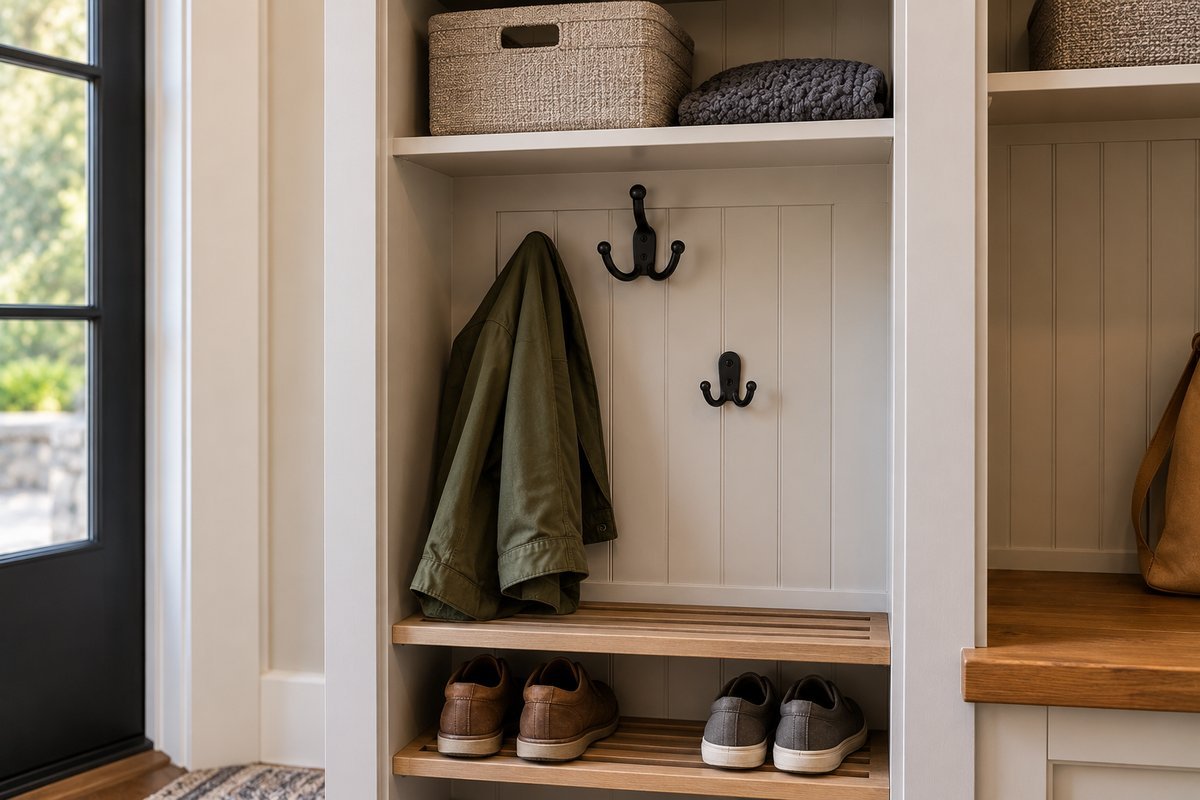
- Hook spacing: two hooks per person at different heights (roughly 48 and 60 inches from the floor) fit both a jacket and a bag without them tangling together.
What is worth buying
A handful of hardware choices make more difference than the cabinet material itself:
- Soft-close hinges on any locker doors, since mudroom doors get slammed by kids in a hurry more than doors anywhere else in the house.
- A washable bench cushion rather than a fixed upholstered top, since bench seats catch mud and wet gear directly.
- Slotted or slatted cubby bottoms for boot storage, so standing water drains instead of pooling under wet boots.
- Double-height hooks per person instead of a single hook, which is the single change that stops the most pile-up at the door.
Skip built-in electronics charging stations unless the household specifically wants one there. They add cost and wiring complexity to a piece of furniture that's mainly handling coats and shoes, and a simple power strip inside a cubby does the same job.
Budget tiers
Under $400: a modular locker set or a bench-plus-hooks combo from a home center, assembled as-is with no custom carpentry.
$400 to $1,200: stock cabinets from a home center or cabinet retailer, assembled into a bank with a site-built bench top connecting them.
$1,200 and up: a fully custom, site-built bank sized to the exact wall, usually painted to match the home's trim, with integrated bench seating and upper cabinets.
What to skip
Glass-front cabinet doors look sharp in photos and show every scuff and smudge within a month of real use. Fully enclosed lockers with no ventilation also trap moisture from wet gear, which is a fast track to a musty smell. Louvered doors or a gap at the top and bottom of an enclosed locker solve this without much extra cost.
How long a locker bank holds up
A properly anchored, well-built locker bank in solid wood or plywood with a durable finish holds up for 10 to 15 years of daily use with occasional touch-up paint. Particleboard versions or units that were never anchored to studs tend to show sagging shelves and loose joints within two to three years, well before the materials themselves would otherwise fail.
Common mistakes
- Skipping stud anchoring because the base looked stable enough on its own during a dry test-fit with nothing stored in it yet.
- Building lockers too narrow to save wall space, which just means coats get crammed and hooks get double-loaded anyway.
- No ventilation for wet gear, leading to a musty smell inside enclosed cubbies within the first wet season.
- One hook per person instead of two at different heights, the single most common reason mudroom hooks turn into a coat pile on the bench instead.
- Skipping the bench cushion budget and ending up with a bare plywood seat nobody wants to sit on to put on boots.
Storage ideas to pair with a locker bank
A locker bank handles coats, bags, and shoes, but a few add-ons close the remaining gaps that show up once the household starts using it every day.
- Labeled bins inside upper cubbies for gloves, hats, and other small items that would otherwise get shoved loose onto a shelf and lost within a week.
- A shallow shoe tray or slatted shelf at floor level, sized for the household's shoe count, since boots left loose on the floor next to a locker bank defeat the purpose of building one.
- A charging drawer or basket near the bench for phones and keys, kept separate from wet gear so electronics don't end up next to a dripping umbrella.
- A rotating seasonal bin, stored in one cubby and swapped twice a year, for gear that isn't needed daily (heavy winter gloves in summer, sunhats in winter) so it doesn't compete with everyday items for the same hooks and shelves.
- A small mirror mounted at the end of the bank, which sounds cosmetic but speeds up the out-the-door routine for households with kids checking their own coats and backpacks before leaving.
Renter-friendly locker ideas
Renters can get most of the locker-bank benefit without any built-in construction. A freestanding modular locker set placed against the wall, combined with an over-the-door hook rack for overflow, covers the two-height-hook and defined-storage-per-person goals without a single hole in drywall beyond what a picture-hanging strip can handle. For smaller entryways, the ideas in our coat closet organization guide and mudroom storage ideas article both cover renter-safe hook and shelving options that pair well with a freestanding locker unit.
If a mudroom or entry needs more than lockers alone, an under-sink storage setup nearby can absorb the overflow of cleaning supplies and boot care items that tend to migrate toward the entryway.
Frequently asked questions
How do you build mudroom lockers?
Measure the space and divide it into 12 to 16 inch columns per person, mark and anchor into wall studs. Build or assemble the cabinet sections, fasten the whole bank to the studs before joining sections together, then add the bench top and hardware last, after any paint or finish has cured.
How deep are mudroom lockers?
Most mudroom lockers run 14 to 16 inches deep for hook-only storage. Lockers built with a hanging rod instead of hooks need 18 to 20 inches of depth so coats clear the door when it closes.
How wide should mudroom lockers be?
12 to 16 inches per person is the standard range for adults. Sections built for younger kids can go as narrow as 10 to 12 inches.
How do you build lockers for a mudroom on a budget?
Stock cabinets from a home center, set side by side and topped with a site-built bench, cost less than a fully custom build while still allowing stud anchoring and real storage capacity.
Do mudroom lockers need doors?
No. Open cubbies get used correctly more consistently than doors, especially in households with kids, since there's nothing to remember to close. Doors help with a tidier look but only pay off if they get closed regularly.
What is the best height for a mudroom bench?
17 to 19 inches, matching a standard dining chair, with at least 15 inches of clearance above the seat before any upper cubby starts.