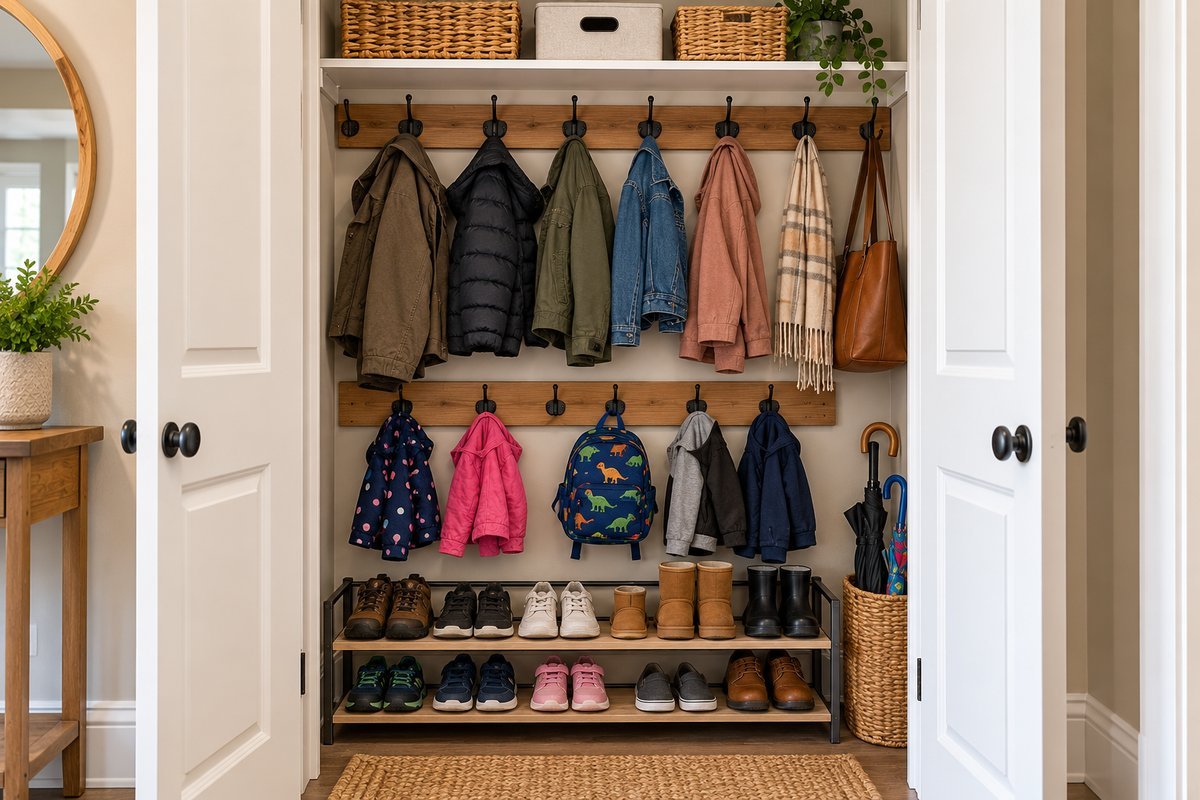
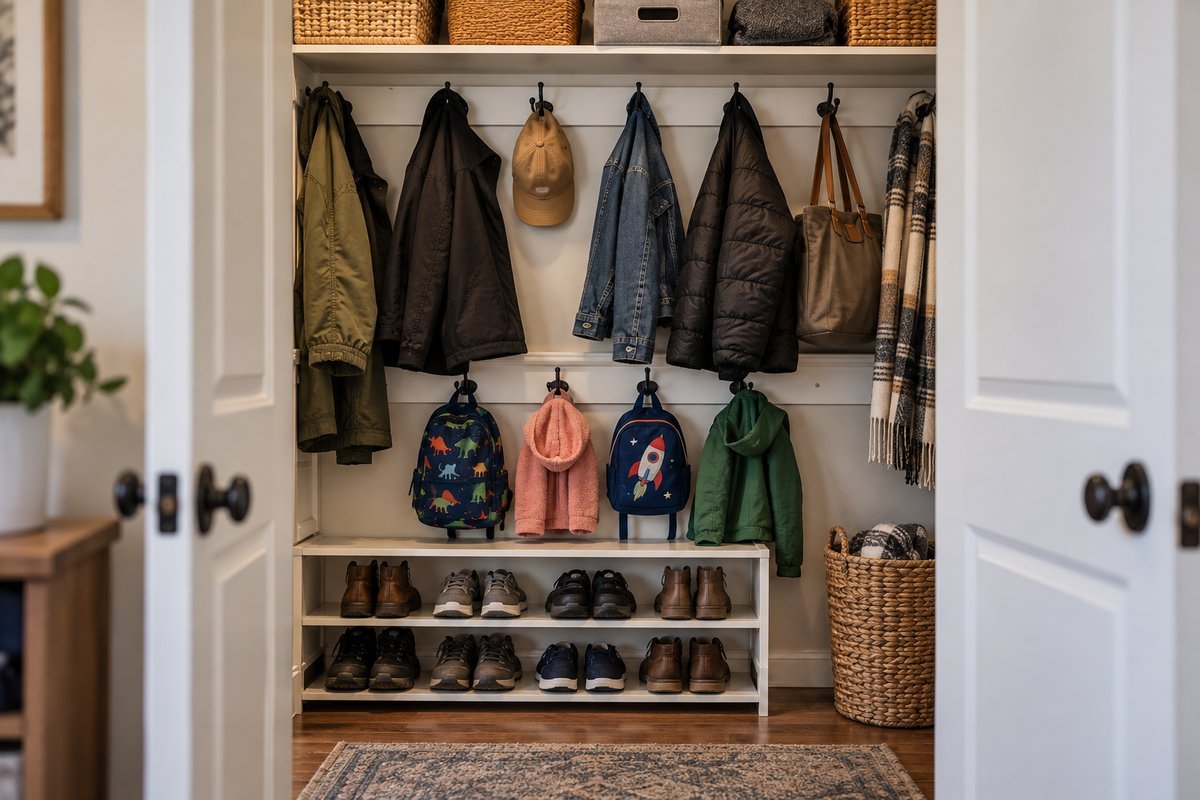
Budget option
Under $40 covers a multi-hook rail, a shoe tray, and a couple of fabric bins, enough to fix a coat closet's two biggest failure points without touching the existing rod or shelf.
Free tool
Not sure what bin size fits your shelf? Use the storage bin size and fit calculator to check tote sizes against your garage, closet, pantry, or under-bed space before you buy.
Table of Contents
A coat closet gets more daily traffic than almost any other storage spot in the house, and it usually gets the least thought. It's the first thing guests see and the last thing anyone organizes on purpose. Most coat closets accumulate their system by accident, one dropped mitten and one extra hook at a time.
These coat closet organization ideas cover how to set one up properly: what to sort out before you buy anything, hooks versus a rod, shoe and boot storage that doesn't turn into a pile, mounting hardware that holds, and what to skip entirely.
What makes a coat closet different from a regular closet
A bedroom closet holds clothes you choose from occasionally. A coat closet holds the handful of things every person in the house touches every single day on the way out the door. It has to survive being used by someone in a hurry, holding a phone, wrangling a kid, or juggling grocery bags. That changes the design priorities. Speed and one-handed access matter more than maximizing every cubic inch, and durability under repeated fast use matters more than a polished look.
It also tends to be smaller and shallower than a bedroom closet. It's often the one closet in the house with no dedicated shelving system at all, just a single rod and a shelf, installed once when the house was built and never touched since.
What to sort out before you organize anything
Before buying a single hook or bin, pull everything out and sort it into four groups: things worn daily (the coats, shoes, and bags in rotation), things worn seasonally (heavy winter coats in July, rain gear in a drought), things that don't belong in this closet at all (sports gear, guest linens), and things to donate. A coat closet project that skips this step almost always fails within a month, because the new bins just get refilled with the same overflow that caused the mess in the first place.
Seasonal items are the easiest win: move anything out of rotation to a bedroom closet, an attic bin, or a garage shelf, and the coat closet immediately has 30-40% more usable space without buying anything.
Coat closet organization ideas by layout
The right system depends heavily on the closet's shape.
Reach-in with bifold doors is the most common layout in older homes. The doors themselves eat into usable width when open, so anything mounted right inside the door frame needs to clear the door's swing. A single rod plus one open shelf above is usually already there. The fix is almost always adding hooks below the rod, not replacing the rod.
Reach-in with no doors (an open nook, common in mudrooms and back entries) can go heavier on wall-mounted systems since there's no door swing to clear. This is the best layout for a full hook rail plus a bench, since everything is visible and grabbable without opening anything.
A shallow closet with only a shelf, no rod (common in smaller homes) works best converted to all hooks. A rod in a shallow space usually can't hold hangers at a usable angle anyway.
Hooks, a rod, or both: which to use
A rod holds more coats per linear foot, but it's slower: hanging and unhanging a coat takes both hands and a few seconds most people don't have on the way out the door. Hooks are faster (a single motion drops or grabs a coat), but they take up more wall space per item and don't work well for anything that needs to hang flat, like a suit jacket or a dress coat.
The households that keep a coat closet organized long-term almost always use both: a rod for anything worn occasionally or that needs to hang properly, and a row of hooks at a lower, easier height for the coats used every single day. Hooks-only systems tend to win for households with kids, since a hook doesn't require the coordination a hanger does.
Coat closet storage comparison at a glance
Shoe and boot storage that doesn't become a pile
A shoe pile forms for one simple reason: taking a shoe off is faster than putting it away properly, so any system that requires more than one motion loses. A shallow shoe shelf that shoes can be kicked toward, an open cubby, or a low bin all beat a tall rack that requires bending down and placing each shoe individually, even though the rack fits more pairs on paper.
For boots specifically, a boot tray earns its space in almost every climate that gets rain or snow: it catches drips and salt residue that would otherwise sit directly on the closet floor. A tray under a shoe shelf, rather than a separate one on the floor, keeps the footprint the same.
Small accessories: hats, gloves, scarves, umbrellas
These are the items that scatter first because there's rarely a designated spot for them. A shallow shelf-top basket, one per household member, keeps a family's gloves and hats from becoming a communal pile that nobody can find a matching pair in. An umbrella stand or a single deep hook by the door works better than trying to fold umbrellas into a bin. Wet umbrellas need to dry, not sit folded against dry coats.
Mounting hooks and rods so they hold
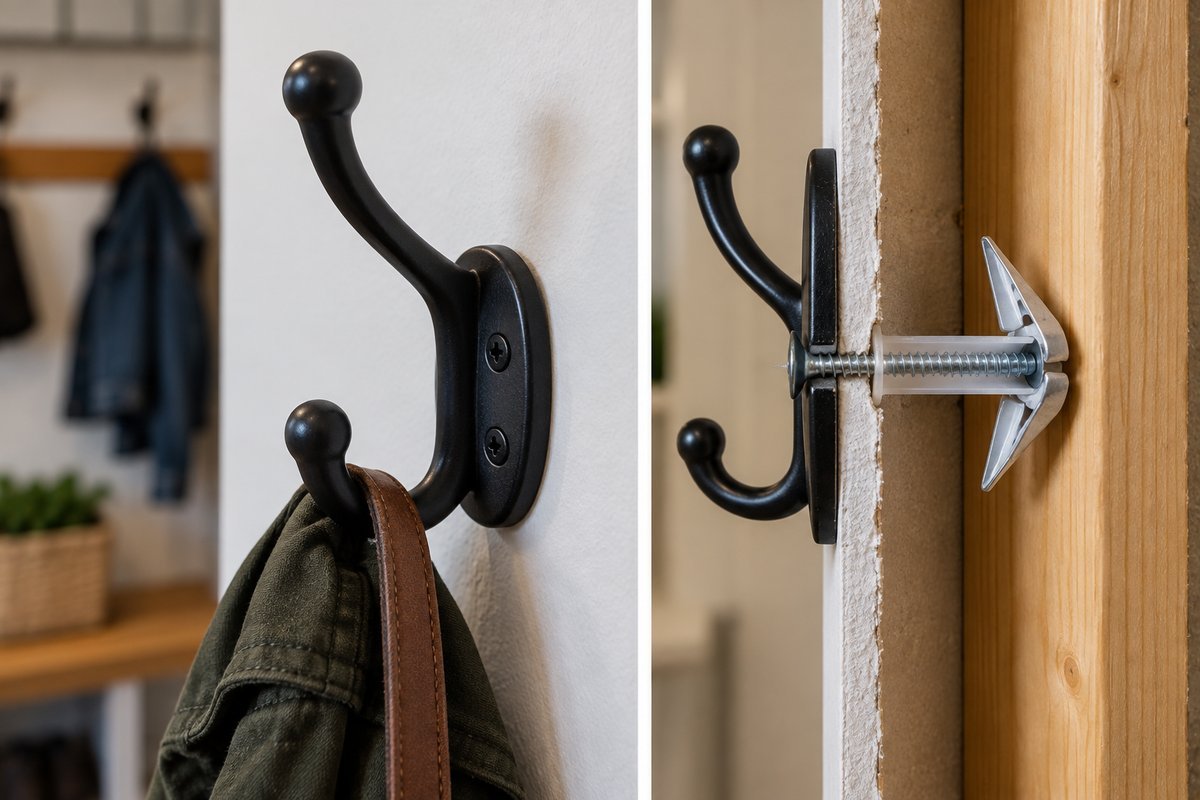
A coat closet setup only holds up long-term if the hardware does. A fully loaded winter coat, especially a kid's, easily weighs 3-5 lbs, and a hook that pulls out of drywall within a season is the single most common reason these projects get abandoned.
Screwing directly into a wall stud is the strongest option and needs no special hardware. A stud finder and the right screws are enough. Where there's no stud in the right spot, the hardware matters: a toggle-style wall anchor (the folding or snap-toggle kind, not a basic plastic sleeve) can rate up to roughly 200+ lbs depending on the model. That is more than enough for hooks and light shelving. As a rule of thumb from DIY Playbook's anchor guide, anything over about 5 lbs mounted to drywall is worth anchoring properly rather than trusting an adhesive strip or a bare screw in plaster.
Budget tiers for a coat closet overhaul
A tight budget (under $40) covers a multi-hook rail, a shoe tray, and a couple of fabric bins, enough to fix the two biggest failure points (no dedicated hook height, no shoe containment) without touching the existing rod or shelf. A mid-range budget ($40-120) adds a proper shoe shelf or stackable cubby system and matched bins for accessories. A full overhaul ($120+) usually means a wall-mounted mudroom-style hook-and-shelf unit or a closet system kit that replaces the single rod-and-shelf setup entirely, worth it mainly for closets that get heavy daily use from more than two or three people.
What to skip
Skip a floor-to-ceiling shelving system in a coat closet unless it also holds storage that isn't coat-related. The space above head height is the least-used part of a coat closet. Building it out first, before fixing the daily-use zone at hook and shelf height, is a common way these projects run over budget without solving the real problem. Skip decorative baskets that don't have a flat, sturdy bottom for shoes. They look better in a photo than they perform after a month of real use.
Common mistakes that undo the system
The most common failure is designing for the "ideal" version of the household rather than the real one. A beautiful hanging system with matching wooden hangers doesn't survive a household where coats get thrown, not hung. The second is putting hooks at one universal height rather than at a height that matches who uses that hook. A hook a 6-year-old can't reach gets ignored, and the coat ends up on the floor instead. The third is skipping the boot tray or shoe containment step because it feels like the least interesting part of the project, but it is also the part that prevents the floor from looking permanently messy.
Renter-friendly options (no drilling)
Command-brand adhesive hooks rated for the coat's weight (check the rated capacity, not just "hook shaped") work for lighter household members' coats and bags without any wall damage. A freestanding coat rack or a shoe bench that isn't wall-mounted at all sidesteps the anchor question entirely and moves with a tenant at move-out. Tension rods (the kind used in a doorway) can also add a second hanging rod inside a closet without a single screw, though they hold less weight reliably than a properly mounted rod.
What's the best way to organize a small coat closet?
Start with hooks instead of a rod wherever possible. A small coat closet built around hooks plus one shallow shoe shelf almost always outperforms trying to cram a full rod-and-shelf system into a tight space.
How high should coat closet hooks be?
Adult hooks typically sit around 60-66 inches from the floor, matching standard closet rod height. For household members who need to reach hooks independently, like kids, a second, lower row around 36-42 inches works better than one universal height.
What can I use instead of a coat closet if I don't have one?
A wall-mounted hook rail with a shelf above it, installed in an entryway or hallway, does the same job as a coat closet. This is the setup a mudroom uses when there's no closet available at all.
Do I need a shoe tray if I already have a shelf?
Only if the shelf sits directly above flooring that shouldn't get wet or salt-stained. A tray or a simple rubber liner under the shelf protects the floor without needing a separate rack.
How do I stop coats from ending up on the floor instead of on hooks?
Almost always a height or capacity problem, not a habit problem. Add a lower hook for whoever keeps missing the existing ones, or add one more hook if the current ones are already full when the coat gets dropped.