
What goes under the sink depends on the zone, not just the room. Under a kitchen sink, the open floor holds the trash can and recycling bin, while the narrow strip around the pipes takes dish soap backstock and sink care supplies. Under a bathroom sink, the open floor holds toiletry and cleaning supply backstock, while the space around the pipes works for hair tools and small stacking bins.
- Kitchen, open floor: trash can, recycling bin, compost bin if you keep one
- Kitchen, around the pipes: dish soap and sponge backstock, trash bag rolls, a small bin for sink drain supplies
- Bathroom, open floor: toiletry backstock, cleaning supplies, extra toilet paper
- Bathroom, around the pipes: hair tools, small stacking bins, cleaning rags
Most under-sink storage ideas online show a single tension rod holding two spray bottles and call it done. The real cabinet under most sinks holds a trash can, a recycling bin, a plunger, six half-used cleaning products, a box of trash bags, and a pipe running right through the middle of the usable space. This covers under-sink storage ideas for kitchen and bathroom cabinets by what is in there, what is worth buying, and what most people regret within a few months.
The right system still depends on which sink it is. A kitchen cabinet has to work around a garbage disposal and a trash pull-out, with plumbing that eats into a third of the usable depth. A bathroom cabinet is usually shallower and has less plumbing in the way, but fills up fast with hair tools and backstock that has nowhere else to live. The fixes below apply to both, but the product picks differ by zone.
Budget option
An under-sink liner or tray is the least exciting item on this list and the one people regret skipping most. It is cheap, and it protects the cabinet floor from every drip and leak.
Table of Contents
What matters before you buy anything
Before adding a single bin, measure the cabinet three times: width at the front, width at the back (it is almost always narrower because of the plumbing), and height from the cabinet floor to the underside of the sink basin at its lowest point. That last number is the one people skip, and it is the reason so many risers and stacking shelves get returned. A riser that is an inch too tall will not close the cabinet door.
Take a second measurement around the pipe: how far it sits from the back wall and from each side. Every organizer on this list either straddles the pipe, sits beside it, or gets cut to fit around it, and none of that works without knowing the clearance first.
Pull everything out and sort it into three piles before buying anything: things used weekly (dish soap, sponge, daily cleaner), things used monthly (specialty cleaners, extra trash bags), and things that do not belong under a sink at all. That third pile is usually bigger than expected. Under-sink cabinets are damp, warm, and hard to see into, which makes them a bad home for paper products, appliance manuals, and anything that should not get splashed. Keeping that one rule in mind up front prevents most early failures.
How to organize under the sink, start to finish
- Empty the entire cabinet and wipe it out. Check for any water damage or soft spots in the cabinet floor while it is empty. This is the only time most people ever look closely at that surface.
- Measure width, depth, height to the basin, and pipe clearance on all sides.
- Sort contents into keep, relocate, and toss. Expired cleaning products and dried-out sponges are more common under sinks than almost anywhere else in the house.
- Choose a base layer: a liner, a shallow tray, or both. This protects the cabinet floor from drips and makes future cleanups faster.
- Add vertical storage first (risers, tension rods, door-mounted racks) since these use space that would otherwise sit empty above the pipe.
- Add pull-out or sliding storage for anything used daily, so it does not require kneeling and reaching to the back.
- Label bins that are not clear, especially anything holding cleaning chemicals, and keep those away from anything a child or pet could reach if the cabinet does not lock.
Under-sink storage ideas by cabinet type
Kitchen sink storage ideas
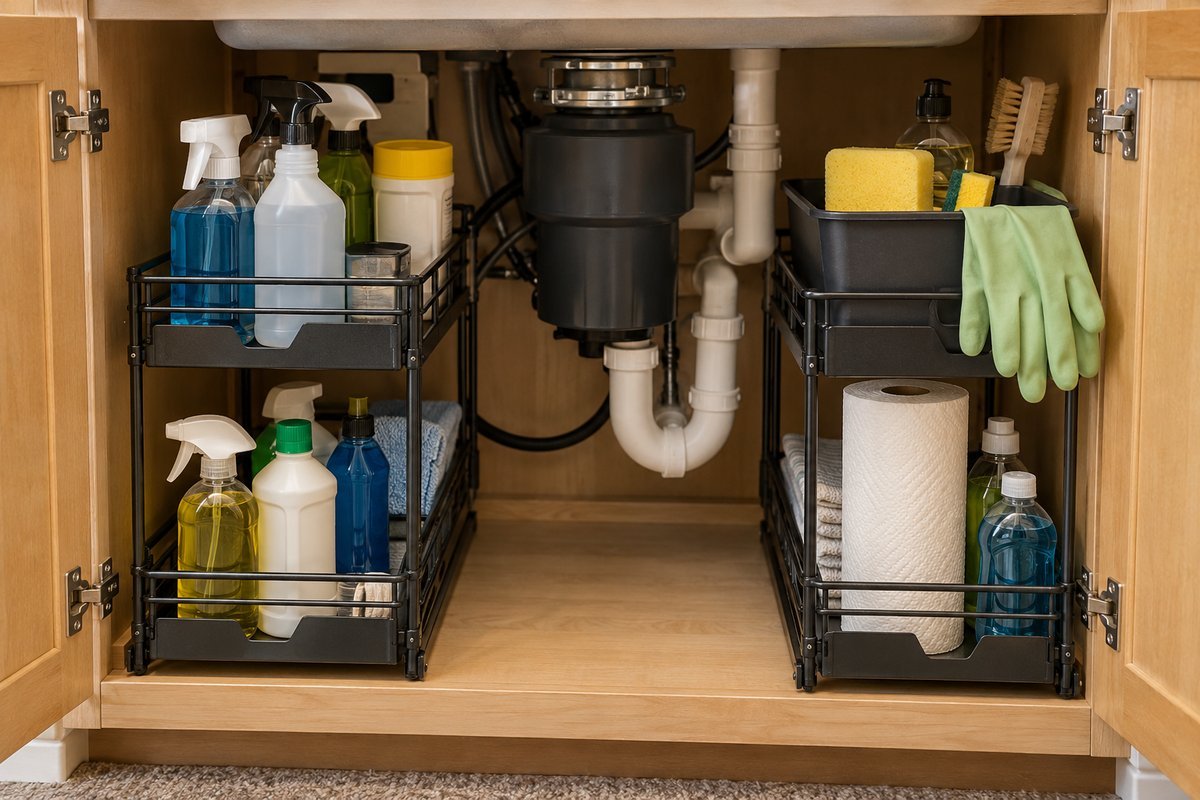
Kitchen cabinets almost always lose depth to a garbage disposal housing and a trash pull-out. A two-tier sliding organizer that straddles the pipe works better here than a single flat shelf, because it uses the height on both sides of the disposal without needing a continuous surface. A slim pull-out caddy mounted to the inside of the door is the other high-value addition in a kitchen cabinet. It holds the sponge, dish brush, and gloves that get used at the sink itself, not stored away from it.
Trash and recycling pull-outs are worth the cost if the cabinet is wide enough to support one, since they solve the single biggest space problem in a kitchen sink cabinet in one step. In a narrow cabinet, a slimmer single-bin pull-out on one side, paired with a stacking riser on the other, uses the space more efficiently than trying to fit a double bin that will not clear the pipe.
Bathroom sink storage ideas
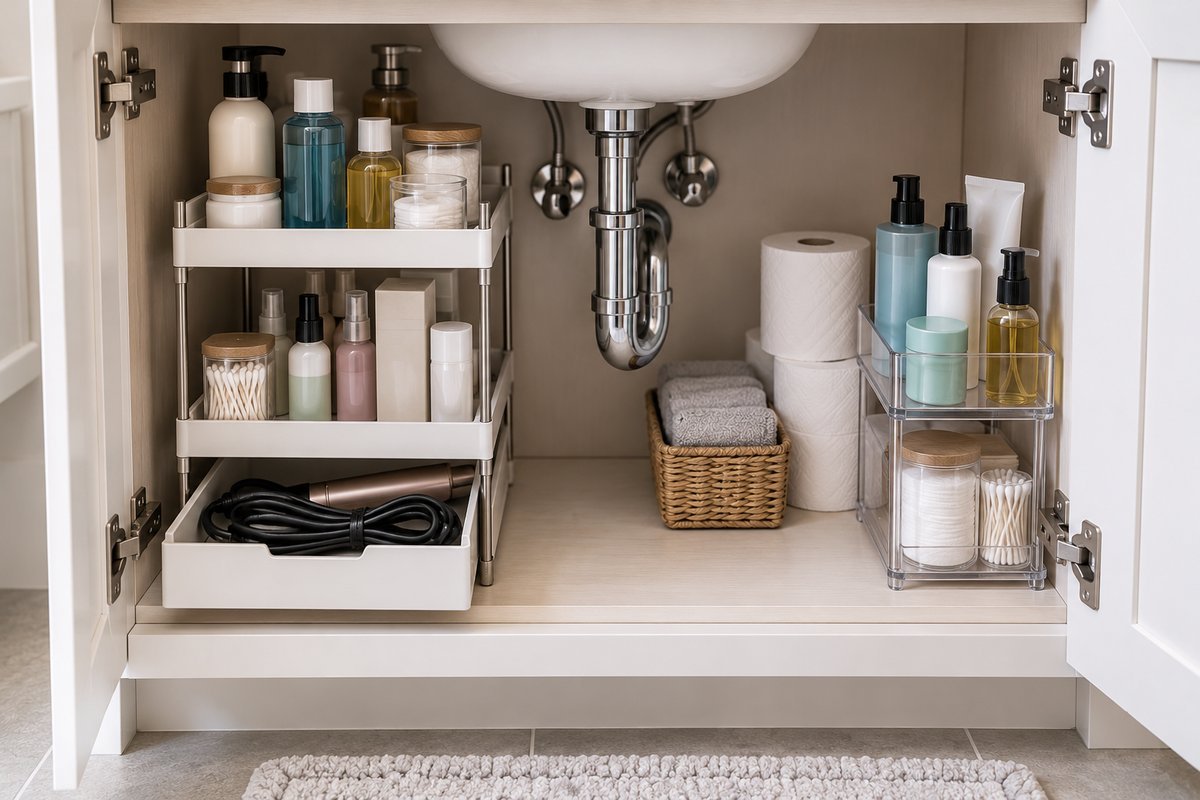
Bathroom cabinets are usually shallower and have less plumbing intrusion, which makes stacking risers and drawer-style organizers a better fit than the sliding systems built for kitchens. A two- or three-tier stackable organizer works well for backstock toiletries, since bathroom cabinets tend to hold more small, similarly shaped items (bottles, boxes, spare rolls) than kitchen cabinets do.
A shallow pull-out drawer mounted just inside the cabinet floor is worth adding if hair tools live under the sink. A flat-iron or curling iron left loose in a cabinet is both a tripping hazard for other items and a burn risk if it has not fully cooled. Turntables (lazy Susans) work better in bathroom cabinets than kitchen ones, since there is usually more open floor space to rotate on and fewer pipes interrupting the turn radius.
Which system fits which cabinet
| Cabinet situation | Best-fit system |
|---|---|
| Kitchen, garbage disposal in the way | Two-tier sliding organizer that straddles the pipe |
| Kitchen, wide cabinet | Trash or recycling pull-out |
| Kitchen, narrow cabinet | Single-bin pull-out plus a stacking riser |
| Bathroom, mostly backstock toiletries | Stackable multi-tier organizer |
| Bathroom, hair tools stored loose | Shallow pull-out drawer |
| Either, minimal pipe clearance | Adjustable-width expanding organizer |
| Rental, no drilling allowed | Tension rods plus freestanding bins |
What is worth buying
A sliding two-tier organizer earns its cost the fastest of anything on this list, since it turns one flat surface into two usable ones without permanent installation. Look for adjustable width, since a fixed-width organizer that does not account for the pipe will either not fit or will waste several inches of usable space on one side.
An under-sink liner or tray is the least exciting item here and the one people regret skipping most often. Cabinet floors under a sink take the brunt of every slow leak, every dripped bottle, and every bit of splash from cleaning. A tray that lifts out for rinsing turns a periodic deep clean into a five-minute job instead of an afternoon of scrubbing swollen particleboard (a cheap board made from pressed wood chips and glue).
A door-mounted rack is worth adding in almost any cabinet, kitchen or bathroom, since it claims space that would otherwise sit empty. The only caution is depth: measure how far the door swings before it clears the cabinet frame, since an over-deep rack can prevent the door from closing.
Working around pipes and a garbage disposal
Most under-sink storage fails for one reason: it was bought to fit the cabinet's outer dimensions and not the clear space around the plumbing. An adjustable or expandable organizer solves this by design, since the width can be set after the pipe is accounted for rather than guessed at from a box's stated dimensions.
For a garbage disposal specifically, look for organizers described as straddling or bridging, since these are built with a gap or an adjustable center section rather than a single flat span. This one choice fixes most failed setups built around a disposal. A flat shelf forced over a disposal housing will either not sit level or will crack under weight over time.
If the plumbing runs unusually close to one side of the cabinet, it is often more effective to give up on a full-width solution entirely and use the two sides independently rather than one product trying to span both. Put a slim caddy or turntable on the narrow side, and a full riser or bin on the wider side.
Storage for cleaning supplies, by category
- Daily-use items (dish soap refill, sponge, gloves): door-mounted caddy or a bin on the front edge of the top tier, closest to the door.
- Sprays and bottles: a lazy Susan (a spinning tray) or turntable keeps labels visible without needing to move other bottles to read them.
- Trash bags and liners: a slim vertical bin or a hanging file-style organizer keeps rolled boxes from collapsing into a pile.
- Rags and cloths: a small bin with dividers, kept away from any chemical storage to avoid cross-contamination.
- Backstock and bulk: the back of the cabinet, behind the pipe, is the right spot for anything reached for only monthly, since it is the least accessible area.
Budget-friendly under-sink storage ideas, by tier
Under $15: Tension rods positioned a few inches below the sink basin to hang spray bottles by their trigger handles. A dollar-store lazy Susan for the flat area beside the pipe. Wire or plastic risers from a discount store to double one shelf into two.
$15 to $40: An adjustable two-tier sliding organizer sized to the cabinet's actual clear width. A door-mounted over-the-door caddy rated for the door's thickness. A lift-out liner tray sized to the cabinet floor.
$40 and up: A soft-close pull-out trash and recycling system sized to the cabinet opening. A custom-cut shelf insert built around the specific pipe layout. A full slide-out drawer system replacing the fixed cabinet floor.
There is rarely a reason to spend at the top tier for a bathroom cabinet, since the $15 to $40 range covers nearly every bathroom use case. The top tier earns its cost mainly in a kitchen cabinet doing double duty for trash, recycling, and cleaning supplies at once.
What we would skip
Fixed-width shelf risers that are not adjustable are the most commonly returned item in this category, and the return rate tracks directly with people skipping the pipe-clearance measurement. Skip anything advertised as a universal fit unless it specifically states an adjustable range that covers the cabinet's actual clearance.
Fabric or cardboard bins are also worth skipping here specifically, even though they work well in a closet or pantry. The combination of dampness, occasional drips, and cleaning chemical fumes breaks fabric and cardboard down faster under a sink than almost anywhere else storage products get used.
Adhesive hooks and racks rated for light duty only are a common source of failure, since anything holding a full spray bottle or a heavier scrub brush is closer to their weight limit than the packaging suggests. A hook rated for two pounds that is asked to hold a full 32-ounce bottle is a return, not a repair, waiting to happen. Avoiding these three traps rules out most setups that fail within the first year.
How long an under-sink system holds up
A well-fitted sliding organizer or pull-out system should last as long as the cabinet itself, since there is nothing in normal use that degrades a properly sized metal or coated-wire unit. The failure point is almost always fit, not durability: a system chosen without measuring the pipe clearance gets removed within the first few months, not because it broke, but because it never worked in that specific cabinet.
Liners and trays are the one component worth replacing on a schedule rather than waiting for failure. A liner that has caught a slow drip for months can hide water damage to the cabinet floor underneath it. Lifting it out every few months for a look, not just a wipe, catches problems while they are still a five-dollar liner replacement instead of a cabinet repair. That one habit is what separates a setup that lasts years from one that gets redone every season.
Common under-sink storage mistakes
Buying a system based on the cabinet's outer width instead of the clear width around the pipe is the single most common mistake, and it is the direct cause of most of the returns and abandoned organizers in this category.
Storing anything paper (extra sponges in cardboard packaging, cleaning wipe refill boxes, appliance manuals) directly against the cabinet floor is a close second. Under-sink cabinets are one of the most humid spots in a kitchen or bathroom, and paper products absorb that moisture long before it becomes visible as damage.
Mixing chemical storage with food-adjacent items in a kitchen cabinet is a smaller but real risk, particularly when a cleaning spray sits next to something like a pet food scoop or a produce bag stash. Keeping a clear physical divider, even just a second bin, between chemicals and anything else reduces this risk at no real cost. The National Capital Poison Center also recommends keeping household chemicals in their original, labeled containers, which matters most in a crowded under-sink cabinet where bottles get moved around often.
Renter-friendly under-sink storage ideas
Tension rods require no drilling and hold spray bottles by the trigger, which is often the single highest-impact renter-friendly change available under a sink. A freestanding two-tier organizer (not a mounted one) delivers most of the benefit of a sliding system without any hardware, at the cost of slightly less stability if the cabinet gets bumped often.
Command-brand or similar removable-adhesive hooks work for lightweight items only, rags and lightweight caddies, not full bottles, and should be tested on an inside corner of the cabinet first, since some cabinet finishes react differently to adhesive than expected.
A lift-out liner is fully renter-friendly on its own and is worth adding even in a rental specifically because it protects a cabinet floor that is not the renter's to repair if it takes water damage over time. For more small-space storage ideas like this one, see our Small-Space & Laundry Storage hub.
The same shallow-shelf thinking applies one room over: see these linen closet organization ideas for getting the most out of another notoriously narrow space.
Frequently asked questions
What is the best way to organize under a sink?
Start by measuring the pipe clearance, not just the cabinet's outer dimensions, then add vertical storage (risers or a door caddy) before adding pull-out storage for daily items. Most failed under-sink systems fail because they were sized to the cabinet, not the usable space around the plumbing.
How do you organize under a kitchen sink with a garbage disposal?
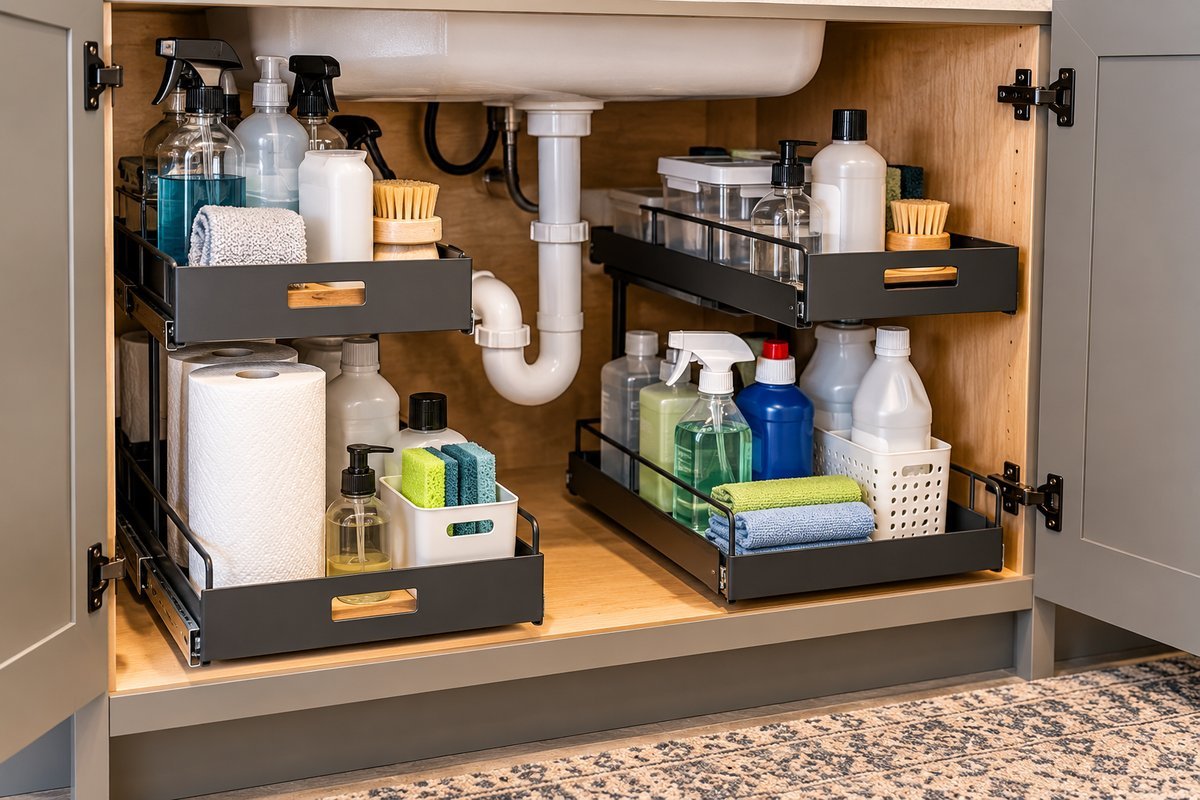
Use a two-tier sliding organizer built to straddle or bridge the disposal housing rather than a single flat shelf. Add a door-mounted caddy for daily-use items like the sponge and dish soap so they are not competing for space with cleaning supplies.
What should you not store under the sink?
Paper products, appliance manuals, and anything that should not get damp do not belong under a sink, since the space is one of the most humid spots in most kitchens and bathrooms. Cleaning chemicals should also be kept out of a cabinet a small child or pet can access unless it has a working lock.
How often should under-sink storage be cleaned out?
Every three to four months for a full empty-and-check, since that is often enough to catch expired products and any early water damage before it becomes serious. Wipe down a liner or tray monthly if the cabinet sees daily use.