
Most garages have a full ceiling of open space doing nothing, and most garage organization advice mentions it in a single paragraph before moving on to wall shelving. That undersells it. A garage ceiling can hold more than a wall of cabinets once it's done right, but it's also the one category where getting the install wrong has real consequences. A rack that lets go overhead is a different kind of problem than a shelf that sags.
This covers what a garage ceiling storage rack attaches to, fixed platforms versus motorized lifts and what each costs, the clearance and weight-rating details that most lists skip, and which of the popular options are worth skipping.
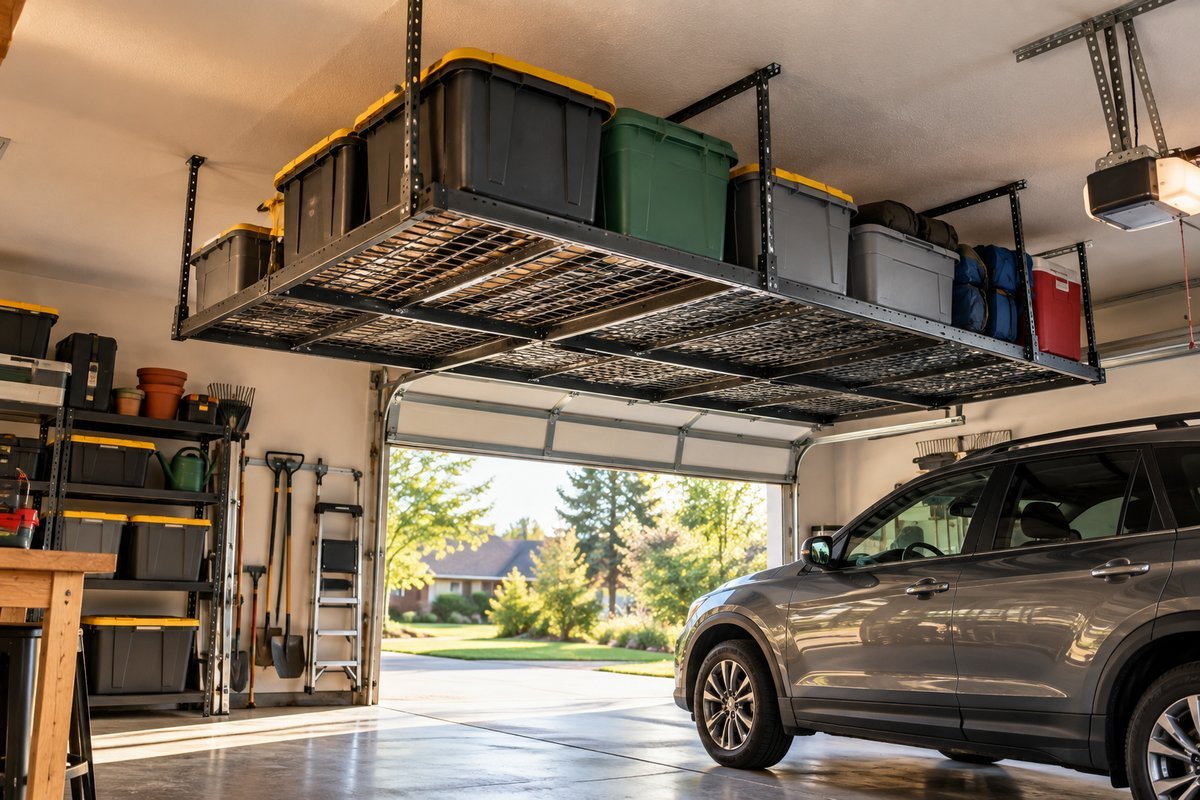
A garage ceiling rack has to anchor into the joists or trusses, never drywall alone, and it needs enough drop clearance to miss the garage door track, the opener rail, and the car below it. A basic fixed platform runs $100 to $250 and holds items you only touch a few times a year. A motorized lift costs several times more but lowers heavy items to shoulder height instead of requiring a ladder, which matters more than the price difference once anything heavy is involved.
Budget option
Under $50 covers a single specialty hoist for one bulky item, like a bike or a kayak, rather than a full overhead platform.
Free tool
Not sure how much weight your garage shelves can safely hold? Use the garage shelf weight capacity planner to check your shelving against your actual load before you stack it.
Free tool
Not sure what bin size fits your shelf? Use the storage bin size and fit calculator to check tote sizes against your garage, closet, pantry, or under-bed space before you buy.
Table of Contents
Why garage ceiling storage works when floor space doesn't
Start with why the ceiling works at all. In a garage, the car, the workbench, and anything with wheels fight for floor space. Wall space runs out fast once a bike rack, a pegboard, and a shelving unit are up. The wall and shelving side of that problem is covered in our garage shelving ideas. The ceiling is different. Almost no garage uses it for anything, which makes it close to free capacity for the one category of items that doesn't need to be touched every week.
That last part matters more than it sounds. A ceiling rack is harder to reach than a wall shelf by design, so it works best for holiday decorations, camping gear, an extra set of patio cushions, and similar items pulled down a handful of times a year. Loading it with anything you reach for weekly just recreates the ladder problem every time.
What holds a ceiling rack up
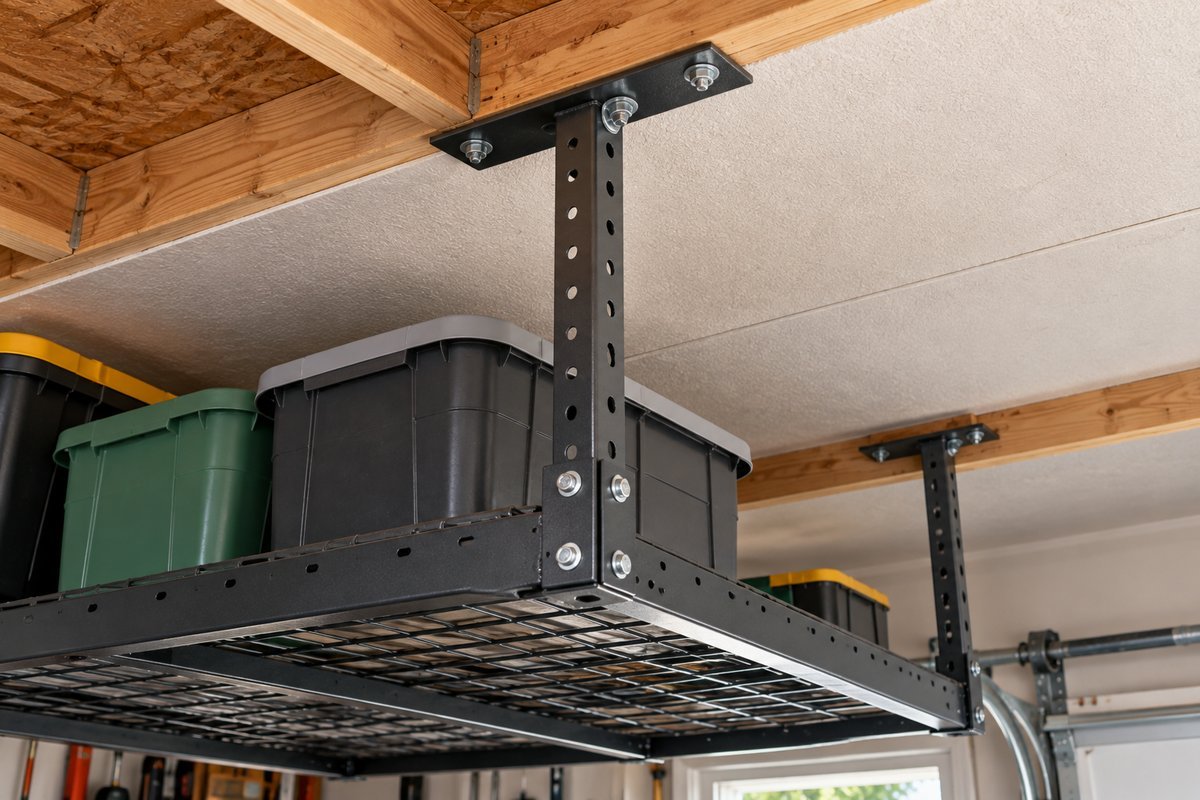
Every overhead garage storage system, fixed or motorized, has to anchor into the structural framing, the joists or trusses, never into drywall alone. Drywall holds almost nothing in shear before it tears loose, and a loaded rack that pulls out of the ceiling isn't a minor failure.
The framing type changes the hardware. Traditional dimensional lumber joists take a straightforward lag bolt into solid wood. Engineered roof trusses, common in homes built from the 1980s on, have their own load paths and sometimes their own manufacturer guidance about where a rack can and can't attach. Finding and marking the real joist or truss pattern before drilling is the first step of any install, not an optional one. It usually means a stud finder rated for ceilings or simply looking for the screw lines already holding the drywall up.
Fixed platform racks vs motorized lifts
A fixed platform rack is a stationary shelf bolted to the joists at a set height. A standard 4 by 8 foot platform gives roughly 105 cubic feet of storage and, on a well-built unit, holds up to several hundred pounds total. It is the cheaper option, and the one most garages need.
A motorized lift lowers to about shoulder height at the push of a button and raises back up out of the way. It costs more, often several times the price of a basic fixed rack, but it solves a real problem a fixed rack can't: anything heavy, or anything stored high enough that a ladder becomes the real barrier, gets handled without climbing. The tradeoff is cost and a more involved install, since a motorized system needs power and more careful mounting than a static platform.
What is worth buying
These options cover almost every project, from a basic fixed rack to a full motorized lift.
- Basic fixed platform rack (FLEXIMOUNTS, NewAge, and similar): roughly $100 to $250 for a standard 4 by 4 or 4 by 8 foot platform. The right starting point for seasonal items and archive boxes in a standard 8-foot garage.
- Heavy-duty fixed rack (14-gauge steel construction, rated up to 800 pounds total): roughly $400 to $500. Worth it in a garage if you store anything heavy: camping gear with a cooler, multiple totes of tile or flooring leftovers, that kind of load.
- Motorized platform lift: roughly $500 to $1,500 depending on capacity and drop height. Worth it when items are reached for more than a couple times a year, when a ladder is a real mobility concern, or when the ceiling is high enough that a fixed rack would sit out of comfortable reach anyway.
- Specialty lifts (bike hoists, kayak pulleys): roughly $30 to $150 per unit. A cheap, targeted fix for one bulky item rather than a full platform, and often the better answer when only one or two odd-shaped things need to come off the floor.
- Heavy-duty joist hardware (lag bolts rated for the rack, not generic drywall anchors): a few dollars per fastener, and the single cheapest thing on this list that determines whether everything above stays up. Confirm the real joist layout before drilling into any finished ceiling.
Fixed rack vs motorized lift vs specialty hoist
Each option trades cost and install complexity against how easy it is to get the stored items back down.
| Solution | Typical cost | Weight capacity | Best for | Watch out for |
|---|---|---|---|---|
| Basic fixed platform | $100 to $250 | Up to ~300 lbs total | Standard 8-foot garage, seasonal items | Needs a ladder every time, not for daily items |
| Heavy-duty fixed platform | $400 to $500 | Up to ~800 lbs total | Heavier or bulkier stored loads | Higher cost for capacity most garages won't use |
| Motorized lift | $500 to $1,500 | Varies by model, often 200 to 400 lbs | Frequent access, high ceilings, ladder concerns | Highest cost. Needs power and careful mounting |
| Specialty hoist (bike, kayak) | $30 to $150 | Single item, typically 50 to 100 lbs | One or two bulky, odd-shaped items | Not a general storage solution on its own |
Garage ceiling storage ideas by ceiling type
Standard 8-foot ceiling
This is the tightest fit and the most common garage. A rack platform mounted at ceiling height leaves only a foot or so of clearance below it, which rules out anything tall parked underneath and means the rack has to sit high enough that the car still clears it. A fixed 4 by 4 or 4 by 8 platform is usually the right call here rather than a motorized lift, since there often isn't enough drop distance for a lift to be worth the cost.
High or vaulted ceiling
Extra height changes the math. A rack mounted high enough to clear a taller vehicle can end up out of comfortable reach even with a ladder, which is exactly the situation a motorized lift is built for. Check the drop distance to shoulder height against the specific lift model before buying, since not every unit lowers far enough for a tall garage.
Exposed joists vs finished drywall
A garage with exposed joists and no drywall ceiling is the easiest install by far. The structure is visible, so finding solid mounting points takes minutes instead of a stud-finder pass. A finished drywall ceiling hides the joists entirely, and mounting hardware has to reach through the drywall into the framing behind it. Getting this wrong (mounting into drywall alone rather than through it into a joist) is the single most common cause of a rack failure.
Clearance: garage door tracks, openers, and the car
The most common installation conflict is between the garage door track and the opener rail, both of which run along the ceiling and take up space a rack can't share. Before mounting anything, measure the door track's full travel and the opener motor's hanging point at the center of the ceiling, then plan the rack's placement to avoid both entirely rather than working around them after the fact.
Car clearance matters just as much. A rack platform needs enough gap below it for the vehicle to clear, plus room above the platform for whatever is stored on it. That rules out ceiling storage entirely in garages with unusually low clearance or a door track that runs close to the ceiling. Measuring before buying saves a return trip more often than any other step in this process.
Weight ratings and what they mean
A rack rated for 300 pounds means 300 pounds total across the whole platform, not per shelf and not per square foot. It's an easy number to underestimate, since a full set of packed holiday totes, a few coolers, and a couple of storage bins add up faster than they look sitting on the garage floor.
The rating also assumes the hardware is anchored the way the manufacturer specifies, into real structural framing with the correct fasteners. A rack that would hold 500 pounds mounted properly might hold a fraction of that if even one corner is anchored into drywall instead of a joist, so the box rating applies only when the install matches the instructions exactly.
Budget-friendly garage ceiling storage ideas, by tier
- Free (a weekend, nothing to buy): sort what belongs on the ceiling, seasonal and infrequently touched items only, and confirm the joist layout before spending anything.
- Under $50: a single specialty hoist for one bulky item, a bike or a kayak, rather than a full platform.
- $100 to $250: a basic fixed 4 by 4 or 4 by 8 platform rack, the right tier for most standard garages.
- $400 to $500: a heavy-duty fixed platform rated up to 800 pounds, worth it for a heavy or bulky seasonal load.
- $500 and up: a motorized lift, worth it once items are reached for often enough that a ladder becomes a real recurring hassle rather than an occasional one.
Common garage ceiling storage mistakes
A few setups backfire in the same predictable ways, almost always because the joists or clearance were never checked before buying.
- Mounting into drywall instead of through it into a joist. The single most common cause of a rack failure, and the easiest to prevent by finding the real framing before drilling.
- Ignoring the garage door track and opener rail during planning. A rack placed without checking these first often has to be relocated or modified later.
- Treating the weight rating as per shelf instead of total. A packed set of holiday totes adds up faster than it looks, and overloading is a safety issue, not just an organizing one.
- Skipping the clearance check for the car. A rack that clears the ceiling but not the vehicle underneath defeats the purpose of the install.
What we would skip
A full motorized lift system in a garage that only stores a few boxes of holiday decorations is more than the situation calls for. A basic fixed platform does the same job for a fraction of the price when the items involved are light and only come down once a year.
We would also skip generic drywall anchors marketed for ceiling use on any load-bearing rack, regardless of what the packaging claims about weight capacity. Anything hanging overhead needs real structural framing, and a fastener rated for drywall alone isn't a place to save a few dollars.
How long a garage ceiling storage fix holds up
Durability is the easiest part to get right. A properly mounted fixed rack, anchored into real joists and loaded within its rating, holds up indefinitely, since nothing mechanical wears out. A motorized lift has more moving parts: a motor, a winch mechanism, cables or a chain drive. Those parts generally hold up for years of occasional use before needing any real maintenance, since the whole point of ceiling storage is that it doesn't get cycled daily the way a garage door does.
What causes problems over time isn't usually the hardware. It's loading the rack past its rating a little at a time, one more tote added each year until the original weight budget is long gone. Checking the load against the rating every so often costs nothing and catches this before it becomes a real problem.
Renter-friendly garage ceiling storage ideas
Ceiling storage is one of the harder categories to make renter-friendly, since anything load-bearing overhead needs to anchor into the structure. A freestanding shelving unit that reaches close to the ceiling recovers some of that vertical space without any mounting, and works as a practical substitute in a rental where drilling into the ceiling isn't an option.
Where the landlord allows it, a small specialty hoist for one item, mounted with the landlord's approval and removed at move-out, is a lighter-touch option than a full platform system. Confirming what's allowed before buying anything is worth the conversation, since ceiling anchoring is exactly the kind of modification a lease is likely to address directly.
Frequently asked questions
How much weight can a garage ceiling storage rack hold?
A basic fixed platform typically holds up to about 300 pounds total, and heavy-duty 14-gauge steel racks go up to around 800 pounds. That rating is for the whole platform, not per shelf, and it only applies when the rack is anchored into real ceiling joists with the correct hardware, not into drywall alone.
Do garage ceiling racks have to be mounted into joists?
Yes. Every overhead garage storage system, fixed or motorized, needs to anchor into the structural framing, the joists or trusses, rather than drywall alone. Drywall can't support a loaded rack, and mounting into it instead of through it into a joist is the most common cause of a rack failure.
Is a motorized garage ceiling lift worth the cost?
It depends on how often you use the stored items. A motorized lift costs several times more than a basic fixed rack, but it lowers items to shoulder height instead of requiring a ladder. That is worth it for anything accessed more than a couple of times a year or for anyone who can't safely use a ladder. For pure seasonal storage touched once a year, a fixed rack does the same job for less money.
How much clearance do you need for garage ceiling storage?
Enough for the car to clear underneath the loaded platform, plus room above the platform for whatever you store on it. Also measure and avoid the garage door track and opener rail before mounting, since they're the most common place a ceiling rack conflicts with existing garage hardware.
What should not go on a garage ceiling rack?
Anything you reach for weekly or more often doesn't belong overhead, since the point of ceiling storage is that it's harder to access than a wall shelf. Anything over the rack's rated weight and anything stored loose without a bin or tote are common mistakes that lead to items shifting or the rack overloading without anyone noticing until it becomes a real problem.
For the rest of the site's garage coverage, including shelving by material and load capacity and tool organization by wall system, see the Garage Storage & Organization hub.