
Most mudroom storage ideas online show a builder-grade bench with three empty hooks and call it done. The real mudroom, whether it's a dedicated room, a stretch of hallway by the garage door, or a repurposed closet, ends up holding wet boots, a dog leash, school backpacks, mail that never got sorted, and a coat for every season at once. This covers mudroom storage ideas by space type, what is worth buying, and what most people regret within a few months. It is part of the Small-Space & Laundry Storage hub alongside our laundry room storage ideas.
The right approach depends on what kind of mudroom you have. A dedicated mudroom with built-ins can support a full system: bench, cubbies, upper cabinets, hooks at two heights. A narrow entryway or hallway "mudroom" has to work harder with less square footage, usually a single wall or a stretch beside a door. A closet converted into a mudroom sits in between: enclosed storage but a small footprint. The fixes below apply to all three, but the specific product picks differ by how much floor and wall space is available.
Budget option
A double hook rail, a boot tray sized to the doorway, and a small catch-all bin for keys and mail, each under $15, are enough to fix a mudroom's worst habits.
Table of Contents
What matters before you buy anything
Before adding a single hook, measure the usable wall space: width, height to the ceiling or to any soffit, and how far anything can project before it blocks the door swing or a walkway. A bench or cubby system that looks right in a photo often assumes a dedicated room, not the three feet of wall next to a back door that most houses have.
Count the people using the space and what they carry in daily. A household of two with no kids needs a fraction of the hook and shoe storage a family of five with a dog needs. Mudrooms fail most often because they were sized for the house's square footage instead of for how many coats, bags, and pairs of shoes arrive through that door every day.
Pull everything currently piled in or near the entry into three groups before buying anything: things used daily (school bags, the dog's leash, everyday shoes), things used seasonally (winter coats and boots in summer, or the reverse), and things that do not belong at the entry at all. That third pile is usually the biggest. Entryways collect mail, empty boxes, and stray toys because they are the first flat surface inside the door, not because they are the right home for those items. Getting this sort done first is what makes the rest of this guide work instead of just adding more bins to a cluttered space.
How to set up a mudroom, start to finish
- Clear the space completely and note what is built in already (a closet, a bench, existing hooks) versus what needs to be added from scratch.
- Measure wall width, height, and depth available without blocking the door or a walking path.
- Sort contents into daily, seasonal, and does-not-belong-here piles. Seasonal items get moved to backstock storage elsewhere in the house.
- Add hooks at two heights if kids use the space, adult height and a lower row within reach of a child, so coats stop landing on the floor.
- Add a landing zone for daily small items (keys, mail, sunglasses) at the point closest to the door, since anything more than a step away from the door gets skipped.
- Add shoe storage next, since shoes are the single biggest floor-clutter source in most entries.
- Add closed storage last, for anything that needs to be out of sight (cleaning supplies, off-season gear, pet supplies), since open storage should be reserved for what gets used daily.
Mudroom storage ideas by space type
Dedicated mudroom storage ideas
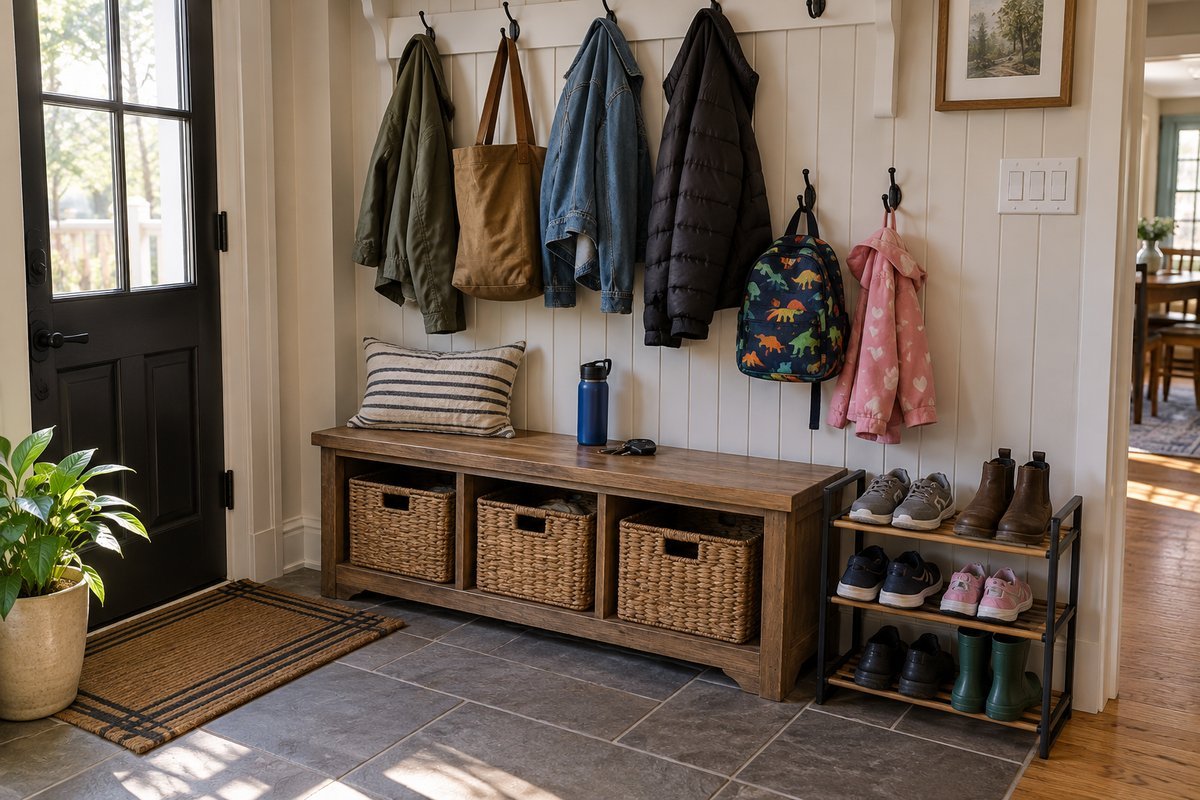
A dedicated mudroom can support a full built-in-style system: a bench with cubbies underneath, hooks above at two heights, and upper cabinets for less-used items. If the room has a closet, use it for off-season coats and bulk supplies rather than daily gear, since daily gear needs to stay visible and within arm's reach, not behind a door. A boot tray or a shallow bin under the bench catches wet or muddy footwear before it reaches the floor, and it is worth choosing one deep enough for winter boots even if only used part of the year.
Hallway and entryway mudroom ideas
A narrow hallway or a stretch of wall by a door has to prioritize vertical space, since floor space is usually the constraint. A slim wall-mounted cabinet with hooks below does most of the work a full bench system would in a dedicated room, without eating into a walkway. A single tiered shoe rack against the wall, rather than a shoe bin that gets kicked around, keeps a hallway version of a mudroom from turning into a tripping hazard.
Closet-converted mudroom ideas
Turning a coat closet into a mudroom means giving up hanging space for shelving and hooks, which is usually the right trade for a household that generates more shoes and bags than long coats. A double hook rail mounted low on the inside of the closet door adds storage that would otherwise sit unused. Removing the closet door entirely and replacing it with an open shelf-and-hook wall works well if the closet sits in a hallway that already reads as an entry. A door that stays open most of the day is not doing much anyway.
Which system fits which space
Not every system fits every space, so match the system to the space type before shopping, not after.
| Space situation | Best-fit system |
|---|---|
| Dedicated mudroom, family with kids | Bench with cubbies, hooks at two heights, upper cabinets |
| Dedicated mudroom, adults only | Bench with hooks, closed cabinet for off-season gear |
| Narrow hallway entry | Wall-mounted slim cabinet with hooks below |
| Entry with no wall space to spare | Vertical tiered shoe rack plus a single hook rail |
| Converted coat closet | Shelving and hooks replacing the hanging rod |
| Rental, no drilling allowed | Freestanding bench or shoe rack plus over-the-door hooks |
What is worth buying
A bench with storage underneath earns its cost the fastest of anything on this list, since it doubles as seating for putting on shoes and as the primary shoe or bin storage in one footprint. Look for a bench rated for daily sitting weight, not just display use, since a thin decorative bench will loosen or crack within a season of real use.
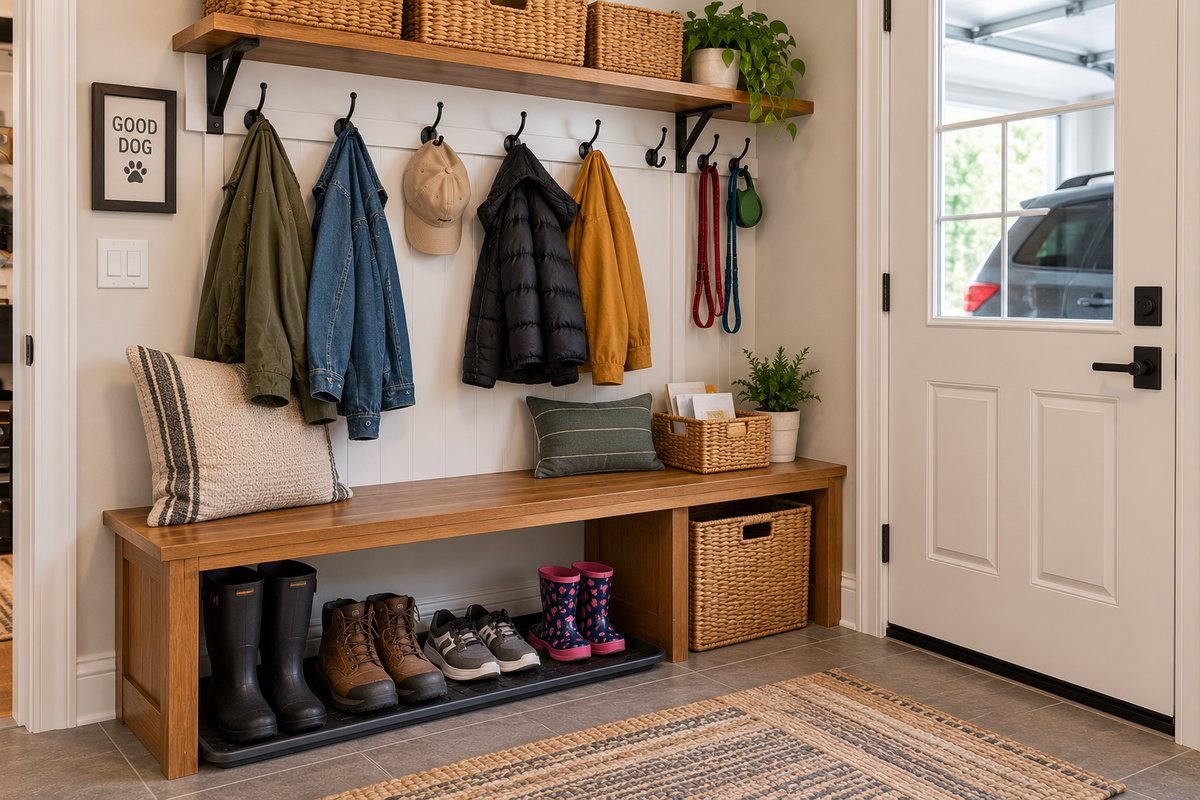
A double hook rail, mounted at both adult and child height, solves the single biggest mudroom failure point: coats and bags landing on the floor instead of on a hook. A single row of hooks at one height works for an adults-only household but leaves kids' gear on the floor in a family with children.
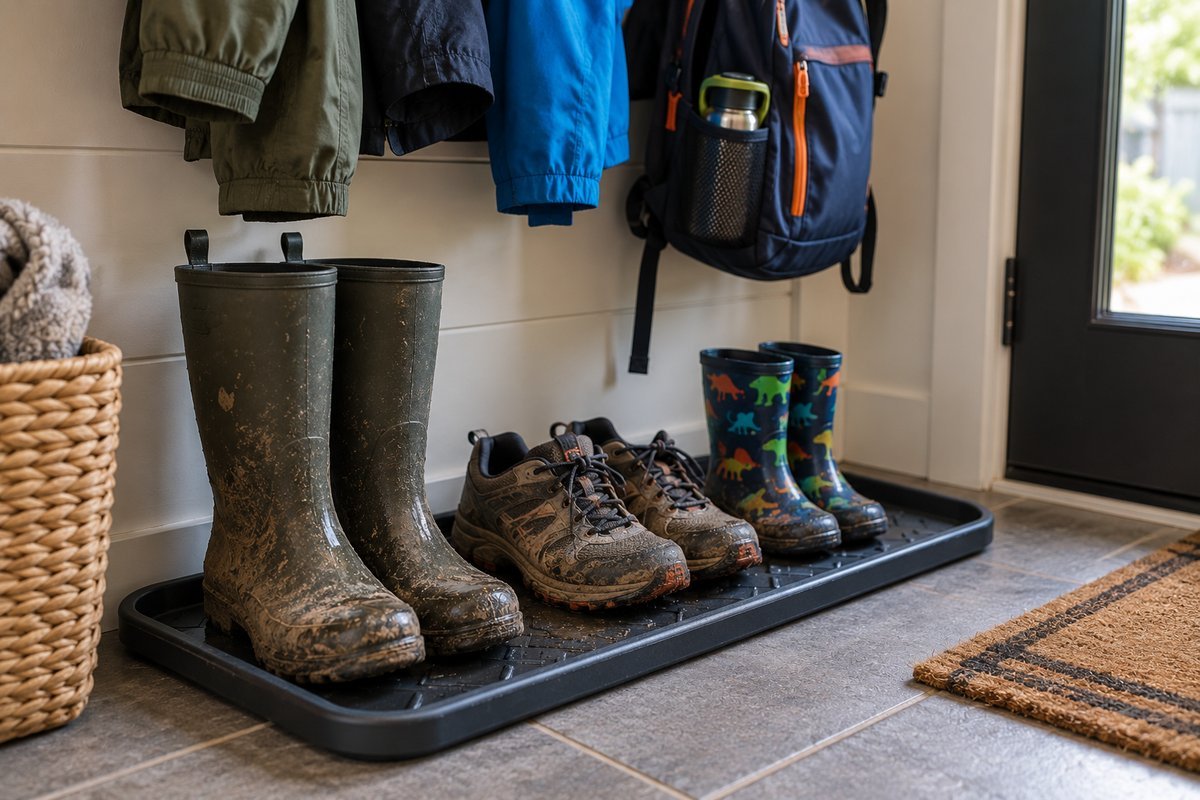
A boot tray or shallow catch-all bin is the least exciting item here and the one people regret skipping most often. It gets skipped for the same reason a kitchen liner gets skipped: it is not visible in a "finished" photo, but it is what protects the floor from the daily wear an entryway takes. A tray that lifts out for rinsing turns a weekly clean into a two-minute job.
Storage by category
Sorting storage by what gets stored, rather than by product type, keeps the system matched to daily use instead of to whatever looked good in a store aisle.
- Daily-use items (keys, mail, sunglasses, wallet): a small shallow bin or a wall-mounted catch-all tray, placed at the exact point closest to the door.
- Shoes: a tiered rack for daily pairs, a closed bin or the closet floor for anything used less than weekly.
- Coats and bags: hooks at two heights over a closet rod, since hooks get used and rods do not, in an entryway specifically.
- Seasonal gear (winter boots, snow gear, umbrellas in a dry climate): the highest shelf or the back of a closet, since it is reached for only part of the year.
- Pet supplies (leash, poop bags, towel for wet paws): a dedicated small hook or bin near the door, kept separate from human items so it does not get buried.
Budget-friendly mudroom storage ideas, by tier
Under $15: A double hook rail from a hardware or discount store. A plastic boot tray sized to the doorway. A small catch-all bin for keys and mail.
$15 to $50: A freestanding shoe rack with two or three tiers. An over-the-door hook organizer for a closet-converted mudroom. A fabric cubby organizer that fits inside an existing shelf or bench.
$50 and up: A storage bench with built-in cubbies. A wall-mounted cabinet with hooks and a small shelf combined. A full locker-style unit for a family that needs individually assigned storage per person.
There is rarely a reason to spend at the top tier for a single-person or couple's entryway, since the $15 to $50 range covers almost every non-family use case. The top tier earns its cost mainly in a household with kids, where individually assigned storage cuts down on daily arguments over whose coat is on the floor.
What we would skip
Not everything here is worth the money, and a few common ones cause more problems than they solve.
A single row of hooks in a household with kids is the most commonly regretted buy in this category, since it looks like enough in a store display but fails within days once a child's coat cannot reach the hook. Skip a single-height hook rail unless the space is adults-only.
Fabric bins with no rigid base are also worth skipping for shoes specifically, even though they work well for coats or bags. Wet or muddy shoes need a wipeable surface, and fabric holds both moisture and odor in a way a plastic or coated-wire bin does not.
A bench with no weight rating listed is a common source of failure, since mudroom benches take more daily sitting-and-standing use than almost any other seating in the house. Anchoring taller cabinet or shelf units to the wall is also worth doing in a mudroom used by kids, following the Consumer Product Safety Commission (CPSC) furniture anti-tip guidance. A bench meant for occasional display use that gets sat on twice a day by a full household is a return, not a repair, waiting to happen.
How long a mudroom system holds up
Not every mudroom system holds up the same way over time, and the difference usually comes down to whether the system was sized correctly in the first place.
A well-built bench-and-hook system should last as long as the house's other built-in furniture, since there is nothing in normal use that degrades a properly rated wood or metal system. The failure point is almost always capacity, not durability: a system sized for the household's needs when it was installed gets crowded and abandoned a few years later as kids grow into more gear, not because anything broke.
Boot trays and shoe mats are the one component worth replacing on a schedule rather than waiting for failure. A tray that has caught months of wet, salted, or muddy footwear can hide floor damage underneath it. Lifting it out every month or two for a real look, not just a wipe, catches problems while they are still a floor worth cleaning instead of a floor worth replacing.
Common mudroom storage mistakes
Buying a system sized for the house's entryway footprint instead of for how many people and how much gear passes through it daily is the single most common mistake. It is the direct cause of most abandoned mudroom systems within the first year.
Putting hooks at only one height in a household with kids is a close second. A child who cannot reach a hook will drop a coat on the floor every time, and no amount of reminding fixes a height problem.
Skipping a landing zone for daily small items (keys, mail, sunglasses) is a smaller but real gap. Without one, those items end up on the nearest flat surface instead of a dedicated spot, which is usually the kitchen counter rather than the entry itself.
Renter-friendly mudroom storage ideas
Renters need storage that leaves no permanent marks, so the picks here skip anything that requires drilling into a wall or door frame.
A freestanding bench or shoe rack delivers most of the benefit of a built-in system without any hardware, at the cost of slightly less stability if bumped often, and it moves with the renter at the end of a lease.
Over-the-door hook organizers work for a closet-converted mudroom with zero drilling, and they hold coats and bags without needing a mounted rail. Command-brand or similar removable-adhesive hooks work for lightweight daily items, keys and a light bag, not full winter coats. Test them on an inside corner of the wall first, since some paint finishes react differently to adhesive than expected.
A boot tray is fully renter-friendly on its own and is worth adding even in a rental specifically because it protects flooring that is not the renter's to repair if it takes water or salt damage over time.
Frequently asked questions
What is the best way to organize a mudroom?
Start by counting how many people and how much daily gear passes through the space, then add hooks at two heights before adding shoe or bench storage. Most mudroom systems fail because they were sized to the room, not to the household's daily traffic.
How do you organize a small entryway with no mudroom?
Prioritize vertical space with a slim wall-mounted cabinet and hooks below rather than a full bench system. Add a single tiered shoe rack against the wall instead of a floor bin that can become a tripping hazard in a narrow space.
What should not be stored in a mudroom?
Anything that needs to stay dry over the long term, like paper mail or cardboard boxes, does not belong in an entry that regularly sees wet shoes and coats. Cleaning supplies stored in a mudroom closet should be kept out of reach if a small child or pet can access the space.
How often should mudroom storage be cleaned out?
Every season, at the point where gear switches over (winter boots in, sandals out, or the reverse). That is a natural checkpoint for removing anything outgrown or unused. Wipe down a boot tray or mat weekly if the entry sees daily wet-weather use.