The best toy storage ideas are simple and easy for a child to use alone. Think low, open bins for everyday toys, picture labels on each bin, lidded boxes up high for small parts, and fewer toys out at a time. Fancy furniture matters less than a system that makes cleanup fast.
This guide walks through that system step by step. It covers which containers work for which toys and how to hide toys in a living room or small apartment. It also covers easy-to-miss safety steps, like toy chest lids and anchoring shelves to the wall.
Free tool
Buying bins for a cube shelf or closet? The storage bin size fit calculator shows which bin sizes will fit before you order.
Table of Contents
Quick take
- Keep fewer toys out. Store the rest and swap them every few weeks.
- One kind of toy per bin. Cars in one, blocks in another. Mixed bins turn into a mess kids dump out to search.
- Keep open bins on low shelves for everyday toys, so kids can help put things away.
- Picture labels for kids who cannot read yet.
- Store small parts, batteries, and magnets high up in closed boxes, out of reach of children under 3.
- Anchor every shelf and dresser to the wall, and skip toy chests with heavy lids that can fall.
Start With Fewer Toys Out
Many toy storage problems start with too many toys. No bin system can hold a toy collection that grows every birthday. So before you try new toy storage ideas, cut down what is out in the room.
There is research behind this. In a small University of Toledo study, researchers gave 36 toddlers ages 18 to 30 months either 4 toys or 16 toys to play with. With fewer toys, they played longer with each one and found more ways to use it. With 16 toys, many children moved through 10 or more toys in the first 15 minutes. The study didn't test toy rotation itself, but it supports keeping only a few toys out at once.
A simple way to put this into practice:
- Gather every toy in one spot. Toss broken toys and toys with missing pieces. Donate what nobody plays with.
- Split what is left into groups by type: building, vehicles, pretend play, art, puzzles and games, soft toys, outdoor.
- Leave out a few bins from each group. Put the rest in labeled boxes in a closet, garage shelf, or under a bed.
- Every few weeks, swap some bins. Toys that come back out often feel new again.
There is no magic number of toys. A good starting point is what fits on one low shelf unit without stacking, plus a basket of books. If cleanup often takes longer than the 5-minute routine below, there may be too many toys out.
Sort Toys Into Groups Kids Understand
Sorting by type is usually the easiest system for kids to follow. Keep the groups broad and obvious, so a 3-year-old can tell where a toy goes.
- Building: blocks, magnetic tiles and large interlocking bricks.
- Vehicles: cars, trucks and trains.
- Pretend play: play food, dolls, dress-up and tools.
- Art: crayons, paper and stickers for kids 3 and up. Keep paints, markers, and scissors up high for younger kids.
- Puzzles and games: in their boxes or in zip bags with the picture cut from the box. Keep the bags out of a baby's reach.
- Soft toys: one basket. When it is full, some go into storage.
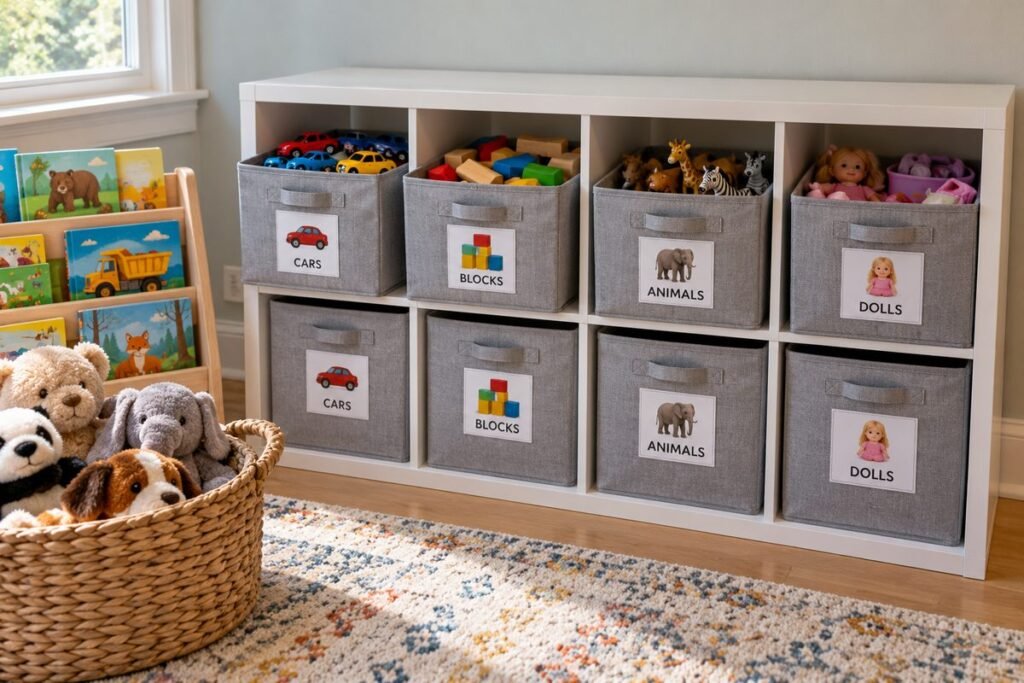
Labels are one of the simplest toy storage ideas to set up. Label every bin. For kids who cannot read yet, use a photo or a simple drawing of what goes inside, plus the word. Clip-on labels or tape-on photo cards work well because you can change them when you rotate toys.
Toy Storage Ideas That Work
These toy storage ideas are the containers and furniture that hold up best in a playroom, bedroom, or living room. Most homes need two or three, not all of them.
StorageTidyHQ is a participant in the Amazon Services LLC Associates Program, an affiliate advertising program designed to provide a means for sites to earn advertising fees by advertising and linking to Amazon.com. As an Amazon Associate, we earn from qualifying purchases.
Cube shelves with fabric bins
A low cube shelf with one fabric bin per cube is one of the most flexible kinds of toy storage. Each bin holds one kind of toy, and kids can pull a whole bin to the floor. With the bins in, the shelf looks like regular furniture. Pick a unit no more than about 3 feet tall for young children, and anchor it to the wall even if it feels sturdy.
Measure the cube openings before you buy bins. Cube shelves are not all the same size, and a bin that is too big will not slide in.
Product pick
Amazon Basics Collapsible Fabric Storage Cubes, 6-Pack
Six collapsible fabric bins with handles, about 10.5 by 10.5 by 11 inches.
Tiered organizer with small bins
A kids toy organizer with rows of small plastic bins works well for toddlers and preschoolers. The bins are light, they slide out at child height, and each one holds a small group of toys. The trade-off is size: small bins fill up fast, so this works best alongside toy rotation.
Anchor this one to the wall too.
Product pick
Humble Crew Kids Toy Organizer with 12 Bins
A 4-tier toy organizer with 12 plastic bins, about 34 inches wide and 31 inches tall.
Clear latching boxes for small parts
Small-piece toys like building bricks, doll accessories and bead kits need lids. Clear boxes let older kids see what is inside, and latching lids keep pieces from spilling if a box tips. If you have a child under 3 in the house, these boxes belong on a high shelf, not on the floor. More on that in the safety section below.
Product pick
Sterilite 6 Quart Latching Box, 12-Pack
Small clear plastic storage boxes with white latching lids, sold in a 12-pack.
Rolling boxes under the bed
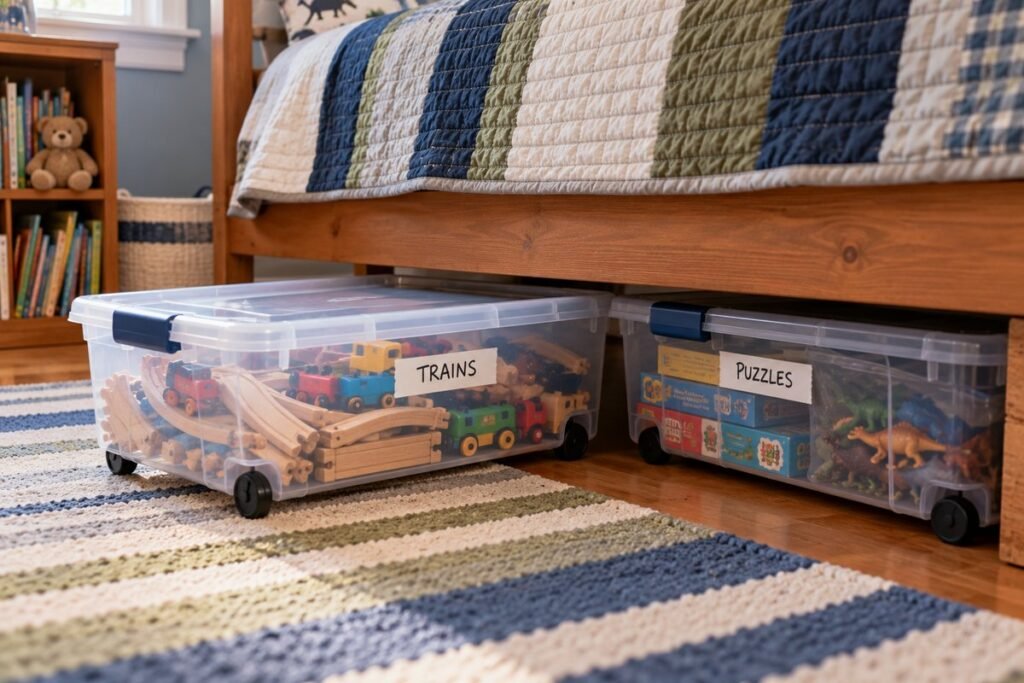
The space under the bed is the easiest place to store rotating toys. Low boxes on wheels slide out in one move, so swapping toys takes a minute. Measure the gap under the bed first, including the bed frame rails.
Product pick
Sterilite Wheeled Latching Box, 56 Quart, 4-Pack
Low clear storage boxes with latching lids and wheels, about 7 inches tall, made to roll under beds.
Over-the-door pocket organizer
A clear pocket organizer on the back of a closet or bedroom door holds small dolls, action figures, toy cars and art supplies. It uses space that is usually empty, and kids can see every pocket. If a child under 3 lives in the home, keep small parts out of this organizer, or hang it inside a closet door that stays shut.
Product pick
Over Door Organizer with 18 Clear Pockets
A hanging clear organizer with 18 pockets and 4 door hooks, about 59 inches tall.
Baskets for big and soft toys
Stuffed animals, balls, and play tunnels do not fit in small bins. One large open basket or a canvas bin on the floor holds them. Keep it open, with no lid, so it is easy to toss toys in at cleanup time.
Front-facing book display
Young children often pick a book by its cover, and a spine shows very little. A shallow shelf or a wall-mounted ledge that shows covers makes books easier to choose. Rotate books the same way you rotate toys.
Living Room and Hidden Toy Storage
When toys share space with adults, the goal is storage that closes up at night. Good options:
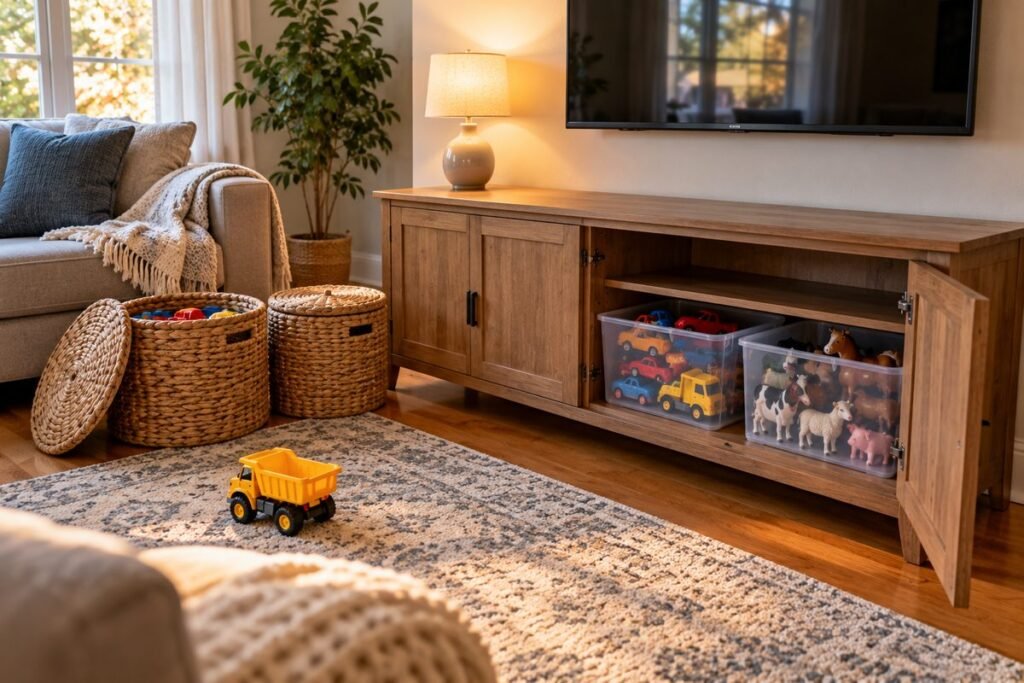
- A media console or sideboard with doors. Give the bottom shelf to toy bins. Doors hide everything in seconds.
- Lidded baskets that match the room. Choose lift-off lids, not hinged ones, so a lid cannot fall closed on small hands. Leave the lids off during the day and put them on at night.
- A storage ottoman or bench. Look for a lid support that holds the lid open at any angle, or a lid that lifts off completely. If a child could fit inside, make sure it has air holes. See the safety section for why.
- Bins under the sofa or a console table. Low rolling bins slide out of sight.
- One toy basket per room, with a nightly reset. Send wandering toys back to the playroom or bedroom.
For living room toy storage ideas, keep the selection small. A few bins of current favorites are enough. Store the rest in a bedroom or closet and rotate them in.
Toy Storage Ideas for Small Spaces
The best toy storage ideas for small spaces go up and under, not out. In an apartment or a shared bedroom, try these:
- Under the bed: rolling boxes for rotation toys and puzzles.
- Backs of doors: pocket organizers for small toys and art supplies.
- The closet floor: a short cube unit or bins on the floor of a kids' closet. Our kids closet organization ideas cover how to split clothes and toy space.
- Wall shelves above adult head height: for light display pieces only. Screw the shelves into wall studs.
- Fewer, better toys: in a small space, rotation is the best way to fit toys.
If closet space is tight overall, the small closet organization ideas guide shows how to free up a shelf for toy storage.
What Goes Low and What Goes High
Where you put a toy decides who can reach it. Good toy storage ideas use height on purpose.
| Store low (kids can reach) | Store high or closed (adults only) |
|---|---|
| Everyday toys in open bins | Toys with small parts, if a child under 3 lives in or visits the home |
| Books and soft toys | Loose batteries and battery toys with loose covers |
| Heavy items like wooden block sets | Magnet sets and toys with small loose magnets |
| Crayons and paper, for kids 3 and up | Paints, markers, scissors and glue for younger kids |
| Puzzles with large pieces | Rotation boxes that are not in use, under a bed or on a low closet shelf if they are heavy |
Put heavy items on the bottom shelf. A shelf loaded at the top is easier to tip, and a heavy bin is hard for a child to lift down safely.
Toy Chest and Furniture Safety
Many toy storage ideas skip this part, but it matters most.
Toy chests and storage benches
Heavy hinged lids can fall on a child's head or neck, and children can get trapped inside chests. The U.S. Consumer Product Safety Commission (CPSC) reported 34 deaths of children since 1996 involving storage and toy chests, in a 2014 warning. Its advice:
- Use a spring-loaded lid support that holds the lid open in any position.
- Make sure the chest has air holes and that the floor or a wall doesn't block them.
- If a chest has a lock or a latch that closes on its own, disable or remove it.
For toddlers, open bins and baskets are simpler. If you love the look of a chest, a lid that lifts off fully avoids the falling-lid problem.
Anchor shelves, dressers and TVs
Furniture and TVs that tip over send about 17,800 people to emergency rooms each year, according to the CPSC. Children under 18 make up 44 percent of those injuries. Toys play a part: kids climb shelves to reach things they want. The CPSC's Anchor It campaign recommends anchoring furniture and TVs. It also says to remove items that tempt kids to climb, such as toys and remote controls, from the top of furniture and the TV.
- Anchor every cube shelf, bookcase, and dresser to a wall stud (the wood framing behind the drywall) with an anti-tip kit.
- Do not keep toys on top of a dresser, bookcase, or TV stand.
- Put favorite toys on the lowest shelves so kids don't need to climb.
- Keep shelves and bins away from windows with blind or curtain cords, so kids do not climb near them.
Dressers made after September 1, 2023 must meet a federal stability rule. That rule covers clothing storage like dressers, not bookcases or cube shelves, so anchor those too.
Small parts, batteries and magnets
The CPSC lists choking on small balls and other small items as one of the main causes of toy-related deaths. It says to keep small balls and toys with small parts away from children younger than 3. This is the big storage issue in homes with kids of different ages. An older sibling's building bricks can be dangerous for a baby. By a high shelf, we mean a closet shelf or cabinet a child cannot see or climb to, not the top of a bookcase or dresser.
- Give older kids a lidded box that lives on a high closet shelf. Give them a play spot, like a table, where small pieces stay.
- Check that battery covers on toys are closed, and screwed shut if they have screws. The CPSC urges families to check battery compartments because swallowed button and coin batteries can cause serious injuries.
- Keep magnetic toys in a closed container out of reach. The American Academy of Pediatrics says the best option is a locked container in a high or hidden place. It also advises against keeping high-powered magnet sets in a home with children.
- Do not keep water beads in a home with young children. The CPSC lists them among the causes of toy-related deaths.
- If you think a child swallowed a button battery or a magnet, get emergency care right away. You can also call Poison Help at 800-222-1222.
Toy Storage Ideas Compared
Here is how the main toy storage ideas in this guide compare.
| Idea | Best for | Ages | Watch out for |
|---|---|---|---|
| Cube shelf with fabric bins | Most toy groups | All ages | Anchor it. Measure cubes before buying bins. |
| Tiered organizer with small bins | Small groups of toys | Toddlers and preschoolers | Fills up fast without rotation |
| Clear latching boxes | Small parts and sets | Older kids | Store high if a child under 3 is around |
| Under-bed rolling boxes | Rotation toys and puzzles | All ages | Measure the gap under the bed |
| Over-door pocket organizer | Small figures and art supplies | Preschool and up | No small parts if a child under 3 is home |
| Open baskets | Soft toys and balls | All ages | Easy to overfill |
| Toy chest or storage bench | Living rooms | Older kids | Needs a lid support and air holes |
A 5-Minute Toy Cleanup Routine
Even the best toy storage ideas only work if toys go back. Kids can help earlier than many parents expect. The American Academy of Child and Adolescent Psychiatry says 2 to 3-year-olds can put toys away, with help.
- Set a 5-minute timer, or play one song.
- Start with the biggest things: soft toys into the basket, books onto the shelf.
- Then one bin at a time. Point to the picture label: cars go here.
- An adult does a last sweep for small parts on the floor.
- Toys that do not have a home go in a "decide later" bin. Empty it once a week.
Praise the effort, not a perfect result. A room that is mostly tidy every night beats a perfect room once a month.
Common Toy Storage Mistakes
- Buying storage before cutting down toys. You end up storing toys nobody plays with.
- One giant toy box. Everything sinks to the bottom, and kids dump it out to find one thing.
- Bins that are too heavy when full. If a child cannot lift it, they cannot put it away.
- Lids on everyday bins for young kids. Each lid is one more step, so toys stay on the floor.
- Shelves that are not anchored. A loaded cube shelf can tip when a child climbs it.
- Small parts in floor bins in a home with a baby or toddler.
For a bigger reset across the house, our closet organization ideas and clutter statistics pages are good next reads.
Toy Storage FAQ
How do I store a lot of toys in a small space?
Keep only a few bins out and store the rest under a bed or on a closet shelf, keeping heavy boxes low. Use the backs of doors for small toys. Swap toys every few weeks so kids still see variety.
What is the best toy storage for toddlers?
Open bins on a low, anchored shelf, with a picture label on each bin. Toddlers can see where things go and help put toys away. Keep toys with small parts out of reach.
Are toy chests safe?
Only with the right lid. The CPSC recommends a lid support that holds the lid open at any angle, unblocked air holes, and no locks or self-closing latches. Open bins are simpler for toddlers.
How often should you rotate toys?
There is no set rule. Many families swap some bins every few weeks. Watch your child. When a toy group stops getting played with, it is time to swap it.
How do I hide toys in the living room?
Use furniture with doors, like a media console or sideboard, and lidded baskets with lift-off lids. Keep only a few favorite bins in the living room and return stray toys to the playroom each night.
Where should I store toys with small parts?
Store them in closed boxes on a high closet shelf, or in an older child's room with the door kept shut, away from children under 3. Give older kids a table or play spot where small pieces stay.