Search for clutter statistics, and you get the same numbers on every page: 300,000 items in the average home, a quarter of garages too full for a car, clutter causing 40% of housework. Few of those pages link to where the number came from. We looked into it, and several of the most repeated figures don't trace back to any study at all.
This page is the opposite approach. Every one of the 14 clutter statistics below links to its primary source (the survey, the paper, or the government table), with the sample size, the year, and who paid for it where that matters. Below that are five popular numbers we could not verify, and what the real data says instead.
Quick take: Americans spend about 2.5 days a year hunting for lost things. 12.6% of U.S. households rent a self-storage unit. Several peer-reviewed studies link clutter at home to worse mood and lower well-being, though the effects are modest. And the famous 300,000 items figure has no known source.
Table of Contents
Clutter statistics at a glance
The table is the short version. Each row has a fuller explanation below, including the fine print most roundups leave out.
| Statistic | Number | Source and year |
|---|---|---|
| Time an average American spends looking for lost items | 2.5 days a year | Pixie survey, 2016 |
| Money spent replacing misplaced things, U.S. total | $2.7 billion a year | Pixie survey, 2016 |
| Adults who lose the TV remote at least once a month | 71% | Pixie survey, 2016 |
| Garages that could fit cars in a UCLA study of 32 Los Angeles families | 25% | UCLA CELF, 2012 |
| Spouses studied whose home descriptions were linked to cortisol patterns | 60 people | Saxbe and Repetti, 2010 |
| Adults in a 2025 study linking home clutter to lower well-being | 501 people | Journal of Environmental Psychology, 2025 |
| Clutter and procrastination linked in adult samples | Positive link | Ferrari et al., Current Psychology, 2018 |
| U.S. households renting self-storage | 12.6% (16.7 million) | Self Storage Association, 2024 data |
| Growth in households renting storage, 2022 to 2024 | 14.5 million to 16.7 million | Self Storage Association, 2025 study |
| U.S. housing units with a garage or carport | About two-thirds | U.S. Department of Energy, 2021 data |
| Median size of a new single-family home completed | 2,142 sq ft | U.S. Census Bureau, 2025 |
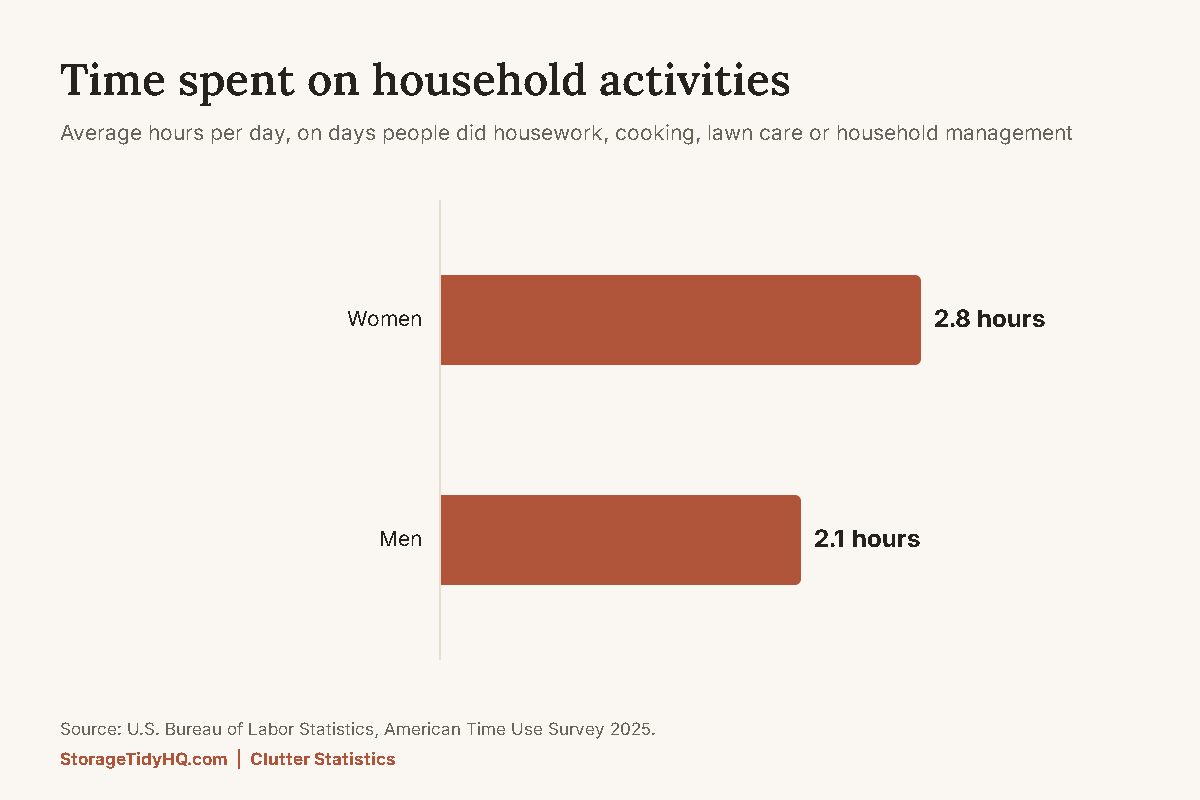
| Daily time on household activities, on days people do them | Women 2.8 hours, men 2.1 hours | BLS American Time Use Survey, 2025 |
| Prevalence of hoarding disorder | About 2.6% | American Psychiatric Association |
| Share of the U.S. food supply lost or wasted at retail and consumer level | 31% | USDA, 2010 estimate |
How much time and money clutter costs
The most quoted clutter statistics about lost time come from one survey. In October 2016, Survey Sampling International polled more than 1,700 U.S. adults for Pixie, a company that makes Bluetooth item trackers. The headline finding: Americans spend about 2.5 days a year looking for lost items, and households spend more than $2.7 billion a year replacing misplaced items.
The rest of the survey is more interesting than the headline. 71% said they lose the TV remote at least once a month. More than 60% were late to work or school because they were searching for something, almost half missed an appointment or meeting for the same reason, and one in three said missing items led to fights with a partner. Two-thirds said they spend up to $50 a year replacing lost things.
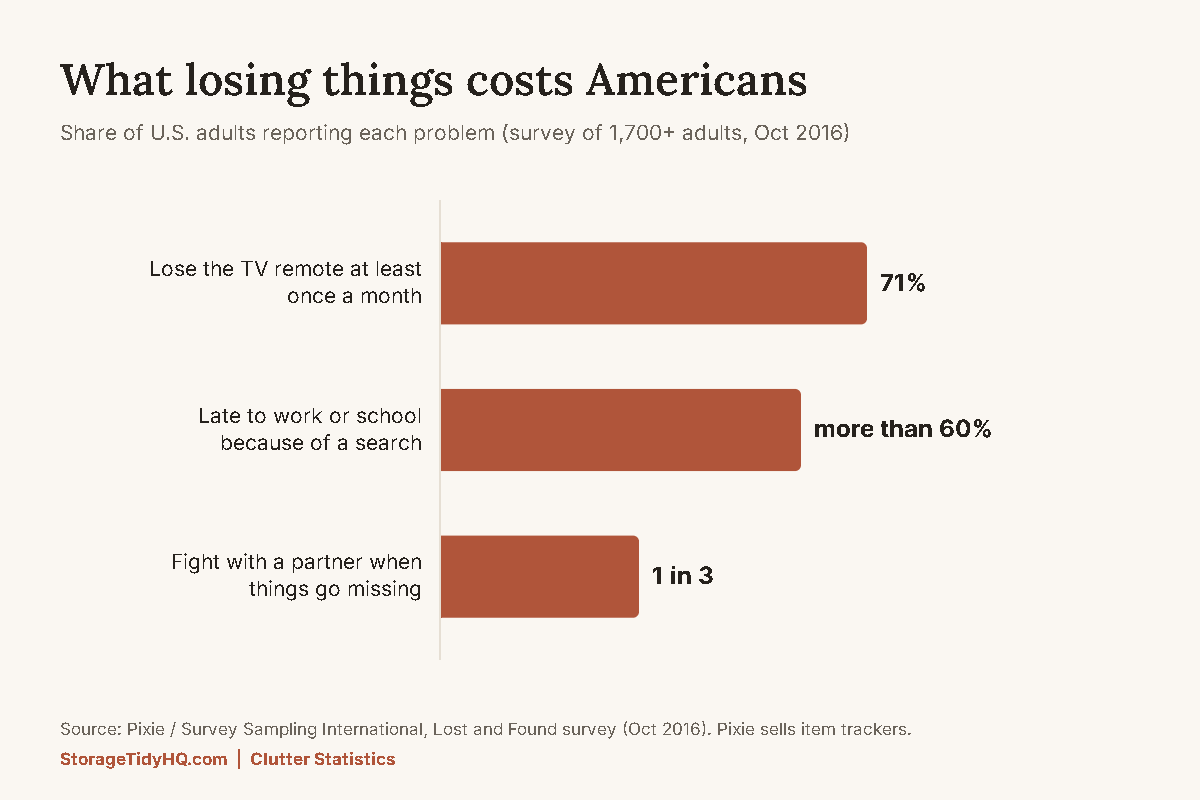
Keep the sponsor in mind when you cite it. A tracker company has an obvious interest in showing that losing things is expensive, and the survey is self-reported, so people are estimating their own search time from memory. It's still the best-known national number on the subject. If a single entryway catch-all or a small closet that has a place for things stops the daily key hunt, that's where most of those 2.5 days go.
Clutter, stress and mood: what the studies found
Four studies come up again and again when people write about clutter and mental health. Here is what each one measured, because the details are narrower than how they're usually summarized.
UCLA: 32 families and their garages
Over a four-year study, UCLA's Center on Everyday Lives of Families filmed and photographed 32 dual-income, middle-class families in Los Angeles. The researchers published the results in 2012 as Life at Home in the Twenty-First Century. Two findings get quoted most. Only 25% of the families' garages could hold a car, because the rest were full of belongings. And managing the sheer volume of possessions was stressful enough that it raised stress hormone levels in the mothers.
That's a small, local sample. It's a detailed look at 32 homes, not a national survey, which matters later in the myths section.
Saxbe and Repetti: how you describe your home
A 2010 study in Personality and Social Psychology Bulletin by Darby Saxbe and Rena Repetti drew on the same UCLA family project and followed 60 people in dual-income marriages. Each gave a self-guided tour of their home, and the researchers counted words describing clutter and unfinished projects versus words describing the home as restful. They also tracked cortisol (a stress hormone) over three weekdays.
The paper reports the effect for wives. Women whose tours described a stressful home showed flatter daily cortisol curves, a pattern associated with worse health outcomes, and their depressed mood rose over the day. Women who described a restful home showed the healthier, steeper curve. This is the source behind most "clutter raises cortisol" headlines, and it measured how people talked about their homes rather than how many belongings they had.
A 2025 study of 501 adults
The newest large study is a 2025 paper in the Journal of Environmental Psychology with 501 adults from the general population. More home clutter predicted more negative mood, lower life satisfaction, and lower mental well-being. Part of the effect ran through how attractive people found their homes. The author notes the effects were modest and didn't vary by the demographic factors tested.
Clutter and procrastination
Joseph Ferrari of DePaul University and Catherine Roster of the University of New Mexico have published several studies on clutter. A 2018 paper in Current Psychology found that people with more clutter were more likely to be chronic procrastinators and less satisfied with their homes, with no meaningful difference across age groups. It's a correlation. Putting off decisions about belongings and owning more of them probably feed each other.
Clutter and focus: what the Princeton study measured
Many clutter statistics roundups say Princeton researchers proved that clutter makes it harder to focus. The paper they mean is a 2011 fMRI study in the Journal of Neuroscience by Stephanie McMains and Sabine Kastner. It showed that when several objects are in view at once, they compete for representation in the visual cortex, and the brain has to work to sort them out.
It didn't look at homes, desks, or clutter as most people mean it. Participants watched arranged shapes on a screen. The finding reasonably supports the idea that a busy visual field costs attention, but "Princeton proved clutter ruins your focus" goes further than the paper does.
Garage statistics: who can park inside
About two-thirds of U.S. housing units had a garage or carport in 2021, according to the Department of Energy, using Census housing survey data. The Pacific region was highest at 80% and the Middle Atlantic lowest at 53%.
Another question is how many of those garages can hold a car, and there's no good national number. The only well-documented figure is the UCLA one above: 25% of 32 Los Angeles garages. If yours is in the other 75%, the fastest ways to free up floor space are overhead ceiling racks and wall systems. We compared the main options in garage storage systems compared.
Self storage statistics
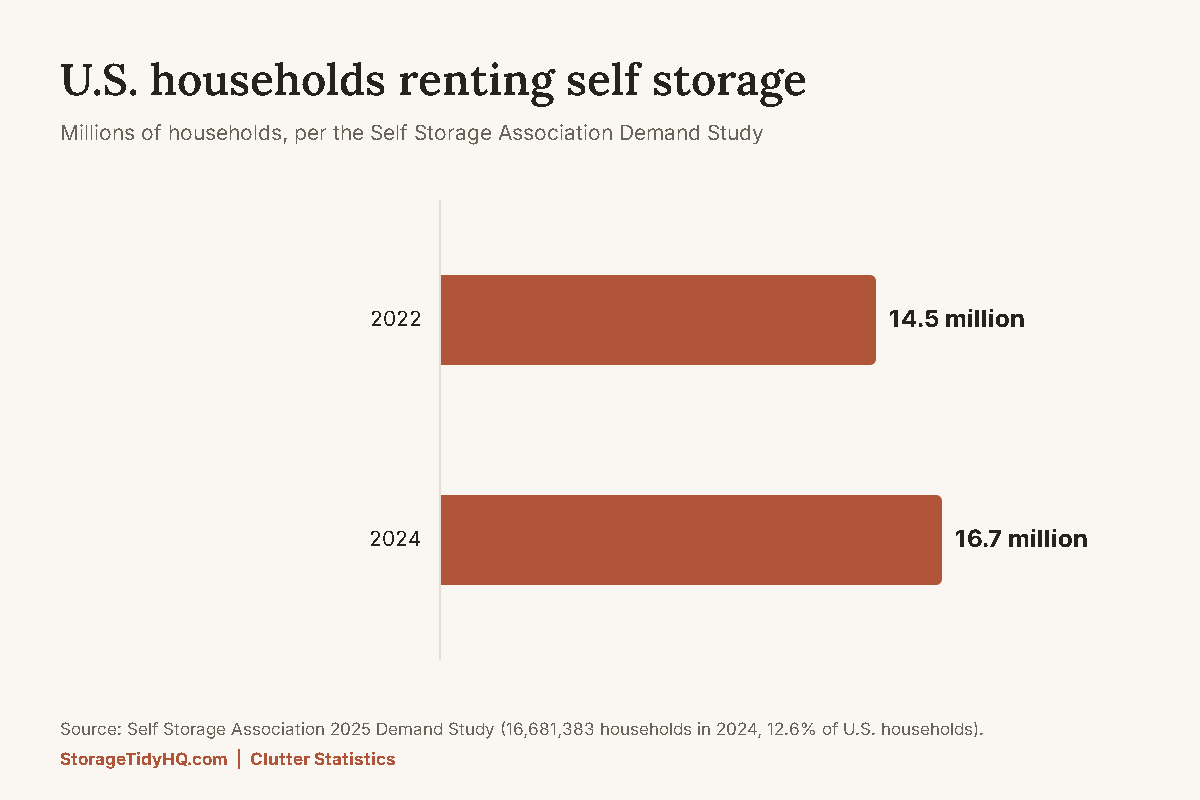
The Self Storage Association's 2025 Demand Study is the industry's own measurement and the most reliable figure available. It found that 12.6% of U.S. households, or 16,681,383 households, were renting a self-storage unit in 2024. That's up from 14.5 million households in 2022.
You'll also see much bigger numbers, like one in three or one in four Americans renting storage. Those come from online surveys of people visiting storage and rental websites, which is a group more likely to rent storage than the country as a whole. See myth four below.
Home size and housework
Space is the other side of the equation. The Census Bureau reports that the median new single-family home completed in 2025 was 2,142 square feet. Less square footage means closets, pantries, and garages have to work harder, which is most of what this site is about.
Housework takes real time too. In the 2025 American Time Use Survey, 87% of women and 75% of men did some household activity on an average day. On the days they did, women spent 2.8 hours and men 2.1 hours. That category is broad: it covers cleaning and laundry, and also cooking, lawn care, and household management. So it's not a clutter number on its own, just the time budget clutter eats into.
Hoarding versus ordinary clutter
Clutter statistics sometimes get mixed up with hoarding statistics. They're different things. The American Psychiatric Association puts the prevalence of hoarding disorder at about 2.6%, with higher rates in people over 60. Hoarding disorder is a diagnosable condition defined by persistent difficulty discarding things and distress at the thought of it, to the point that living spaces can't be used as intended. A crowded coat closet isn't that, and if you're worried someone you know has crossed that line, a doctor or licensed therapist is the right first call, not an organizing article.
Pantry clutter and food waste
One more number that connects to clutter in a practical way. The U.S. Department of Agriculture (USDA) estimated that 31% of the U.S. food supply was lost or wasted at the retail and consumer level in 2010, or 133 billion pounds worth almost $162 billion. A deep, jumbled pantry is where cans and half bags go to expire, which is why our pantry organization ideas focus on visibility over maximum capacity.
Five clutter statistics myths we could not verify
These show up on many clutter statistics pages. For each one, we looked for an original study and didn't find one, or found that the real source says something narrower.
Myth 1: The average American home has 300,000 items
This one traces to a 2014 Los Angeles Times article quoting a professional organizer. No study counted it. As one detailed debunk points out, "item" isn't even defined (is a box of paper clips one item or a hundred?), and Britain's most notorious hoarder was reported to have about 60,000 items. Treat 300,000 as a guess, not a statistic.
Myth 2: The Department of Energy says 25% of people with two-car garages can't park in them
We couldn't find this in any Department of Energy publication. The Department of Energy garage data we did find counts how many homes have a garage or carport, not whether cars fit inside. The 25% figure comes from UCLA and describes garages that could hold a car in 32 Los Angeles homes. Both the attribution and the national framing look wrong.
Myth 3: Getting rid of clutter eliminates 40% of housework
This is usually credited to the National Soap and Detergent Association, now called the American Cleaning Institute. We couldn't find a published study, survey or report behind it. Without an original source, it can't be checked or cited.
Myth 4: One in three (or one in four) Americans rents a storage unit
The StorageCafe figure behind the one-in-four version comes from an online survey of 1,430 respondents recruited on RentCafe and StorageCafe, run from November 2025 to June 2026. That's a self-selected group of people already browsing rental and storage sites. The Self Storage Association's household number, 12.6%, is the better national figure.
Myth 5: Princeton proved that clutter destroys your focus
As covered above, the 2011 Princeton paper studied how shapes on a screen compete in the visual cortex. It's relevant background, but it isn't a study of cluttered homes or offices, and it didn't measure productivity.
How we checked these clutter statistics
For every figure, we opened the primary source itself: the survey press release, the journal abstract, or the government table. We recorded who ran it, the sample size, the year, and who funded it, when that affects how the number should be read. If a number only appeared in other roundups, it went in the myths list instead of the table. We'll update this page when a newer version of any source is published, such as the next Self Storage Association Demand Study or the annual Census Bureau and Bureau of Labor Statistics releases.
Last checked: September 28, 2026.
Using these statistics
You're welcome to use any figure or chart on this page in an article, class or presentation. Please link to the primary source for the number and to this page as the place you found it, so readers can check the context. Suggested citation: StorageTidyHQ, "Clutter Statistics: 14 Verified Numbers and 5 Myths," storagetidyhq.com/clutter-statistics/, September 2026.
Clutter statistics FAQ
How much time do people spend looking for lost things?
About 2.5 days a year, according to a 2016 survey of more than 1,700 U.S. adults commissioned by Pixie, a maker of item trackers. It's self-reported, so it's an estimate, not a measurement.
What percentage of Americans rent a storage unit?
12.6% of U.S. households rented a self-storage unit in 2024, about 16.7 million households, according to the Self Storage Association's 2025 Demand Study.
Does clutter cause stress?
Studies link clutter to worse mood and lower well-being, and one found that women who described their homes as cluttered or unfinished had less healthy daily cortisol patterns. These are associations, not proof that clutter causes stress, and the effects in the largest recent study were modest.
Is it true the average home has 300,000 items?
No study supports it. The figure comes from a 2014 newspaper quote, and it has been repeated ever since without a source.
How common is hoarding disorder?
About 2.6% of people, per the American Psychiatric Association, with higher rates after age 60. Ordinary clutter is far more common and isn't the same thing.