The best small bathroom storage ideas start with the wall, not the floor. A small bathroom rarely has floor space to spare, but it usually has open wall above the toilet, a bare back of the door, and shower corners that could hold more than they do. Most clutter in a small bathroom comes from a few things with no set place: backup toilet paper, extra towels, and the bottles that pile up on the tub ledge.
StorageTidyHQ is a participant in the Amazon Services LLC Associates Program, an affiliate advertising program designed to provide a means for sites to earn advertising fees by advertising and linking to Amazon.com. As an Amazon Associate, we earn from qualifying purchases.
This guide walks through where to add storage in a small bathroom, what holds up in a damp room, and what to skip. It also covers options for renters who cannot drill into tile or cut into walls.
Quick take
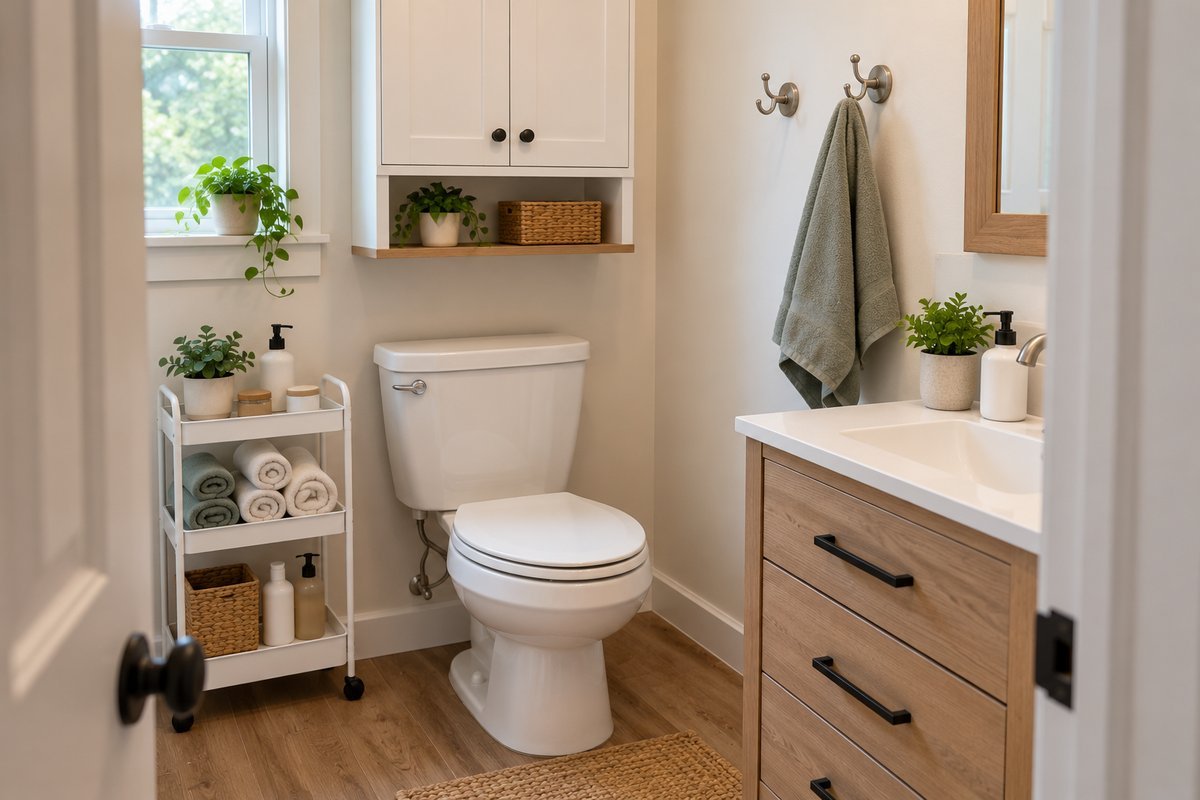
Use the wall above the toilet first. A wall cabinet or two sturdy shelves anchored into studs adds the most storage for the least floor space. Next, add hooks or a rack on the back of the door, and a tension pole caddy in the shower. If you own the home and plan a remodel, a recessed niche or medicine cabinet between the studs adds storage without taking up any room at all.
Budget option
A few hooks, an over-the-door rack, a shower caddy, and two or three lidded bins handle most small bathrooms without any drilling or new furniture.
Free tool
Not sure what bin size fits your shelf or cabinet? Use the storage bin size fit calculator to check before you buy.
Table of Contents
Measure before you buy anything
Small bathroom storage ideas only work if they fit your room. Before you shop, measure four spots: the wall above the toilet, the gap between the toilet and the vanity or wall, the back of the door, and the inside of the shower or tub.
Write down the width, the height, and the depth of each spot. Depth matters more than people expect. A shelf that sticks out too far over the toilet gets in the way when you stand up, and a cabinet that is too deep can block the mirror or the light.
Leave room around the toilet, too. The International Residential Code, a model building code that many US states and towns adopt, calls for at least 15 inches from the center of the toilet to any side wall, partition, or vanity, and at least 21 inches of clear space in front of it. Freestanding storage next to the toilet should not cut into those spaces. Also leave enough room above the tank to lift the tank lid, since you will need to get inside the tank for repairs someday.
Use the wall above the toilet
The wall above the toilet is the biggest open space in most small bathrooms, so it is the first place to look when you weigh small bathroom storage ideas. There are three common ways to use it.
Wall cabinet
A wall cabinet with doors is the best choice for things you want out of sight, like backup toilet paper, spare soap, and cleaning supplies. Closed doors also keep dust and steam off what is inside. Hang it high enough to clear the tank lid and screw it into the wall studs, not just the drywall.
Product pick
ChooChoo Over-the-Toilet Wall Cabinet
A wall cabinet with two doors that hangs above the toilet.
Floating shelves
Two or three open shelves work well for things you use every day, like hand towels, a small plant, or a jar of cotton swabs. Open shelves look lighter in a small room, but anything on them collects dust and steam. Keep the shelves for items you are happy to see, and put the rest in a lidded bin or basket on the shelf.
Freestanding over-the-toilet unit
Freestanding units with legs that straddle the toilet need no drilling, which makes them a good fit for renters. The downside is that they can wobble. Check that the unit can be tied to the wall with the included strap or bracket, and keep heavy items on the lower shelves.
Product pick
Kalrin 4-Tier Over-the-Toilet Rack
A freestanding rack with four shelves that fits over the toilet.
Add a recessed niche or medicine cabinet
A recessed cabinet or niche sits inside the wall, between the studs, so it adds storage without sticking out into the room. Of all the small bathroom storage ideas here, it is the only one that takes up no room at all. In most homes, studs are 16 inches apart from center to center. Since a standard stud is 1.5 inches thick, that leaves about 14.5 inches of open space between them. A standard 2 by 4 wall is about 3.5 inches deep inside. Many recessed medicine cabinets are sized to fit that space, so check the cabinet's rough opening size before you buy.
Before you cut, find out what is inside the wall. Water pipes, wires, and vent ducts often run through bathroom walls. A small test hole lets you look inside with a flashlight. Outside walls are often full of insulation and are a poor spot for a recessed cabinet. If the wall is not a good fit, a surface-mount medicine cabinet hangs on the wall and needs no cutting.
One thing to keep out of the bathroom cabinet: most medicines. MedlinePlus, from the National Library of Medicine, warns that heat and moisture from the shower, bath, and sink can damage medicines, and it suggests a cool, dry spot like a dresser drawer or a kitchen cabinet away from the stove and sink. It also says to keep medicines out of reach and out of sight of children, in a cabinet with a child latch or lock. That frees the medicine cabinet for toiletries, which handle the damp much better.
Get more out of the vanity
If you have a vanity, the cabinet under the sink is often the messiest spot in the room. The pipes take up the middle, so the trick is to use the sides and the doors. Stackable drawers on each side of the pipes, a small turntable for bottles, and a narrow organizer on the inside of the door all help. Our guide to under-sink storage ideas covers this space in more detail.
On top of the vanity, keep only what you use every day. A small tray groups toothbrushes and soap so the counter is easy to wipe. Everything else can go in drawers or in the wall cabinet.
A pedestal sink has no cabinet at all. In that case, a slim shelf above the sink or a small cart beside it gives you the storage a vanity would.
Shower and tub storage
The shower is where bottles pile up fastest. These small bathroom storage ideas keep the tub ledge clear.
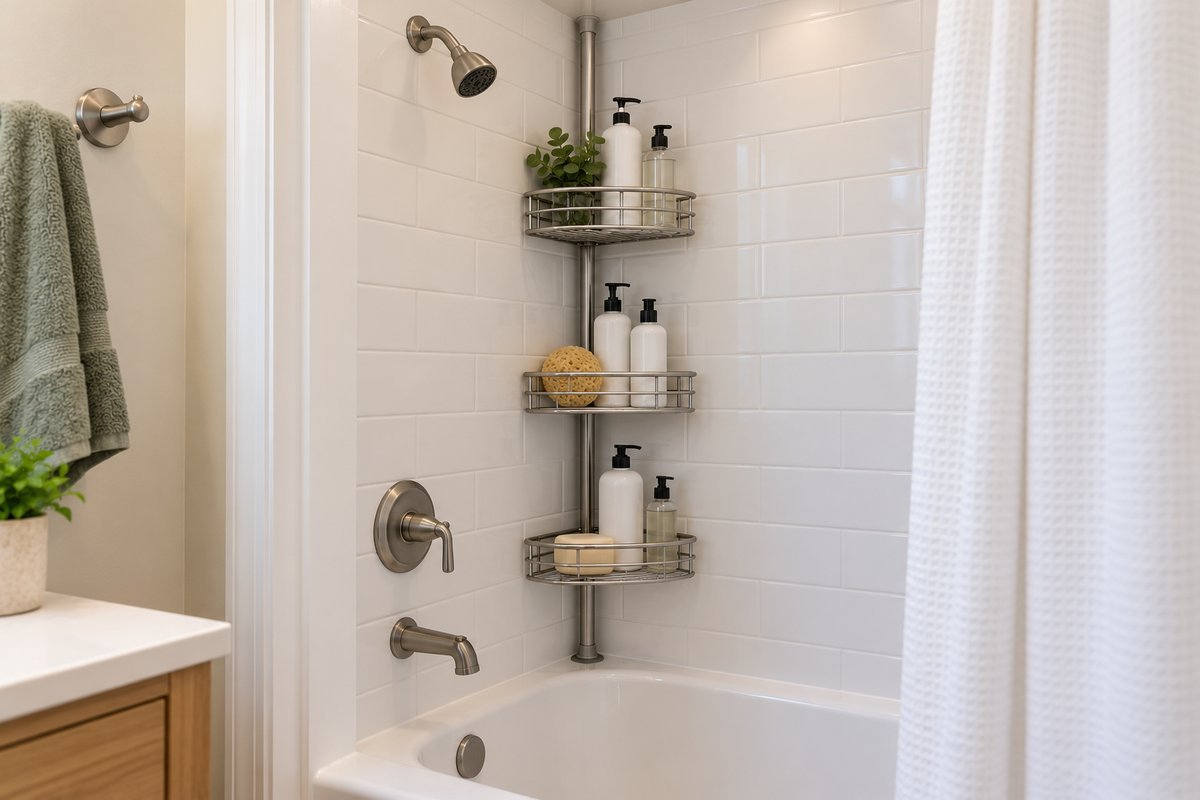
- Tension pole caddy. A pole that presses between the tub and the ceiling usually holds three or four shelves in a corner. It needs no drilling and moves with you if you rent.
- Corner shelves. Small shelves that tuck into a corner use space that is otherwise empty. Look for a version that drains so water does not sit on it.
- Over-the-showerhead caddy. These hang from the shower arm. They are cheap and easy, but they can slide down or tip, so keep them light.
- Built-in niche. If you are remodeling, a niche built into the shower wall is the cleanest option. It has to be waterproofed like the rest of the shower, so it is a job for the remodel, not a weekend.
Pick rust-resistant materials for anything in the shower, like stainless steel, aluminum, or plastic. Cheap chrome-plated wire can rust over time in a wet room, often where the wires are joined. It also helps to cut down on how many bottles are open at once. Finish one before opening the next, and keep the backups in a bin in the cabinet.
The back of the door and other dead space
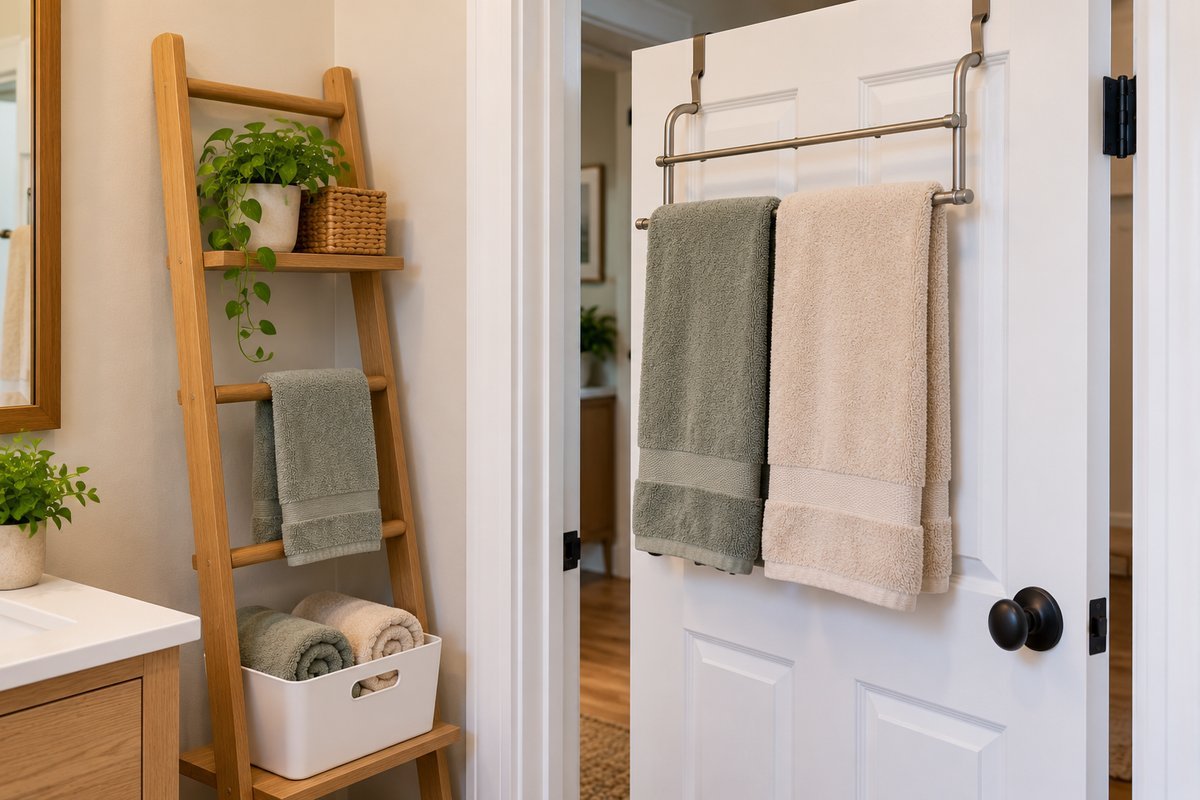
The back of the bathroom door is easy to forget, which makes it one of the most overlooked small bathroom storage ideas. An over-the-door rack or a row of hooks can hold towels, robes, or a hanging organizer with pockets for hair tools and small items. Before you buy, check that the door still closes with the rack in place. Some doors have only a small gap at the top.
Other spots that are often empty:
- Above the door. A single shelf over the door frame can hold extra toilet paper or rarely used items.
- The gap beside the toilet. A slim rolling cart fits the narrow space between the toilet and a wall or vanity. Measure the gap and compare it with the cart's listed width, leaving a little room to slide it in and out.
- The window ledge. A deep ledge can hold a few items, but keep it clear if the window opens or if the spot gets wet.
- A ladder shelf. A leaning ladder shelf takes up little floor space and holds towels on its rungs.
Small bathroom towel storage ideas
Towels take up more space than almost anything else in a small bathroom. A few ways to handle them:
- Hooks instead of a long bar. Hooks take up less wall width than a towel bar. A towel bar spreads the towel out so it dries faster, though, so if your bathroom stays damp, a bar may be the better pick for the towel you use every day.
- Rolled towels in a basket. Rolling towels instead of folding them lets you fit more in a basket or on an open shelf.
- A towel rack on the door. An over-the-door rack holds two or three towels and keeps the walls free.
- Extra towels elsewhere. If you have a hall linen closet, keep only the towels in use in the bathroom and store the rest there. Our linen closet organization ideas cover how to set that space up.
Small bathroom storage ideas compared
This table sums up the small bathroom storage ideas above, with what each one is best for and what to watch out for.
| Storage spot | Best for | Drilling? | Renter friendly? | Watch out for |
|---|---|---|---|---|
| Wall cabinet above the toilet | Backups and cleaning supplies | Yes, into studs | Ask your landlord | Leave room to lift the tank lid |
| Floating shelves | Hand towels and daily items | Yes | Ask your landlord | Dust and steam on open items |
| Over-the-toilet unit | No-drill storage | No | Yes | Can wobble, so strap it to the wall |
| Recessed cabinet or niche | Toiletries | Cuts into the wall | No | Pipes, wires, and outside walls |
| Tension pole caddy | Shower bottles | No | Yes | Pick rust-resistant shelves |
| Over-the-door rack | Towels and robes | No | Yes | The door must still close |
| Slim rolling cart | The gap beside the toilet | No | Yes | Measure the gap first |
Why some bathroom storage fails
Bathrooms are damp, and dampness is hard on storage. The EPA suggests running the bathroom exhaust fan or opening a window when you shower, and keeping indoor humidity below 60 percent, ideally between 30 and 50 percent. Steam that stays in the room ends up in your cabinets and baskets.
A few things help storage last longer in a damp room:
- Pick materials that handle moisture. Plastic, metal with a good finish, and sealed or painted wood hold up better than raw particleboard. Particleboard can swell if it stays wet.
- Leave space for air. Do not pack shelves and cabinets so tight that nothing can dry. A little open space lets air move.
- Watch woven baskets. Seagrass and other natural-fiber baskets look nice but can grow mildew in a steamy room. Use them for dry items, away from the shower, or use plastic bins instead.
- Wipe up spills. A wet bottle on a wood shelf leaves a ring over time. A small tray under bottles makes cleanup easy.
Renter-friendly small bathroom storage
If you rent, you may not be allowed to drill into walls or tile. These bathroom storage ideas for small spaces need no holes:
- A freestanding over-the-toilet unit
- A tension pole caddy in the shower
- An over-the-door rack or hooks
- A slim rolling cart beside the toilet
- Lidded bins and baskets on existing shelves
- Adhesive hooks for light items
For adhesive hooks, check the weight limit on the package and whether the brand says the hook works in a humid room. Some adhesive hooks are not made for steamy rooms and can let go when the adhesive softens. Keep them for light things like a washcloth or a hand towel.
What to skip
- Big freestanding cabinets on the floor. In a small bathroom, floor space matters more than any extra storage a cabinet adds. Use the wall space instead.
- Too many small containers. Lots of tiny bins can look neat on day one and turn into clutter within a few weeks. A few larger, lidded bins are easier to keep up.
- Open shelves for everything. Open shelves look nice, but every item on them collects dust and steam. Save them for a few things you like to look at.
- Storage that blocks the toilet or the door. If a unit makes the room harder to move around in, it is not worth the space it adds.
Common mistakes
The most common mistake with small bathroom storage ideas is buying storage before you clear out. Toss old bottles, expired products, and anything you have not used in months first. Many small bathrooms need less storage than it seems once the extras are gone.
The second mistake is hanging heavy things on drywall alone. A wall cabinet full of bottles is heavy. Screw it into the studs or use anchors rated for the weight, and check the rating on the package.
The third is forgetting about cleaning. Every shelf and container is one more thing to wipe. Pick storage that is easy to clean, and keep the number of items on display low.
Small bathroom storage FAQ
How can I add storage to a small bathroom without drilling?
Use a freestanding over-the-toilet unit, a tension pole caddy in the shower, an over-the-door rack, and a slim rolling cart beside the toilet. Lidded bins on existing shelves help too. None of these need holes in the wall.
Where should I store extra toilet paper in a small bathroom?
A closed wall cabinet above the toilet works well because it keeps the rolls dry and out of sight. A shelf above the door or a lidded basket on an over-the-toilet unit also works.
Is it OK to keep medicine in the bathroom?
MedlinePlus advises against it, because heat and moisture from the shower and sink can damage medicines. It suggests a cool, dry spot like a dresser drawer or a kitchen cabinet away from the stove and sink, out of reach and out of sight of children.
How do I keep bathroom storage from getting moldy?
Run the exhaust fan or open a window when you shower, as the EPA suggests. Pick plastic, metal, or sealed wood, leave some space for air to move, and keep woven baskets away from the shower.
The bottom line
The best small bathroom storage ideas use space you already have: the wall above the toilet, the back of the door, and the corners of the shower. Measure first, clear out what you do not use, and use the walls before you add anything to the floor. Once the storage is in place, our bathroom organization ideas guide shows how to sort what goes inside it. For more ideas for tight spaces, see our small-space and laundry storage guides.