Most garage organization advice online is a photo of a spotless two-car garage with matching cabinets and a polished epoxy floor, and no real information about what it costs or how long it holds up once the lawn mower, the bikes, and the holiday bins go back in. This is the fuller version: real garage organization ideas broken down by garage type, what each fix actually costs, and which popular fixes are genuinely worth skipping.
This applies whether the garage in question is a one-car garage that also has to fit a workbench, a two-car garage that has slowly become the house’s overflow storage, or a garage that doubles as a real workshop. The decisions under all three are similar, even though the specific fix looks different in each case.
Quick take
Get things off the floor before anything else. Wall and ceiling space is nearly free capacity that most garages never use. A full built-in cabinet system is nice but rarely necessary. Most garages need $150 to $500 in the right fixes, not a $3,000 wall of cabinets.
Table of Contents
The decisions that actually matter
Most garage organization ideas boil down to a harder version of the same problem a closet or pantry has: several completely different categories of stuff at once, tools, seasonal items, sports gear, yard equipment, and whatever the house has no other room for. A few decisions do most of the work.
- Floor space is for the car and for things in use, nothing else. Everything that isn’t a vehicle or an active project belongs on a wall, a shelf, or the ceiling. This one rule solves more garage clutter than any product purchase.
- Zone by category, not by “where it fits.” Tools in one area, seasonal and holiday items in another, sports and yard gear in a third. A garage organized by category stays usable. One organized by whatever gap was open that day does not.
- Use ceiling storage for things you touch a few times a year. Holiday decorations, camping gear, the extra set of patio cushions. Ceiling racks are harder to access than wall storage, so they should hold stuff you can afford to reach only occasionally.
How to organize a garage, start to finish
This is the order that actually works, done in one pass rather than the piecemeal way most garages get “organized” a corner at a time over several years.
- Pull the car out and empty the floor completely. Everything onto the driveway. This is the only way to see what’s actually being stored.
- Sort into keep, donate, or sell, and toss. Garages accumulate things nobody else in the house even knows are there. Be honest about what hasn’t been touched in two years.
- Sweep and assess the walls and ceiling. This is the moment to notice whether there’s a stud pattern you can actually mount into, and whether the ceiling has enough clearance for a rack.
- Install wall and ceiling storage before anything goes back in. Same logic as a closet or pantry: putting things back onto a setup that’s about to change wastes the effort.
- Zone the space, then bring items back in by zone. Keep tools near the workbench, seasonal items up on ceiling racks, and yard and sports gear near the door that leads outside.
- Park the car last, once everything else has a home. If the car doesn’t fit back in after all this, the garage isn’t actually organized yet; it’s just tidier.
A full garage reset like this usually takes a full weekend for an average two-car garage, more if wall or ceiling systems are being installed rather than just adjusted. The sorting step is almost always the slowest part, not the physical install.
Garage organization ideas by garage type
The right fix depends heavily on how the garage actually gets used, not just its size.
One-car garage organization ideas
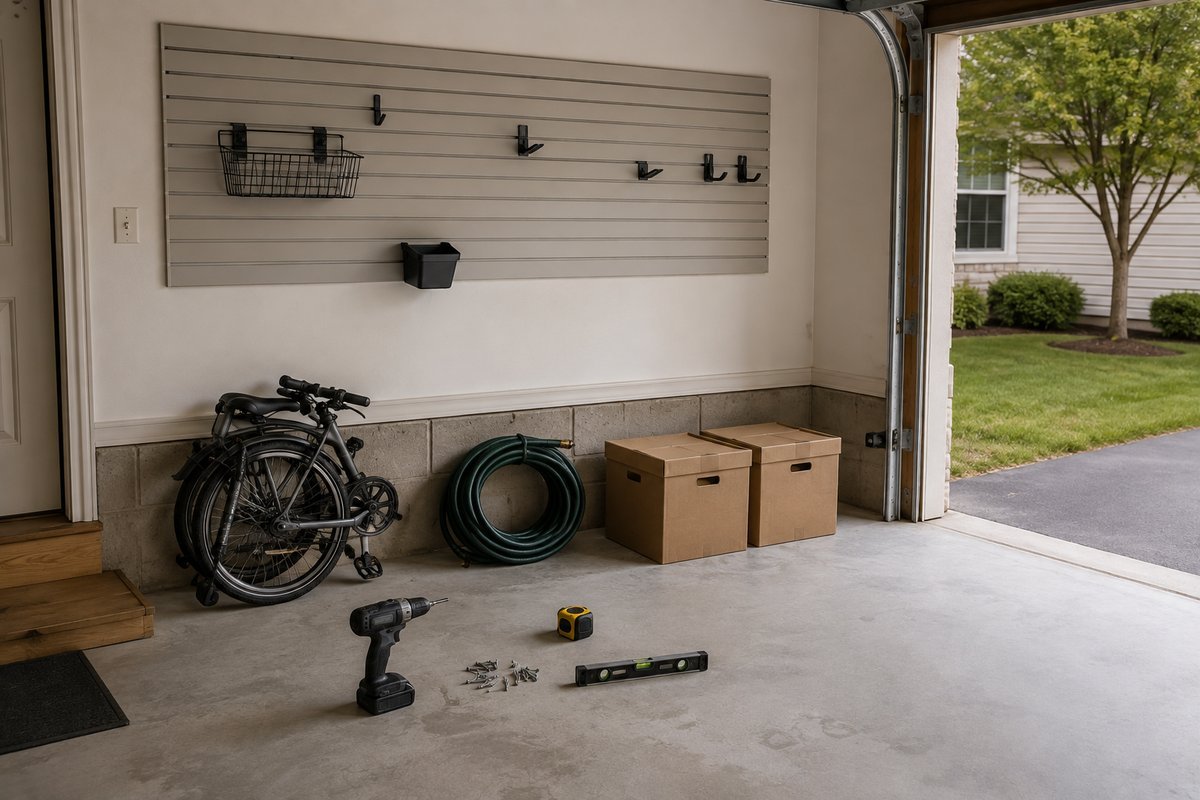
A one-car garage that also has to fit a workbench, a bike, and the trash cans has almost no floor space to spare. Wall-mounted track systems and slatwall panels do the most work here, turning empty vertical space into hanging storage without eating into the footprint. Foldable or wall-mounted workbenches are worth the extra cost in a tight one-car garage specifically because they give the floor back when not in use.
Two-car garage organization ideas
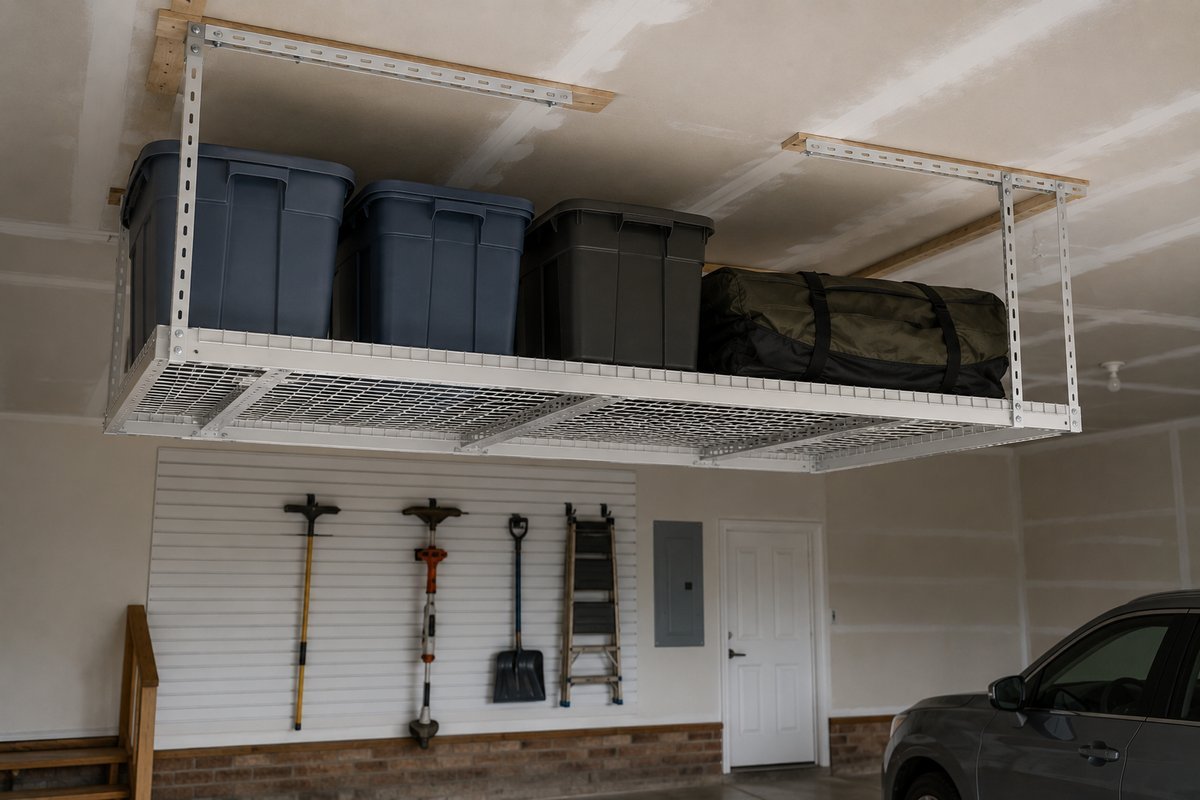
A two-car garage has more floor space, which is exactly what makes it the house’s overflow storage room. Zoning matters most here: pick a wall for tools, a wall or ceiling section for seasonal items, and keep a clear aisle down the middle so both cars can actually get in. Overhead ceiling racks earn their keep in a two-car garage because there’s enough open ceiling to make one worth mounting.
Workshop garage organization ideas
A garage that doubles as a real workshop needs a different priority order: the workbench and its immediate tool storage come first, then everything else gets built around it. Pegboard above the bench keeps daily tools visible and within reach. Rolling tool chests and stackable bins work better than fixed shelving here, since a workshop’s layout tends to shift as projects change.
What is actually worth buying
Garage organization ideas lists tend to recommend a full wall of matching cabinets. In practice, a short list covers almost every real garage:
- Wall track or slatwall panels (Gladiator GearTrack, Rubbermaid FastTrack) roughly $30 to $80 per section. This is the highest-impact purchase for turning empty wall space into real storage.
- An overhead ceiling storage rack (FLEXIMOUNTS, NewAge) is roughly $100 to $250 for a basic 4-by-4-foot platform. Best for seasonal items that only need to come down a few times a year.
- Heavy-duty wall shelving: roughly $60 to $150 per shelf unit. Worth it for anything too heavy or bulky for a track system, like paint cans or bulk pet food.
- Pegboard with hooks: roughly $20 to $50 for a starter setup. The cheapest way to get tools off the workbench and visible at a glance.
- A rolling tool chest or storage cart roughly $80 to $300 depending on size. Best in a garage doubling as a workshop, where the layout changes project to project.
- Clear stackable bins roughly $8 to $20 each. Buy uniform sizes for whatever category they’re holding, seasonal items especially, so a ceiling rack doesn’t end up full of mismatched shapes.
- A basic label maker costs roughly $15 to $30. Worth it on bins that go up on a ceiling rack or high shelf, since you won’t want to pull one down just to check what’s inside.
Garage storage systems: kit or build your own
A packaged garage storage system, cabinets, wall panels, and overhead racks sold together as one set, is the fastest way to organize a garage and also the most expensive. A mid-range packaged system typically runs $1,500 to $3,000 installed. Building the same setup piece by piece from a hardware store, using separate wall track, standalone shelving, and a basic overhead rack, usually lands between $400 and $900 for a comparable amount of storage. The trade is convenience and a matched look versus real savings and a weekend of your own labor.
A packaged system is worth it when you’re fully redoing the garage at once, when matching cabinets matters for resale or personal taste, or when you don’t have time to shop and install piece by piece. Building it yourself is worth it in almost every other case, especially for a garage that only needs one or two problem areas solved rather than a full redesign.
Budget-friendly garage organization ideas, by tier
Budget-friendly garage organization ideas don’t have to mean skipping the fix. They mean picking the right tier for what the garage actually needs.
- Free (a weekend, no purchase): Pull everything out, sort into keep, donate, and toss, and put items back zoned by category with nothing left sitting on the floor that doesn’t need to be. This alone recovers real usable space in almost every garage.
- Under $50: A basic pegboard kit with hooks, a handful of clear bins, and a roll of labels. Covers tool visibility and basic bin storage without permanently altering the walls.
- $50 to $200: A section or two of wall track or slatwall panel, plus a few heavy-duty shelf brackets. This range actually starts clearing the floor.
- $200 to $600: A full run of wall track across one wall, a basic overhead ceiling rack, and enough bins to fill both. This tier changes how much the garage actually holds, not just how it looks.
Garage ceiling storage: what to know before you install
Garage ceiling storage is one of the highest-value fixes available, since most garages have a full open ceiling doing nothing. It’s also the one category where getting the install wrong actually matters. Ceiling racks mount into the joists, not just the drywall, so finding and marking the real joist pattern before drilling is the first step, not an optional one. Weight ratings matter more here than on wall shelving: a rack rated for 250 pounds means 250 pounds total, not per shelf, and it’s easy to underestimate how much a full set of holiday totes actually weighs once they’re packed.
Clearance is the other thing people miss. A rack platform needs enough gap below it for the car to clear, plus room above for whatever you store on it, which rules out ceiling storage in garages with low clearance or a garage door track that runs close to the ceiling. Measuring before buying saves a return trip more often than any other step in this list.
Overhead garage storage racks range from simple fixed platforms to motorized lifts that lower to shoulder height at the push of a button. The motorized versions cost several times more and mostly make sense for anyone who can’t safely use a ladder, or for genuinely heavy items that are awkward to lift overhead by hand. For most households, a basic fixed platform rack does the job for a fraction of the price.
How long a garage organization project actually holds up
This is the part most garage organization ideas lists skip. A zoned garage with wall track and a ceiling rack generally holds its shape for a year or more before it needs a real reset, longer than a closet or pantry, mostly because garage storage tends to hold less frequently touched items in the first place. What actually breaks the system down over time is usually a new hobby, a new vehicle that changes what fits, or a big seasonal haul (holiday decorations, sports gear from a new activity) that never gets assigned a zone and just lands on the floor near the door.
The fixes that hold up longest are the structural ones: wall track and ceiling racks sized for what you’re actually storing. The fixes that fail fastest are loose piles with no assigned zone, since nothing stops the next new item from landing right back on the floor.
Common garage organization mistakes
A few garage organization ideas backfire in the same predictable ways.
- Buying a full cabinet system before solving the floor problem. Matching cabinets look good, but if the floor is still covered in loose items, the garage isn’t organized; it’s just more expensive.
- Skipping the ceiling. The single most commonly wasted space in a garage, especially for items used only a few times a year.
- Zoning by leftover space instead of by category. Putting things wherever there happens to be room means the same clutter just moves around instead of actually getting organized.
- Ignoring weight limits on shelving and ceiling racks. A rack rated for less than what’s stacked on it is a real safety issue, not just an organizing one.
- Skipping the “empty it out first” step. Organizing around what’s already sitting there almost always means re-hiding the same clutter behind nicer bins.
What we would skip
Not every one of these garage organization ideas is worth the money. A full matching cabinet wall in a garage used only for basic storage is usually overkill. That level of build makes sense in a dedicated workshop or a garage being redone specifically for resale, but on an average garage, wall track plus a few standalone shelves does the same job for a fraction of the price. We would also skip epoxy flooring purely for organization’s sake. It looks great, but it doesn’t add storage capacity, and the money is almost always better spent on wall and ceiling systems first.
Frequently asked questions
What is the best way to organize your garage?
Empty it completely, sort into keep, donate, and toss, then rebuild using walls and ceiling before the floor. Zone by category (tools, seasonal, yard and sports gear) rather than putting things wherever there happens to be space, and park the car last once everything else has a home.
What are common garage organization mistakes?
Buying a full cabinet system before solving the floor problem, skipping the ceiling entirely, zoning by leftover space instead of by category, ignoring weight limits on shelving and racks, and skipping the step of emptying the garage completely before starting.
What are 5 professional organizing tips for a garage?
Get everything off the floor first, use vertical and ceiling space before buying more floor storage, zone by category, install wall or ceiling storage before putting items back rather than after, and label anything going up high enough that you can’t easily see inside it.
How can I effectively organize my garage?
Start with a full empty-out rather than organizing around what’s already there, install wall track or shelving and an overhead rack before anything goes back in, and keep daily-use items like tools accessible while seasonal items go up on the ceiling where they’re harder to reach but that’s fine, since they’re only needed a few times a year.
Renter-friendly garage organization ideas
A rented house or an assigned garage space usually rules out drilling permanent wall track or a ceiling rack into someone else’s studs. Freestanding wire or plastic shelving units, rolling tool carts, and pegboard mounted on a freestanding frame rather than the actual wall all install and leave without a mark. Heavy-duty adhesive hooks handle light items like extension cords or garden tools on painted drywall or a finished garage wall, though they’re not rated for anything genuinely heavy. The zoning and floor-first steps cost nothing and transfer identically in a rental, which is why they’re worth doing even in a garage that might only be home for a year or two.
For a closer look at packaged systems versus building your own, including a full cost breakdown, see the Garage Storage & Organization hub.