Most small closet organization ideas online assume a closet at least four feet wide with room to add a full shelving system. The real version is a reach-in closet barely two feet deep, or a closet with an awkward angle cut into one corner, and the fixes have to work around that instead of ignoring it. This covers small closet organization ideas by closet shape, what is actually worth buying, and what most people regret once the closet is full again within a month.
The right approach depends heavily on whether the closet is a narrow reach-in, a closet with an awkward corner or slanted ceiling, or barely a closet at all, more of a nook with a rod. The decisions underneath are close to the same across all three, even though the specific fix looks different in each case.
Quick take
Double the hanging rod before buying anything else. Most closets waste the space below a single rod completely. Slim, matching hangers reclaim more room than any organizer sold specifically for small closets. Most small closets need $40 to $200 in the right fixes, not a full custom build.
Table of Contents
The decisions that actually matter
Before buying organizers, it helps to separate what a small closet actually needs from what looks good in a photo of a much bigger one. The small closet organization ideas that actually work start with the room’s real limits, not a showroom layout. A small closet’s job is narrow: hold clothes without crushing them, keep shoes off the floor, and give everything else in the closet a specific spot so it doesn’t end up in a pile on the floor under the hanging clothes.
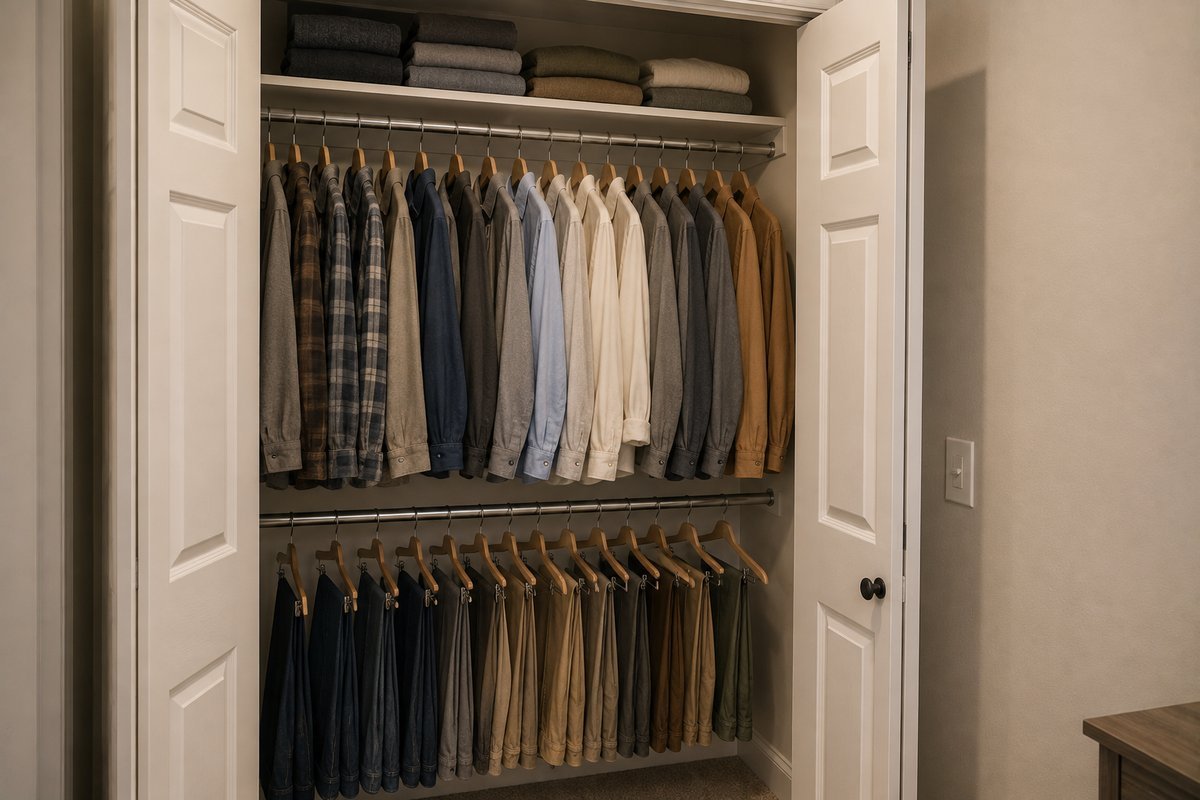
Most reach-in closets are built with a single rod set too high, leaving two or three feet of dead air underneath it. Doubling that rod, or dropping it and adding a second one below, is nearly always the single highest-value change available. After that, the real question is whether the closet needs a full shelving system or just a handful of targeted fixes: shoe storage, a shelf for folded items, and hooks for anything that should not be hung at all.
How to organize a small closet, start to finish
- Take everything out, including the floor, and sort into keep, donate, and toss before anything goes back in.
- Measure the closet’s actual width, depth, and the space above and below the existing rod before buying anything.
- Add a second rod or move the existing one to reclaim the dead space underneath, if the closet holds mostly shirts, folded pants, or short dresses.
- Switch to slim, matching hangers before adding any other organizer, since this alone typically reclaims two to four inches of hanging space.
- Add shoe storage and a shelf or bin system last, once the hanging space is settled, so they go where there is actually room left rather than wherever seemed open at the start.
Small closet organization ideas by closet shape
The right fix depends heavily on the closet’s actual shape, not just its overall size.
Narrow reach-in closet organization ideas
A narrow reach-in closet, often two feet deep or less, loses usable depth to anything mounted too far from the wall. A double-hang rod system claims the most space here, since most reach-in closets are built for one rod and leave the lower half empty. A slim over-the-door shoe organizer handles footwear without taking any floor space, which matters most in a closet this size.
Awkward angle or slanted ceiling closet organization ideas
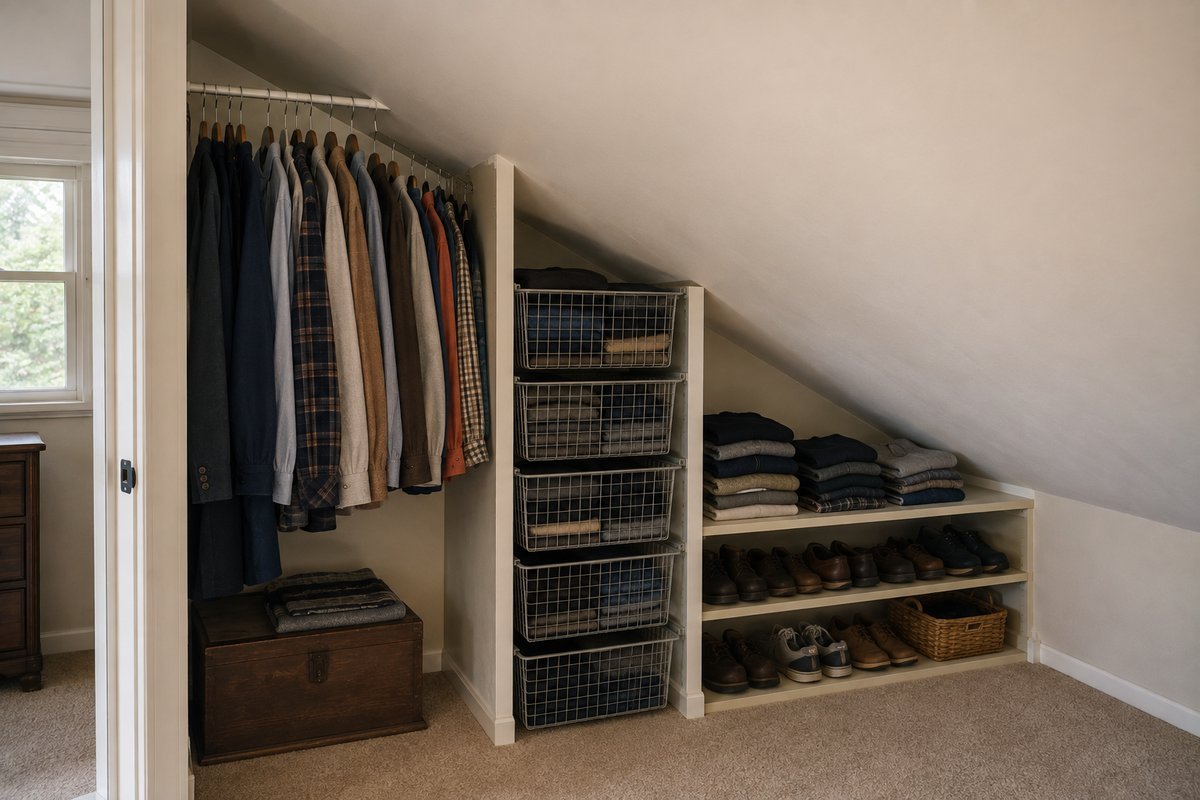
A closet built into a knee wall or with a slanted ceiling on one side wastes the low section unless you plan for it specifically. Use short hanging rods sized to fit only the tall section, paired with low bins or baskets for folded items in the short section, to use the space a standard full-width rod would simply ignore. Corner shelving units, cut or bought to fit the specific angle, use the deepest, most awkward part of the closet instead of leaving it empty.
No real closet: wardrobe and nook organization ideas
A bedroom with no built-in closet, just a nook or a corner with a single rod, needs the most complete solution of the three, since nothing is built in to start with. A freestanding wardrobe or garment rack with a shelf underneath handles hanging clothes and folded items in one unit. A fabric closet system with a zippered cover keeps dust off clothes in a space that was never meant to be a closet in the first place, and it comes down easily if the setup needs to change later.
What is actually worth buying
Not every product marketed for closets earns its shelf space, but these small closet organization ideas are worth spending money on. Slim, matching hangers are worth it in every small closet without exception, since replacing a mismatched set of thick plastic and wire hangers with a single slim style reclaims real hanging width for free, aside from the hangers themselves.
A double-hang rod kit is worth it in any closet built for a single rod that holds mostly shirts or folded pants, since it can roughly double usable hanging space. An over-the-door shoe organizer is worth it in a closet with a door, since it adds storage without touching the floor or the shelves.
A shelf divider is worth the small cost for anyone who stacks folded sweaters or jeans, since it stops a tall stack from toppling every time something is pulled from the middle. A single valet hook or rod, mounted just inside the closet, is worth adding for hanging tomorrow’s outfit or a bag heading out the door, since it keeps that item out of the main hanging space entirely.
Most small closet organization ideas marketed as complete systems bundle several of these pieces together, which can be worth it if the bundle matches the closet’s actual shape, but buying the individual pieces that solve a specific, identified problem almost always costs less than a bundle chosen because it looked complete in a photo.
Small closet shelving materials worth knowing about
Wire shelving is the cheapest and easiest to fit into an oddly sized closet, since most kits allow you to cut to width, and it lets dust and lint fall through instead of collecting on top. The tradeoff is that folded knits can pick up ridge marks from the wire if they sit there for weeks at a time.
Laminate shelving costs more but gives a flat, solid surface that will not leave marks on folded clothes, and it looks more finished if the closet door stays open often. Solid wood shelving sits at the top of the price range and holds the most weight without sagging over time, which matters most for a shelf stacked with heavier items like sweaters or shoe boxes.
None of the three is the wrong choice for a small closet specifically. Wire suits a closet that gets cut to an unusual width, laminate suits one that stays visible with the door open, and wood suits one carrying real weight on every shelf.
Small closet organization ideas for seasonal items
A small closet rarely has room to keep every season’s clothes hanging at once, which is where a rotation system earns its keep, and it is one of the more overlooked small closet organization ideas for anyone storing wool or other natural fibers long term. Vacuum-sealed storage bags compress bulky off-season items like coats and sweaters to a fraction of their hanging or folded size, freeing up real space for what you’re actually using. A single labeled bin on the closet’s top shelf, swapped twice a year, keeps the rotation simple enough that it actually happens instead of becoming a project people put off.
Wool sweaters and other natural fibers stored for months at a time are also a target for clothes moths, and Penn State Extension recommends washing items before long-term storage and checking sealed bins periodically rather than assuming they are safe once zipped shut.
Off-season shoes are easy to forget in this rotation, and they take up floor space year-round if nobody thinks to move them. A second small bin, stored on a shelf rather than the closet floor, handles this without needing a dedicated system.
Small closet organization systems: kit or build your own
A packaged closet kit, whether wire or laminate, costs more than building the same layout from individual rods, brackets, and shelving boards, but it arrives matched and sized for common closet widths, which saves real measuring and cutting time. Building a small closet system from individual pieces costs meaningfully less, often close to half the price of a comparable kit, and a small closet’s limited width makes the cutting and fitting simple enough for a first DIY project.
A full custom build, with cut-to-fit shelving and drawers, rarely makes sense in a small closet, since there usually isn’t enough width to fit drawers alongside hanging space without losing capacity elsewhere. The rod-and-shelf combination most kits already offer solves the vast majority of small closets without custom builds.
Budget-friendly small closet organization ideas, by tier
Under $30: A full set of slim, matching hangers. A hanging shelf organizer for sweaters or shoes that requires no installation. A pack of adhesive hooks for scarves, bags, or a robe.
$30 to $75: An over-the-door shoe organizer. A second closet rod and the brackets to mount it below the existing one. A stackable set of shelf dividers and drawer bins for the closet floor.
$75 to $200: A basic wire or laminate closet kit sized to the closet’s width, including rod and shelf. A slim rolling shoe rack for a closet with a few inches of extra floor depth. A corner shelf unit for a closet with an awkward angle.
$200 and up: A freestanding wardrobe or fabric closet system for a room with no built-in closet at all, typically only worth this much when it needs to also look finished as a piece of furniture rather than purely functional.
What we would skip
Not every small closet organization idea on the shelf is worth the money or the effort. A full custom closet build in a closet under three feet wide, since the cost rarely matches the limited capacity actually gained over a good kit. A closet organizer marketed as an all-in-one system with more compartments than the closet has room for, since most end up half empty and still in the way. Decorative closet lighting or hardware upgrades before you solve the actual storage problem, since they improve how the closet looks in a photo without adding a single inch of usable space.
How long a small closet organization project actually holds up
A properly mounted double rod, secured into studs or with the anchors rated for the closet’s actual wall material, holds the weight of a full closet of clothes indefinitely, with no real maintenance required. Slim hangers hold up for years under normal use, though the cheapest velvet-flocked versions can shed their coating faster than the rigid plastic ones. An over-the-door organizer is the shortest-lived item on this list: the hooks that grip the door tend to loosen within a year or two of daily use, especially on a hollow-core door, and need occasional retightening or replacement.
Common small closet organization mistakes
Some small closet organization ideas fail because of how they get chosen or installed, not because the product itself is bad. These are the mistakes that show up most often.
Buying a full organizer kit before measuring the closet’s actual width, which leads to returning shelving that doesn’t fit. Leaving the original single rod in place and adding storage around it instead of addressing the wasted space below it first. Mixing hanger types, which quietly eats hanging width one mismatched hanger at a time. Filling every shelf and bin to capacity immediately, which leaves no room for anything new without starting the whole sorting process over again.
Renter-friendly small closet organization ideas
A rented apartment or house usually allows more closet changes than people assume, since most fixes don’t require drilling. A tension rod, sized to the closet’s width, adds a second hanging level without a single screw. An over-the-door shoe organizer and adhesive hooks add storage without touching the walls. A freestanding shelf unit placed inside the closet floor adds real capacity and moves out with you when the lease ends. The one fix that does need permission is mounting a second permanent rod into the wall, which is worth asking about specifically since it is usually a small, easily reversible change most landlords approve.
For a closer look at organizing a full closet system rather than just a small one, see the Closet Organization & Systems hub.
Frequently asked questions
What is the best way to organize a small closet?
Empty it completely, sort into keep, donate, and toss, then rebuild by adding a second rod below the existing one before anything else. Switch to slim matching hangers, and add shoe storage and shelf bins last, once the hanging space is settled. These small closet organization ideas work the same way whether the closet is a narrow reach-in or a shallow wall closet.
What are common small closet organization mistakes?
Buying an organizer before measuring the closet’s actual width, leaving the original single rod in place instead of doubling it, mixing hanger types, and filling every shelf to capacity immediately with no room to spare.
How do I maximize space in a small closet?
Add a second rod to use the space below a standard single rod, switch to slim, matching hangers to reclaim hanging width, and use the back of the door for shoes instead of floor or shelf space. Vertical space above the existing shelf, often left empty, is usually the next easiest gain.
What should I do with an awkward angled closet?
Use a short rod sized to the tall section only, and put low bins or baskets in the short section where a standard rod would not clear the ceiling. A corner shelf unit cut or bought to fit the angle uses the deepest part of the closet instead of leaving it as dead space.
Should small closet shelving be wire, laminate, or wood?
Wire is the cheapest and easiest to cut to fit an odd width, but it can leave ridge marks on knits left sitting for weeks. Laminate gives a flat surface that will not mark folded clothes and looks more finished. Wood holds the most weight without sagging, which matters most for shelves carrying shoes or heavy sweaters.
How do I store off-season clothes in a small closet?
Compress bulky off-season items like coats and sweaters into vacuum-sealed bags, then store them in a single labeled bin on the closet’s top shelf, swapping them twice a year. This frees the hanging space and shelf room that off-season clothes would otherwise occupy year-round.