Most “garage organization ideas on a budget” lists are really just a shorter version of the full-price list, minus the expensive stuff. That’s not the same as actually building a plan around what’s free, what’s genuinely cheap, and what one or two purchases are worth stretching for. This is the budget-first version: what to do before spending anything, what to buy when you do spend, and which popular “budget” products are actually a waste of money at any price.
This works whether the goal is a total garage overhaul on a tight number, or just fixing the worst problem area without a big project. The sequence is the same either way: free first, cheap next, and real money only where it actually earns its keep.
Quick take
Sorting and zoning cost nothing and solve most of the visible mess by themselves. After that, a $20 pegboard kit and a few repurposed containers cover daily tools and loose items. The one thing worth real money, even on a tight budget, is a proper wall anchor point or two for anything heavy. Skip the packaged “budget” cabinet kits; they cost more than building the same coverage piece by piece.
Table of Contents
The decisions that actually matter on a budget
Good garage organization ideas on a budget follow the same physics as a full-price plan; the difference is entirely in sequencing and where the money goes.
- Free steps come before any purchase. Sorting, zoning, and a real donate/toss pass solve more of the actual problem than any product will. Skipping this step and buying storage first just means paying to store things that should have left the garage.
- Spend on the one thing that touches everything else. A basic wall track or a run of heavy-duty shelf brackets is the single purchase that makes every other cheap fix (bins, hooks, repurposed containers) actually work. Buying small stuff first and the anchor point last means redoing the small stuff.
- Repurposed and dollar-store items are fine for light, low-stakes storage, not for anything heavy or overhead. A margarine tub is a perfectly good screw bin. It is not a substitute for a rated ceiling rack under a box of holiday lights.
Garage organization ideas on a budget, in the right order
Doing these out of order is the single biggest reason a “budget” garage project ends up costing more than a planned one.
- Empty the garage and sort first, before buying anything. This step is free and it’s also the biggest space recovery of the whole project. A garage that gets a real donate/toss pass often needs less storage than it looked like it did.
- Identify the one or two things that actually need real money. Usually that’s a wall anchor point for anything heavy, or a single run of shelving. Everything else on this list is cheap or free.
- Fill in with repurposed containers and dollar-store organizers. Once there’s a real place for things to go, cheap containers hold them just as well as expensive ones.
- Zone by category, not by what container you happen to have. A free bucket used for yard tools works exactly as well as a $40 bin for the same job, as long as it’s assigned to one category and stays there.
- Label as you go. A marker and painter’s tape is a free label maker. It matters more on a budget setup, since mismatched repurposed containers are harder to identify at a glance than matching bought ones.
Free and repurposed garage organization ideas
These cost nothing beyond what’s usually already sitting around the house.
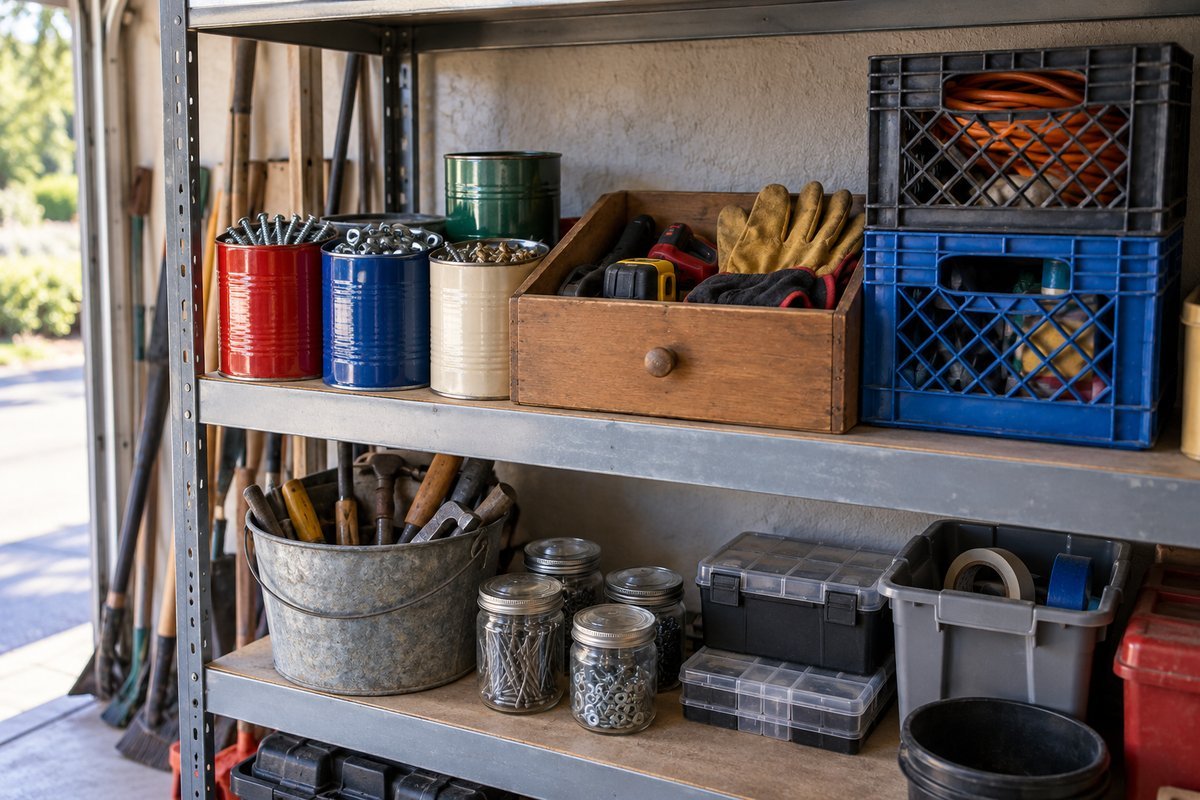
- Coffee cans and glass jars for hardware. Screws, nails, and washers sorted by size in reused containers, either lined up on a shelf or lids screwed to the underside of a shelf so the jar hangs down.
- Old dresser drawers as bin substitutes. A drawer pulled from a piece of furniture headed to donation makes a surprisingly solid open-front bin for a shelf, sized for bulkier items like gloves or extension cords.
- Milk crates for vertical bin storage. Free or nearly free secondhand, and they stack cleanly, which a mismatched pile of cardboard boxes never does.
- Pool noodles slit lengthwise on the edge of a workbench or shelf. Protects tool edges and blades from banging around in a drawer, at close to zero cost.
- A yardstick or leftover trim board with cup hooks screwed in. A functional pegboard substitute for a handful of small tools, using scrap wood instead of a purchased panel.
Dollar-store and small hardware-store fixes
The next tier up still isn’t a real purchase decision, just small, cheap items that fill specific gaps repurposed containers can’t.
- Command-style heavy-duty hooks, roughly $8 to $15 for a multipack. Handle light items like extension cords, jump ropes, or garden tools on a finished wall without drilling. Not rated for anything genuinely heavy.
- Dollar-store bins and baskets, roughly $1 to $5 each. Fine for light, low-stakes storage on an accessible shelf. Skip them for anything going onto a ceiling rack, where uniform sizing and a rated weight matter more.
- A roll of painter’s tape and a permanent marker, roughly $5 total. The entire labeling system for a budget garage, and it works just as well as a purchased label maker for this purpose.
- Zip ties, roughly $5 to $8 for a pack. Bundling cords, hoses, and long tools like rakes so they hang flat against a wall instead of sprawling across the floor.
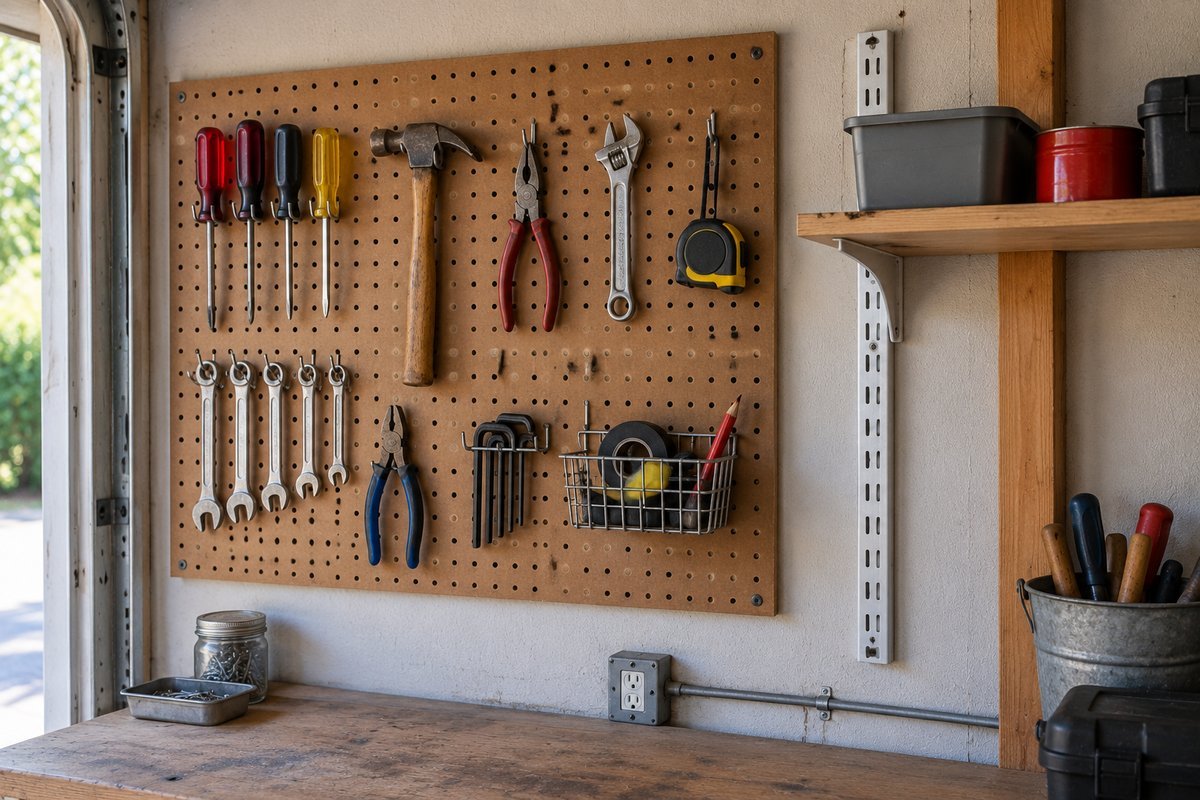
- A single roll of pegboard, roughly $15 to $25 for a 2-by-4-foot sheet. The cheapest true wall-mounted tool storage available, once you’re ready to drill into studs.
The one or two things worth spending real money on
A genuinely budget garage still has one or two line items worth paying for, because a cheap substitute either doesn’t work or isn’t safe.
- A real stud-mounted wall track or shelf bracket set, roughly $30 to $60 for a starter section. This is the anchor point every other cheap fix in this list depends on. A repurposed shelf resting on cinder blocks does not do the same job for anything meant to stay mounted long-term.
- A basic rated overhead rack, roughly $80 to $120 for the smallest genuine option, if ceiling storage is actually needed. Worth skipping entirely on the tightest budgets; a taped-off floor zone for seasonal bins is a reasonable substitute until there’s room in the budget for this.
Past these two categories, almost everything else on a garage organization ideas on a budget list can be free, repurposed, or under $15.
What NOT to cheap out on
A few corners are worth not cutting, even on the tightest budget, because the downside isn’t clutter, it’s a real hazard.
- Weight ratings on anything overhead. A shelf or hook rated for less than what’s hanging on it is a safety issue above a car, a workbench, or a walkway, not just an organizing one. This is not the place to substitute a cheaper unrated version.
- Wall anchors into actual studs for anything heavy. Drywall anchors alone will not hold a loaded shelf or a hung bike long-term. Finding the stud costs nothing; skipping it to save a few minutes is how shelves end up on the floor.
- Fire and chemical storage. Gas cans, propane, and old paint need proper ventilated, upright storage regardless of budget. This is one category where a repurposed container is genuinely the wrong call.
DIY versus buying cheap: where each one wins
Building something yourself isn’t automatically cheaper than buying the budget version, and it’s worth knowing which is which before spending a weekend on a project that would have cost less to just buy.
Scrap-wood shelving genuinely beats buying cheap pressboard shelves, both on price and on how long it lasts, if there’s already a saw and some lumber scraps on hand. A pegboard panel is close enough in price between building a frame from scratch and buying a basic kit that buying is usually the better use of time. Repurposed containers almost always beat buying anything for loose, light storage; there’s no version of buying bins that beats a free dresser drawer or milk crate for the same job.
The one place DIY consistently loses is anything load-bearing overhead; a homemade ceiling rack is a real risk for the amount of money it saves over a rated $80 to $120 unit.
Budget-friendly ideas by tier
A finer breakdown of garage organization ideas on a budget than “under $50,” since most of a budget garage project actually happens well under that number.
- $0 (a weekend, no purchase): Full empty-out, sort into keep, donate, and toss, zone by category using whatever containers already exist in the house, and label with tape and a marker. This alone handles the majority of what makes a garage feel disorganized.
- Under $25: A multipack of heavy-duty adhesive hooks, a roll of zip ties, and a few dollar-store bins for loose, light items on an existing shelf.
- $25 to $75: A single sheet of pegboard with a basic hook kit, or a small starter section of wall track, mounted properly into studs.
- $75 to $200: A full run of wall track or shelf brackets across one wall, the highest-impact single purchase on this list, plus enough dollar-store or repurposed containers to fill it.
How long budget garage fixes actually hold up
Free and repurposed fixes hold up about as well as bought ones for light, low-stakes storage, since a milk crate doesn’t wear out any faster than a purchased bin holding the same weight. Where budget fixes actually fail is skipping the one real purchase, the stud-mounted anchor point, and trying to make everything else work off of leaned shelving or adhesive hooks instead.
That setup looks fine for a few weeks and then slowly slides back into a pile once anything with real weight goes up. The fixes that hold up longest on a tight budget are the ones that still spend the small amount of money on the anchor point and save everywhere else, not the ones that try to avoid spending anything at all.
Common mistakes when organizing a garage on a budget
Some garage organization ideas on a budget fail because of how they get sequenced, not because the fix itself was wrong. These are the mistakes that show up most often.
- Buying a packaged “budget” storage kit. These usually cost more than the same coverage built piece by piece from repurposed containers and a single hardware-store purchase, while offering less capacity.
- Skipping the free sorting step to get straight to buying. The sort is where most of the actual space gets recovered; buying storage first just means storing things that should have been donated or tossed.
- Using adhesive hooks or leaned shelving for anything heavy. Fine for light items, a real safety problem for tools, paint cans, or anything that would hurt if it fell.
- Mismatched, unlabeled repurposed containers. Free containers are only a win if they’re labeled; otherwise, a garage full of unlabeled coffee cans and drawers is just as hard to search as a pile.
- Spreading the whole budget across small items instead of the one wall anchor. A pile of $5 hooks and bins with nothing solid to mount to ends up back on the floor faster than a single properly mounted wall track.
What we would skip
Not every product marketed as a budget fix belongs on a list of real garage organization ideas on a budget. Packaged “budget” or “starter” cabinet kits are the clearest waste of money on this list. They’re priced like a deal but usually cost more per square foot of actual storage than building the same coverage from a single wall track purchase plus repurposed containers. We’d also skip cheap unrated ceiling hooks marketed for garage storage; the savings over a properly rated rack are small, and the failure mode (something heavy falling from overhead) isn’t worth it.
Frequently asked questions
What is the cheapest way to organize a garage?
A full sort and zone pass, done for free, using containers already in the house, repurposed dresser drawers, coffee cans, and milk crates, labeled with tape and a marker. This handles most of the visible clutter before any money is spent, and it’s the first step in almost every one of these garage organization ideas on a budget.
What garage organization ideas on a budget actually last?
The ones that still spend a small amount on a real stud-mounted wall track or shelf bracket, since that’s the anchor point everything else depends on. Fixes that skip this and rely only on adhesive hooks or leaned shelving tend to slide back into a pile within a few weeks.
Can you organize a garage without buying anything?
Mostly, yes. Sorting, zoning, and labeling with household items and tape cost nothing and solve most of the visible disorganization. The main exception is anything heavy or overhead, which genuinely needs a rated mount rather than a free substitute.
Are packaged budget garage storage kits worth it?
Usually not. They tend to cost more per square foot of storage than building the same coverage from a single wall track purchase, a pegboard panel, and repurposed or dollar-store containers, while offering less flexibility to fit the specific garage.
What should you not cheap out on in a garage?
Weight ratings on anything overhead, stud-mounted anchors for anything heavy, and proper storage for gas, propane, or old paint. These are safety issues, not just organizing ones, and they’re the wrong place to substitute a free or unrated alternative.
Renter-friendly budget garage organization
Renters get an easier version of this list by default, since drilling into someone else’s studs is usually off the table anyway. Freestanding wire shelving, rolling carts, milk crates, and repurposed containers do almost everything on this page without a single hole in the wall. Heavy-duty adhesive hooks handle light items on a finished wall or painted drywall, though the same rule applies: nothing genuinely heavy goes on an adhesive mount, rented garage or not. The free sorting and zoning steps transfer identically and cost nothing to undo when the lease ends.
For the full breakdown of garage types, packaged systems versus building your own, and higher-budget fixes, see the Garage Storage & Organization hub.